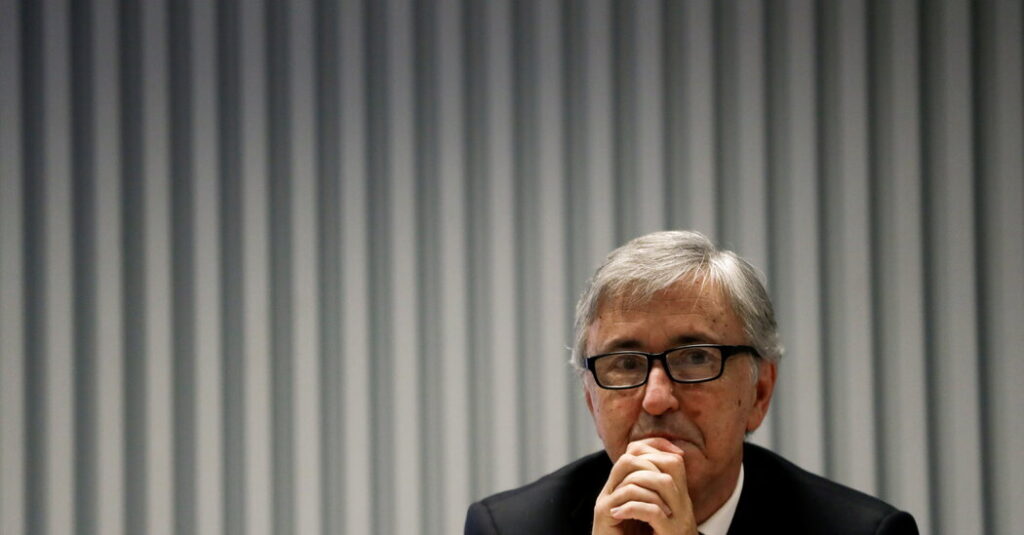
The former chief executive of an Italian highway operator was handed a 12-year prison sentence by an Italian court on Thursday for lapses that contributed to the collapse of a major bridge in Genoa in 2018 that killed 43 people.
The former executive, Giovanni Castellucci, oversaw the highway operator, Autostrade per l’Italia, that ran the bridge — named for its designer, Riccardo Morandi — when the structure failed on Aug. 14, 2018.
The disaster became a source of national embarrassment, raising alarms about Italy’s aging infrastructure. An investigation into the causes expanded to assess hundreds of bridges, tunnels and bypasses across the country, leading some of them to close.
Since July 2022, Mr. Castellucci had stood trial with 56 other defendants, including others from the company and civil servants from the Transport Ministry. Mr. Castellucci was convicted of negligence and manslaughter, and prosecutors had asked for a sentence of about 18 years. Of the other defendants, 31 were found guilty of negligence, manslaughter and other offenses, including falsifying documents, and were also handed sentences on Thursday ranging from a year and 11 months to 12 years. All had denied wrongdoing and can appeal their convictions. Another 25 were acquitted.
When the 3,600-foot Morandi Bridge collapsed in 2018, during torrential rain shortly before noon, dozens of vehicles tumbled into a ravine 150 feet below.
Prosecutors argued that Autostrade per l’Italia had not performed all the necessary maintenance to keep the bridge safe. Lawyers for the defendants said that the bridge had collapsed because of a construction defect.
Completed in 1967, the bridge was held up by three narrow, A-shape towers, paired with 12 stays — supports that descended from the top of the towers and fastened to the sides of the roadway. The structure had last been refitted in the early 1990s, after Mr. Morandi had died, while under the management of a state-controlled operator. The bridge was again inspected in 2012, but the investments needed for a proper retrofit were still being discussed the year it collapsed.
The bridge was hailed initially for the innovative use of prestressed concrete and clean lines, but a report in 2020 introduced as evidence in the trial suggested that the design was actually a weakness, making for a fragile structure.
The bridge spanned more than half a mile over a riverbed, residential buildings and warehouses and its collapse severed the primary connection between the western part of Genoa and the rest of the city, and between Genoa and much of northwestern Italy.
A replacement, designed by the well-known Genoa architect Renzo Piano, was inaugurated in 2020.
This week, the current Autostrade chief executive, Arrigo Giana, issued a public apology for the Morandi Bridge collapse in an open letter published in the daily Corriere della Sera.
At the time of the disaster, Autostrade was controlled by the Benetton family. In 2022, bending to government pressure, Benetton relinquished control of the company.
The post Highway Executive Given 12-Year Sentence Over Deadly Bridge Collapse in Italy appeared first on New York Times.