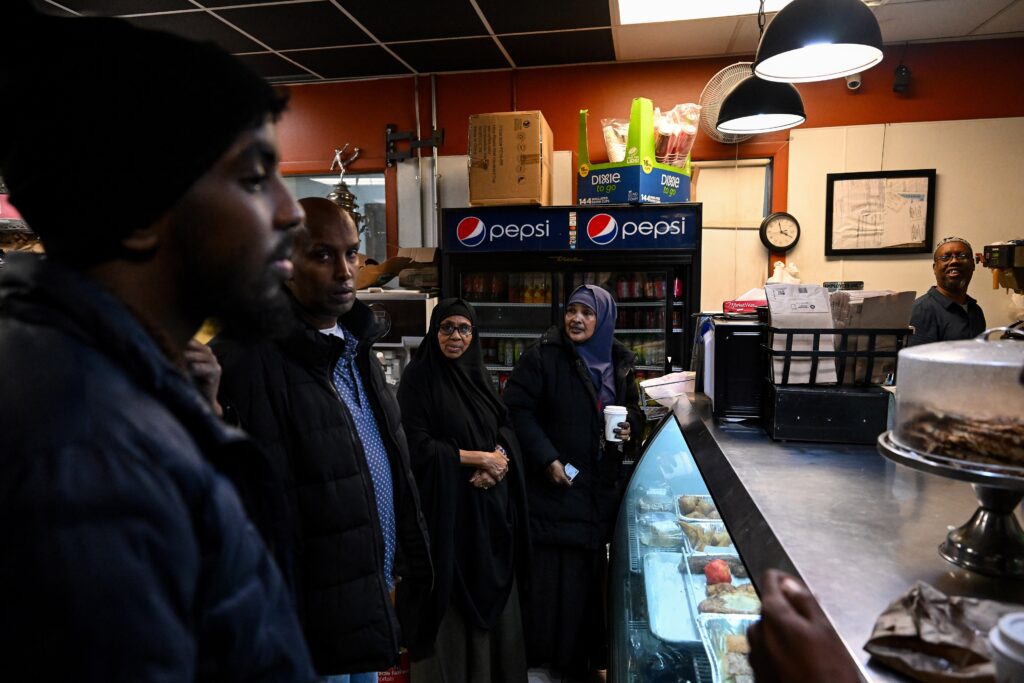
MINNEAPOLIS — The usually bustling Karmel Mall, a hub for the city’s Somali residents, is quiet. Signs on the mall’s doors declare, “No ICE enter without court order.” Nearby, a Mexican bakery and a neighboring taqueria are closed.
Immigration activists and lawyers say Somali residents have been pulled over, asked for their passports and detained by masked Immigration and Customs Enforcement agents this week after President Donald Trump called the state’s Somali immigrants “garbage” that should go back to Somalia.
“I have been getting calls all day and night from people who should not be at risk,” said Cameron Geibnik, a Minneapolis immigration attorney who described talking to naturalized citizens or permanent residents scared of being detained.
Trump’s rants against Minneapolis, which has the United States’ largest population of people of Somali descent, about 80,000 residents, has put this community in an unusual position. Most Somali immigrants came to the country decades ago and have become U.S. citizens. During the last presidential election, Trump performed better in Minneapolis neighborhoodswith large Somali populations than he did in 2020.
But Trump has launched diatribe after diatribe against the community in recent weeks, even as advocates and local leaders say the Department of Homeland Security seems to have launched new efforts to target undocumented immigrants. Minneapolis residents and local officials say immigration officers appear focused on Somali neighborhoods.
It’s unclear how many people have been detained so far, local officials say. DHS didn’t respond to an email seeking comment.
Dieu Do, a community organizer with the Minnesota Immigrant Rights Action Committee, said at least 30 people had contacted their group Wednesday reporting that they had been stopped by immigration officers in their cars, at bus stops or on the street, or visited at their homes. “There’s a tangible level of fear that you can feel, especially among the Somali community right now,” she said.
Geibnik, the immigration lawyer, said two of his clients were taken into ICE custody this week but declined to provide more details about their cases. He has advised other clients with U.S. citizenship or who are in the process of obtaining a green card to carry their paperwork with them in case they are detained, he said.
The Trump administration also launched a new immigration enforcement operation in New Orleans this week, part of a series of sweeps across the country, including Los Angeles, Washington and Chicago, resulting in thousands of arrests, legal challenges and protests. In both Chicago and Washington, data shows that most of the immigrants detained do not have criminal records.
Most recently, Trump’s tirades have been directed at reports of extensive fraud in Minnesota’s social services system, in which dozens of Somali individuals are accused of stealing millions in government funds. The funds were intended for housing for disabled adults, food security for children and support for children with autism, but allegedly were spent on personal luxuries, including cars and real estate. “Somalians ripped off that state for billions of dollars, billions every year, billions of dollars. And they contribute nothing,” Trump said this week.
He has also said thathe would end the temporary protected status held by a relatively small group of Somali migrants living in Minnesota, which the Immigration Law Center of Minnesota estimates to be about 700 people.
But Trump’s antipathy toward the Somali community in Minneapolis dates back to at least 2016, when he pointed to a mall stabbing rampage in the region carried out by a Somali immigrant as part of a bigger problem. Dahir Adan injured 10 peopleat a St. Cloud mall before he was shot dead by a police officer. “Here in Minnesota, you’ve seen firsthand the problems caused with faulty refugee vetting, with large numbers of Somali refugees coming into your state without your knowledge, without your support or approval,” Trump said during a 2016 campaign stop.
Minnesota became a magnet for Somali immigrants starting in the 1990s after the outbreak of civil war in the East African country. About 40 percent of Somalis in the United States live in the state, and nearly 90 percent of them are citizens either by birth or naturalization, said Jeffrey Passel, senior demographer at the Pew Research Center. Only about 1 percent are in the country illegally, he said.
Minneapolis residents have taken pride in the city’s status as a haven for refugee communities, including Somalis and Hmong immigrants. There are a number of Somali Americans in Minnesota’s state legislature, and the first Somali American member of Congress, Rep. Ilhan Omar (D), a frequent target of Trump, hails from the state.
“Our Somali brothers and sisters, our neighbors and citizens, and great contributors to our wonderful country,” said state Sen. Bobby Joe Champion, a member of the Democratic-Farmer-Labor Party. “I’m hearing from a cross-section of people, even those who are not immigrants. Because they care about the neighbors and their friends, as well.”
Mohamoud Mohamed, who has helped settle Somali refugees in the state for over 25 years, organized Somali voters for Trump during the 2024 election. In three Minneapolis neighborhoods with large East African populations, support for Democrat Kamala Harris fell significantly compared with support for Joe Biden in 2020, according to an analysis of precinct results by the Minnesota Star Tribune.
“The way he is behaving is not what we were expecting from him,” said Mohamed, who voted for Trump in 2024. “He was talking about illegal immigration, but 99 percent of the Somali community in Minnesota are fully legal.”
The administration is unlikely to be able to remove many Somalis from the country, he said, but he is worried that the president’s words are endangering his community. “The rhetoric coming from our president is scary,” said Mohamed, who founded St. Cloud Area Somali Salvation Organization. “It’s a nightmare. We are coming together to support each other as a community. There’s nothing else we can do.”
Mohamed said with the war continuing to rage in Somalia, returning to the East African nation is not an option. “Next time I see him, I would like to ask Trump if he can provide for me a rocket to go to Mars because there is nowhere else I can go from here,” he said.
Jaylani Hussein, executive director of the Minnesota chapter of the Council on American-Islamic Relations, who led the Abandon Harris campaign, said Republicans captured discontent in the Somali community, many of whom are Muslim, over the war in Gaza. Trump “even mentioned some positive things about the community while he was on the campaign trail. So now demonizing this entire community for the acts of a very few just doesn’t make any sense,” he said.
To avoid detention, “people are staying away, out of sight,” and his business has slowed considerably this week, said Dahir Mohamed, who runs a cafe in a popular mall in a Somali neighborhood. Even those who are in the country legally fear being stopped by immigration agents, especially those who don’t speak fluent English, he said.
The operation in the Twin Cities appears to be more targeted than similar raids in places such as Chicago and Los Angeles, where immigration officials cast a wide net, said Hussein, who came to the country as a refugee with his family in 1993. “Here, they’re just literally going and parking in Somali neighborhoods right now,” he said. “They’re going to realize that they’re approaching people who are citizens, which is why we’re mostly concerned for the other folks who live in the proximity.”
Hassan Hassan, who is a U.S. citizen, said he had been stopped by ICE officers while driving home from work Tuesday afternoon. The officers asked him to get out of the car, but he declined, Hassan said. “I said: ‘What’s the need for the stop? Have I committed a crime?’” he said. “You can’t just target everybody because of their nationality, because they’re Somali. That’s unfair.” A masked man took his ID, made a call and then let him go after about 20 minutes, Hassan said.
But others being stopped in the area were taken into custody, Hassan said. “It’s a sad time,” he said. “This is home. The Minnesota people is great people. They’re welcoming us, when my parents are refugees.”
He now carries his passport with him all the time.
Felton reported from New York.
The post Minnesota, known for a warm welcome, turns icy for Somali immigrants appeared first on Washington Post.