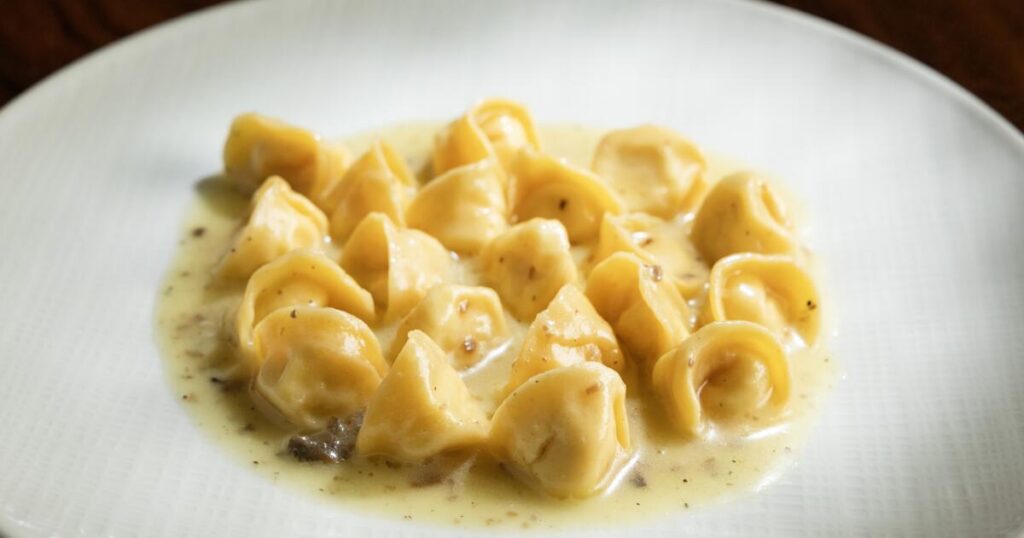
The most euphoria-inducing, toe-curling plate of pasta I had in recent memory came from a hotel restaurant in Beverly Hills. In the center, a cluster of tortellini lounged in a pool of truffle-flecked butter sauce. The tiny pinched parcels were just thick enough, beautifully taut and stuffed with a velvety mixture of mascarpone, ricotta and roasted sweet white corn that tasted like summer. If I closed my eyes, I could pretend I was in a small village in northern Italy.
In reality, I was at Baldi, the new Tuscan steakhouse on the ground floor of the Waldorf Astoria Hotel, in the space formerly occupied by Jean-Georges. It’s run by Edoardo “Edo” Baldi of the Baldi family, a name that over the last three decades has become synonymous with upscale Italian restaurants in Los Angeles, and the celebrities who love them.
His father, the late Giorgio Baldi, opened his namesake restaurant in Santa Monica in 1990, known as much for its famous clientele (there was a time when Rihanna was spotted there weekly), as it is for helping popularize corn-filled pasta and beef carpaccio.
Edoardo opened e. Baldi on N. Canon Drive in Beverly Hills in 2006. I have eaten at the restaurant a handful of times over the last two decades, and always at the invitation of an older man who works in entertainment. Take from this information what you will.
There was usually a pizza on the table, with a cracker-thin crust under a cloak of bubbly cheese laced with truffle. Followed by a plate of agnolotti filled with sweet corn. The food was respectable, but most of the guests seemed more concerned with who was sitting next to them than what was on the table.
At Baldi, the chef is turning out some of his best, most inspired cooking, but he’s doing it under the guise of an Italian steakhouse, inside the most luxe hotel in all of Los Angeles.
The restaurant boasts more than a dozen cuts of steak, with USDA prime beef, as well as American, Australian and Japanese Wagyu. They range in price from an $82, 12-ounce ribeye to the $75 per ounce (four-ounce minimum) olive-fed Sunuki Kawai New York Strip from the Kagawa Prefecture in Japan. All of the steaks, excluding the Japanese Wagyu, are marinated in olive oil, balsamic vinegar, chopped rosemary, salt and pepper. They’re grilled on an open flame, then finished under the broiler with more of the marinade.
When Baldi was a child, his mother served steak with both a red and a green sauce for dipping. They’re both duplicated at the restaurant. The first registers as a quasi Italian ketchup, sweet with tomato paste, a little red wine vinegar and garlic. The green is a salsa verde, chunky and bright with capers and parsley, egg whites and breadcrumbs.
Each steak, regardless of the cut, looks like it’s been plucked from the set of a Taylor Sheridan cowboy series, with perfect, even bistre crusts and ruby centers. But the levels of marination proved unpredictable, sometimes threatening to render the cut and provenance of the meat irrelevant. A bone-in ribeye seemed bloated and saturated in olive oil and vinegar, while a Kansas City Strip tasted perfectly of olive wood smoke and a hint of rosemary. The steaks improved with each visit, but purists may want to stick to the Japanese Wagyu.
If you’re used to the butter- and cream-laden side dishes that have become fixtures of the American steakhouse, the offerings at Baldi might appear lackluster. Here, the sides are more in line with the chef’s roots in Tuscany, favoring simply grilled, steamed or roasted vegetables.
While the steaks might not draw your attention — or your expense account — away from your favorite L.A. steakhouse, Baldi has become my new favorite destination for pasta, with each shape made in house, with the exception of the spaghetti.
The mezzo maniche are coated in a rich, smoke-tinged Amatriciana-style tomato sauce with salty pops of bacon. On another evening, the same tiny ridges cling to a beef ragout Baldi learned to make from a family friend in Forte dei Marmi. It’s a robust sauce of beef, veal and red wine, softened into something luxurious by the late addition of milk and a little Parmigiano. Delicate ribbons of fettuccine tangle in a silky sauce of butter and Parmigiano. Big, wide tubes of paccheri are dressed in pomodoro with a concentrated tomato flavor heightened by a surprising thread of pesto.
You may momentarily forget your surroundings as you wipe the pomodoro from a corner of your mouth, but the setting comes with all the pomp of an upscale restaurant in this particular ZIP Code.
Before dinner, there is the valet line, with a cast of characters whose wealth and proclivities are so extreme, they border on otherworldly. Severe-looking men emerge from Bentley SUVs with a trail of women. More women pile out of black cars wearing skirts so short, they dare not bend over, or even look down. Many pause to take selfies in front of the restaurant’s massive mahogany door with the sign that reads “baldi.”
To get to the dining room, you walk through the beautiful marble-lined bar filled with guests sipping variations on the negroni, or martinis spiked with gin infused with lemons from the Amalfi Coast. Past the impressive wine room (if you have a penchant for Barolo or Brunello di Montalcino, this is the place to spend your money) and into a lush, sprawling dining room wrapped in terracotta tones peppered with live greenery and a ceiling covered in big woven lanterns. It is easily the least hotel-looking hotel restaurant in all of Los Angeles.
The prices tip Baldi into the special occasion category, though most guests are dressed in shirts appropriate for a Tuesday morning golf game. And service is relaxed, and friendly. The waitstaff insist on presenting each dish to the table, then serving portions directly onto diners’ plates. Once, when I refused another helping of tortellini, my server took on the persona of a pushy grandmother and placed a spoonful onto my plate, anyway. “It’s so good,” he said with a wink. “You’ll eat it.”
I did.
The post This Beverly Hills steakhouse should actually be your new favorite destination for pasta appeared first on Los Angeles Times.