In the middle of what experts expected to be a “very sharky” summer, a program that tracks great whites and helps beachgoers stay safe will soon run out of money.
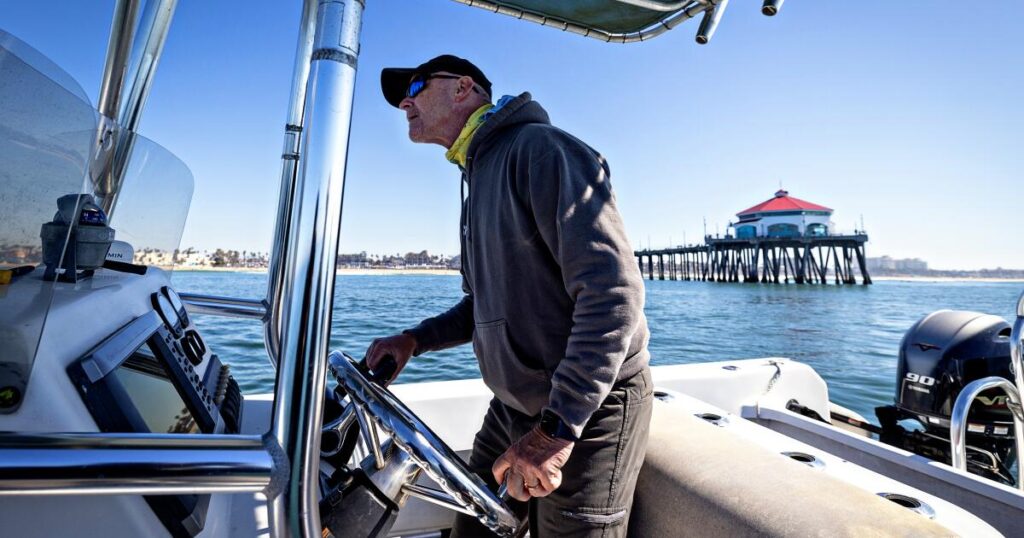
Since 2018, the California Beach Shark Safety program at Cal State Long Beach has tagged great whites in local waters and shared their locations with lifeguards. Researchers with the program perform community outreach and try to change the narrative on sharks.
The number of juvenile great whites along the Southern California coast has been increasing, driven in part by warming waters, as they congregate along certain beaches to feed on stingrays and small fish. But attacks are rare — swimmers and surfers often have no idea there’s a shark nearby.
The shark safety program, part of the Cal State Long Beach Shark Lab, was launched after the lab received a $3.75-million state grant tied to lifeguards’ concerns about the number of great whites. Last year, the lab received an $800,000 grant from a private foundation.
Both grants are running out, leaving the beach safety program, which has an annual operating budget of about $1 million, in danger of closing in September. The university’s shark lab, which has studied shark behavior and ecology for 60 years, will probably survive.
Christopher Lowe, the shark lab’s director, is searching for funding, whether from foundations, private donors or corporations, for the shark safety program, which covers 500 miles of coastline from Morro Bay to the Mexican border.
Lowe said the program saves coastal communities from “unnecessary beach closures,” which can cost millions of dollars in lost revenue, by helping them assess the risks instead of shutting down beaches after shark sightings.
“If we’re not monitoring, how will we be able to tell the public what to expect and maybe how to change their behavior to keep them safe?” he said.
This year, an unseasonably warm spring led to an uptick in great whites near local beaches. A strong “super El Niño” cyclecould make the ocean even toastier and attract more sharks.
In April, a surfing competition in Huntington Beach was postponed after officials noticed an aggressive 10-foot shark.
Since 1950, California has recorded 235 shark incidents, of which 97 resulted in no injury, 121 resulted in a nonlethal injury and 17 were fatal, according to the Department of Fish and Wildlife.
The shark safety program has tagged 380 great whites since its inception, and about 250 sharks have active transmitters. Acoustic receivers collect the data, which is shared with lifeguards. The program also uses 16 buoy systems to send live detection data to lifeguards.
Unless the program gets more funding, that equipment will have to be removed in September, making it harder for lifeguards to know where the sharks are.
The program also teaches kids about sharks and beach safety.
“Our program is really dedicated to understanding what sharks are doing, and then making sure that information gets to lifeguards routinely, and then out to the public,” Lowe said. “If it wasn’t for all of this technology, lifeguards would be flying blind.”
The post As great whites and humans share the waters, shark lab runs out of funding appeared first on Los Angeles Times.