‘Marcel Duchamp’
Through Aug. 22 at the Museum of Modern Art, Manhattan; moma.org.
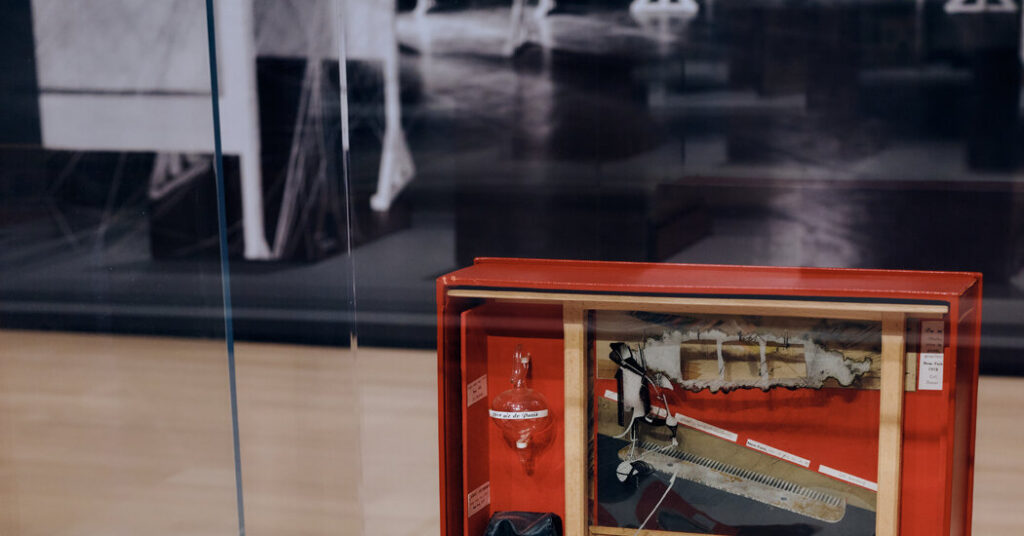
The critic Holland Cotter writes that Marcel Duchamp “single-handedly changed — to the degree that any one artist can — the entire art game and redefined what art is and what can be art.” Thankfully this extraordinarily detailed retrospective delivers on the superlative. Here, Cubism is fused with Futurism. On view are oil portraits — both traditional and bizarre — of family and friends, in addition to the “Boîte-en-Valise,” portable museums in compartmented boxes, each packed with artworks in miniature. And there’s plenty of eroticism throughout. It’s the first full-scale reckoning of the modern artist’s career in the United States in more than half a century, and it all adds up to a much-needed cultural “foundation-shaking,” Cotter writes. Read the review.
‘Greater New York 2026’
Through Aug. 17 at MoMA PS1, Queens; momaps1.org.
Every five years, MoMA PS1 mounts a survey of artists living and working in New York City. This year’s show features works by 53 artists who are confronting a host of themes familiar to New Yorkers. Some tackle the hustle of city life — a harsh gig economy, the plight of delivery drivers. Others celebrate the city’s more joyful vibrancy — expressed through community and colorful signage. A showcase on the Cevallos brothers displays that joy with their brightly colored, block-lettered posters that reflect the signs and ads seen in Latino neighborhoods. A mix of the two — the city’s grit and its dreams — is exhibited in Kenneth Tam’s installation on cabdrivers. In video interviews, weary cabbies share their grievances that have come as the taxi medallion has weakened. A carpet made of blinking LED lights and the beaded seat covers favored by taxi drivers covers the floor. “It resembles a topographical model of the city,” the critic Max Lakin writes, “twinkling with promise but craggy, beautiful and unforgiving in the same breath.” Read the review.
‘Whitney Biennial 2026’
Through Aug. 23 at the Whitney Museum of American Art, Manhattan; whitney.org.
Cotter writes in his review that this year’s Biennial is a “spare-looking but textured show”; one without an overarching theme. In place of such cohesion is a collective relationship to looming forces: the climate crisis, policing, omnipresent technology. In short, according to Cotter, “the moral anxieties and mortal realities those anxieties create.” Providing a connective tissue for the works of the 56 artists spotlighted is an element not visual, but auditory. Ambient music, insect buzzing, terrestrial pulsations and electronic drones create a soundscape for multichannel videos, collages of natural materials and sculptures of the fiber, inflatable and hand-molded varieties. It’s art with a side of sound bath. Read the review.
‘Paul Klee: Other Possible Worlds’
Through July 26 at the Jewish Museum, Manhattan; thejewishmuseum.org.
Paul Klee’s “Angelus Novus” is a 1920 watercolor print of a curious, scratchy-lined angel with a mane of loopy curls. While it has sparked both philosophical debate and inspired works of poetry, theater, music and film for the past century, it is not Klee’s best work, the critic Deborah Solomon writes. But it is, perhaps, the star of this exhibition of 100 paintings and drawings that span Klee’s career. The Swiss-born, German-educated master has other angels to his name, though, ones with “impressively complex personalities with human flaws,” Solomon writes. “Other Possible Worlds” pays special attention to the artist’s final years when he endured illness and Nazi persecution. Solomon calls the show “an incisive and boldly revisionist exhibition that brings us a newly vulnerable Klee.” Read the review.
‘New Humans’
Through Aug. 9 at the New Museum, Manhattan; newmuseum.org.
After two years and a $82 million expansion, the New Museum is back. Its first show is one of “true ambition,” the critic Jason Farago writes. In a sprawling, overstuffed showcase of more than 700 objects from 150 artists, scientists and filmmakers, the survey examines the momentous technological leaps — from early automatons to algorithmic slop — that have redefined humanity. This inquiry into the state of our existence fills three floors and spills onto the stairs. There are fleshy gadgets, video sculptures, ugly paintings, fetish objects and a “grand, goofy Hall of Robots” with a Pepto-Bismol pink carpet, Farago writes. “‘New Humans’ is a big, serious show for adults,” he adds, “it’s meant to fight over, which is just the way I like it.” Read the review.
‘Carol Bove’
Through Aug. 2 at the Solomon R. Guggenheim Museum, Manhattan; guggenheim.org.
The artist Carol Bove thinks museums can be physically taxing on the body. So her retrospective at the Guggenheim, with its quarter-mile, six-story incline, has several opportunities for comfort. It’s a “buoyantly feel-good affair,” Solomon writes. You can play chess on five round coffee tables, laze in one of the new lounges and peruse a “touching library,” where art materials typically off limits are available for defiant contact. Or walk among Bove’s towering tube sculptures, colorful ribbons of industrial steel that are crinkled and crumpled and covered in lush automotive body paint. Or stand before a more sparse installation of driftwood and feathers. The show surveys 25 years of Bove’s work and is filled with heady cultural references and winking titles. Solomon calls Bove “one of the country’s most imaginative and esteemed sculptors.” Read the critic’s notebook.
‘Gothic by Design: The Dawn of Architectural Draftsmanship’
Through July 19 at the Metropolitan Museum of Art, Manhattan; metmuseum.org.
Ever wondered how the Cathedral of Notre-Dame got its flying buttresses, rose windows, ribbed vaults and soaring spires? “Gothic by Design: The Dawn of Architectural Draftsmanship” illuminates how master masons and artists from the 13th to 16th centuries began to seed their visions for cathedrals and a range of Gothic architecture. Little-known artworks on parchment transmit complex ideas, unveiling the intricate beauty and engineering ingenuity of European Gothic draftsmanship. In a presentation of more than 90 works — drawings, prints, paintings, sculpture and gold items — the exhibition reveals the artistry behind Gothic buildings, and revels in the imagination of its architects.
‘Lillian Bassman: Bazaar and Beyond’
Through July 26 at the Metropolitan Museum of Art, Manhattan; metmuseum.org.
Lillian Bassman, one of the 20th century’s most inventive and experimental fashion photographers, was known for shadowy portraits of models and daring images of lingerie. Her sensual silhouettes gave a lightness to fabrics typically depicted as heavy and inflexible. She was also an art director for Junior Bazaar, a spinoff of Harper’s Bazaar. She brought bold graphic design and an avant-garde sensibility to fashion coverage, and gave assignments to photographers like Richard Avedon, Robert Frank and Louis Faurer. In vintage prints, collages and maquettes, “Bazaar and Beyond” charts Bassman’s ascent from magazine design apprentice to art director and celebrated fine-art photographer.
‘Old Masters, New Amsterdam’
Through Aug. 30 at the New York Historical, Manhattan; nyhistory.org.
New York City’s oldest museum, the New York Historical (formerly the New-York Historical Society) welcomed its newest expansion, the Tang Wing for American Democracy, in March. The addition was timed to the country’s 250th anniversary observances this year, and there’s plenty to see on the histories of protesting and voting. But one of the museum’s older galleries has a different kind of timeline on offer. Through period art and artifacts, “Old Masters, New Amsterdam” celebrates the 400th anniversary of the Dutch founding of New Amsterdam on Manhattan. Paintings by Rembrandt and his contemporaries give a portrait of Dutch culture and a taste of what life in the Manhattan settlement might have looked like — “the beta version of New York City we know,” Cotter writes. A digital interactive map lets visitors explore sites in the 17th-century city, including a house where enslaved Africans lived and the original City Hall. Read the critic’s notebook.
The post 9 Art Shows to Catch Before They Close This Summer appeared first on New York Times.