Ted Huffman wove through the corridors of the Théâtre de l’Archevêché, an outdoor opera house and the central theater of the Aix-en-Provence Festival. He exited into a courtyard that had been decorated with strung lights, and built out with dining tables and a loop of prefabricated structures: dressing rooms where stars of a new “Magic Flute” were getting ready for opening night.
He knocked on a door, and was welcomed by Brindley Sherratt, the evening’s Sarastro. “Toi, toi, toi!” Huffman said, a variation on “break a leg,” while another performer, Rodolphe Briand, opened a window to hand him an opening-night gift. Huffman visited each dressing room and at the end found Ying Fang, the soprano singing Pamina, in the courtyard. They shared a hug and small talk before he left with one last “Toi, toi, toi!”
Interactions like this are nothing new for Huffman, 49, a seasoned opera director known for collaborating deeply with singers. Something was different, though. For the first time, he was greeting the festival’s performers before an premiere not as a fellow artist, but as their boss.
Since January, Huffman has been the general director of the festival, which continues through Tuesday. It’s a job he didn’t expect to have, at least not so soon. Pierre Audi, his predecessor, died last year. Suddenly, there was a vacancy at Aix, one of the world’s great destinations for summer opera: where laid-back linen outfits billowing in the Provençal breeze meet pathbreakingly audacious productions, and where artists and industry insiders get a rare opportunity to see one another’s work and cross-pollinate.
When Audi died, he had mostly finished programming the 2026 and ’27 festivals. So, Huffman won’t truly make Aix his own for another two years. It’s helpful to have the time, though, he said, to get settled in, direct new stagings and wrangle a budget that had ballooned out of control.
“There’s definitely a huge benefit to being here and being able accompany Pierre’s programming,” Huffman said in an interview. “I’m able to observe and learn about how the festival works in ways that I couldn’t have seen as an artist.”
Huffman got his start as a singer. He grew up in Greenwich, Conn., and performed as a boy soprano, making it to the Metropolitan Opera stage at 12 and starring in Gian Carlo Menotti’s holiday classic “Amahl and the Night Visitors” at Lincoln Center. After college, he continued to sing, as well as wait tables, in New York. But eventually, he realized he might be more interested in creating shows than performing in them.
In 2004, he met Robert Ainsley, who now runs the Glimmerglass Festival, and together they founded the Greenwich Music Festival in Connecticut, which until Aix was Huffman’s only experience as an administrator. It was ambitious yet humble, he said, a way for friends to “do the things that we wouldn’t get the opportunities to do otherwise.”
Huffman staged Monteverdi’s 17th-century “Il Ritorno d’Ulisse in Patria” in a church basement, but also Victor Ullman’s 20th-century “Der Kaiser von Atlantis.” He programmed the modern music of Tristan Murail, and worked with the composer Huang Ruo early in his career. At the same time, Huffman said, the festival was rooted in Greenwich, involving local choirs and children from nearby schools.
“To have started our own company, and to have pursued our own artistic dreams without needing to please someone else, is quite essential to how we all began,” Huffman said. “We were able to follow our artistic instincts in a way that is hard when you’re a young artist, especially in America.”
His career took a more institutional turn when, in 2010, he joined the Merola Opera Program in San Francisco, which brought him to Europe for meetings that led to a flourishing career abroad, including credits as a librettist and shows at Aix.
Huffman is interested in making productions in which, he said, “the humans onstage are the most important aspect.” The results may look spare, but he considers himself a maximalist “in attempting to engage the imagination of the audience.” Behind the scenes, and spilling into the show, there is a porous sense of hierarchy: a departure from the operatic conventions in which artists have strictly defined roles in the cast, chorus and orchestra.
Last summer at Aix, for example, he and the composer Oliver Leith adapted Britten’s “Billy Budd” into a one-act opera called “Billy Budd, Sailor,” in which the instrumentalists performed alongside the singers. The production was collaborative, and its mechanics were kept moving by the cast as if they were the crew they were depicting, generating an energy, dark and erotic, that could be felt throughout the theater.
“I try not to make shows that feel like they’re behind a glass wall, or that treat the stage as a screen,” Huffman said, “but, rather, that there’s an osmosis between the audience and the performers.”
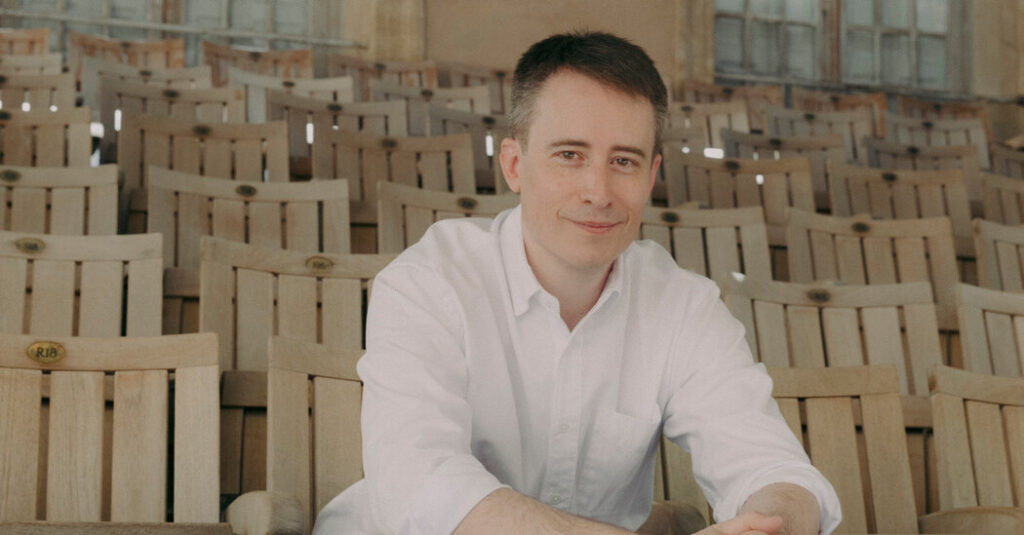
Huffman has the face of someone much younger and dresses casually, often in sneakers and an oversize Oxford shirt. He exudes friendliness, with a tendency to squint and smile as he listens, and when he speaks, he does so softly and reservedly, transforming his boyish approachability into a kind of laconic wisdom and calm authority.
Timothée Picard, the Aix Festival’s dramaturg and artistic adviser, called him enigmatic. “He doesn’t communicate so much, but he’s very strong and focused, a director with a sense of responsibility,” Picard said. “And he has those same qualities now as general director.”
Huffman wasn’t looking for a move into administration, but Aix was a tantalizing opportunity. “This is a place where I’ve worked more than, I think, anywhere else in the world, and where I’ve made a lot of my best work,” he said. “And I think that’s because of the particular culture here, of everyone realizing that this festival exists to be inventive.”
He knew he was an outsider candidate. He bought a suit for the interview, and with what he called “a pretty good” high school French education, he made his case, proposing a leaner but no less boundary-pushing program that could also feel more anchored in Aix-en-Provence. Sophie Joissains, the city’s mayor, who like many people around the festival pronounce his last name “OOF-mahn,” said in a French-language interview that he was “an obvious choice.”
His production of “Billy Budd, Sailor” points to why. Huffman had been offered a major show at the Archevêché, but because of the festival’s financial trouble, he was asked instead to do something at the 500-seat Théâtre du Jeu de Paume. “He immediately said, ‘OK,’ and ‘Billy Budd, Sailor,’ which was a small production, won over all the international critics,” Joissains said. “So he showed both great humility, a capacity to adapt to circumstances that is quite rare without badmouthing, and, at the same time, incredible talent.”
That adaptability has been crucial to Huffman’s work as general director. He inherited a festival with global prestige but precarious finances. Audi increased the budget before he had secured sponsors for it; in recent years, there have been more productions and new venues, but not enough money to sustain them. Huffman and Aix’s administration have stabilized the budget, but in the future, he said, the festival will have to strike a balance between “really reaching for the stars” and “being smart and agile and inventive in how we adapt to smaller formats and become a more sustainable art form.”
Huffman’s schedule during the first week of this year’s festival was full of meetings, but also public appearances and events. He sat with Joissains during a concert on the Cours Mirabeau; spoke at the unveiling of a plaque to commemorate Lily Pastré, who helped establish the festival after World War II; and spoke with sponsor after sponsor.
On the night of the “Magic Flute” opening, Huffman changed into a suit and tie, then darted from one donor dinner to another. He isn’t an extrovert, but he played the part as he met new people, many of whom were eager to share warm memories of (and strong opinions about) the festival.
By the end, he was exhausted. “I felt like I spoke real French for like five-sixths of that,” he said, “and in the last sixth, my French left me.” But the night was just getting started. He gathered himself, then prepared to greet the artists.
The post At This Opera Festival, He’s No Longer Another Artist. He’s the Boss. appeared first on New York Times.