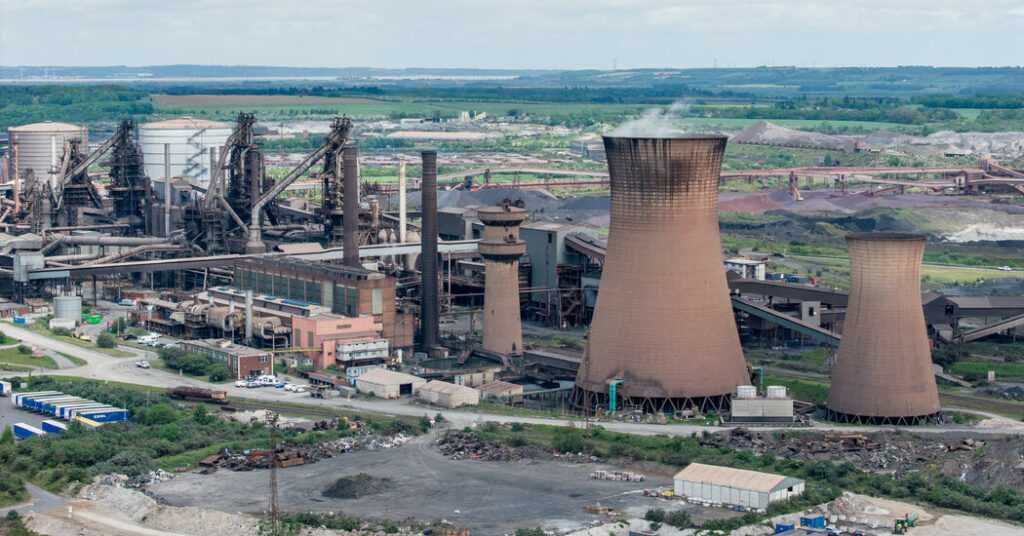
The British government fully took over the country’s last major crude steel production facility on Thursday, ending a long-running saga over control of the site between the government and its former Chinese owners.
The nationalization of British Steel, which operates the blast furnaces and steel-making complex in Scunthorpe, in the East Midlands of England, is one of the final acts of the premiership of Keir Starmer. He announced the move to nationalize British Steel two months ago.
At the time, dreadful results in local elections threatened his leadership of the Labour Party and, by extension, the government. Mr. Starmer argued that “strong nations” must make their own steel, and that his decision to put British Steel under public ownership would protect jobs.
Mr. Starmer’s premiership is set to end in a matter of days. But the nationalization of British Steel has gone ahead.
“British Steel is part of the fabric of our nation and a cornerstone of Britain’s industrial strength,” Mr. Starmer said in a statement on Thursday. “Today’s decision secures the future of steelmaking in the U.K., protects skilled jobs and safeguards a vital national capability.”
The government first intervened in Scunthorpe in April 2025, when it appeared that British Steel’s owners, Jingye Group, were taking unilateral action to close down the blast furnaces, threatening Britain’s last-remaining capacity to make crude steel. The government invoked emergency measures to seize control of the day-to-day running of the plant.
Over the following year, the government sought to find a private buyer for British Steel, which requires large investments to modernize its production and reduce carbon emissions. In the end, the government failed to find a buyer and opted for nationalization.
The government said that an independent valuer will be appointed to assess whether any compensation is payable to Jingye.
In a statement on Monday, Jingye demanded that the British government “promptly, adequately, and effectively” compensate it for its full investment in British Steel. It described the government’s takeover action as “extreme, escalating measures” that proved the value of British Steel.
Jingye said that it had made “substantial financial investments” in operations and equipment since its acquisition of British Steel in early 2020. “We are resolved to pursue full recovery of these investments, without compromise,” the company said.
The decision to nationalize British Steel is part of an emerging trend by the Labour Party to take more control of industries and sectors that are deemed to be failing. The government is renationalizing rail operations around the country.
Andy Burnham, the former mayor of Greater Manchester, is set to become the country’s next prime minister. He has said that he wants to bring more essential utilities and services, like water, housing and energy, under greater public control.
Britain’s steel industry has been ailing for decades, hampered by the high cost of energy needed to run plants, as well as by competition from China’s vast exports of cheaper steel. More recently, U.S. tariffs on steel have also weighed on the sector.
The government is trying to revitalize the industry. It wants up to half of Britain’s steel needs to be produced domestically. At the start of July, the British government implemented new steel tariffs, which further limited tariff-free steel imports.
Despite nationalization, British Steel’s future will be challenging, given the investment required and wider struggles of the sector. In March, a government audit agency said the day-to-day running of British Steel was costing the government about 1.3 million pounds ($1.8 million) a day, but how much it will cost going forward will depend on whether the government decides to refurbish the existing blast furnaces or build electric ones.
On Thursday, the government said it intended to stabilize the company and “consider its future direction,” which could include private sector investment.
Xinyun Wu contributed research from Taipei, Taiwan.
The post Britain Nationalizes Its Last Major Steel Mill appeared first on New York Times.