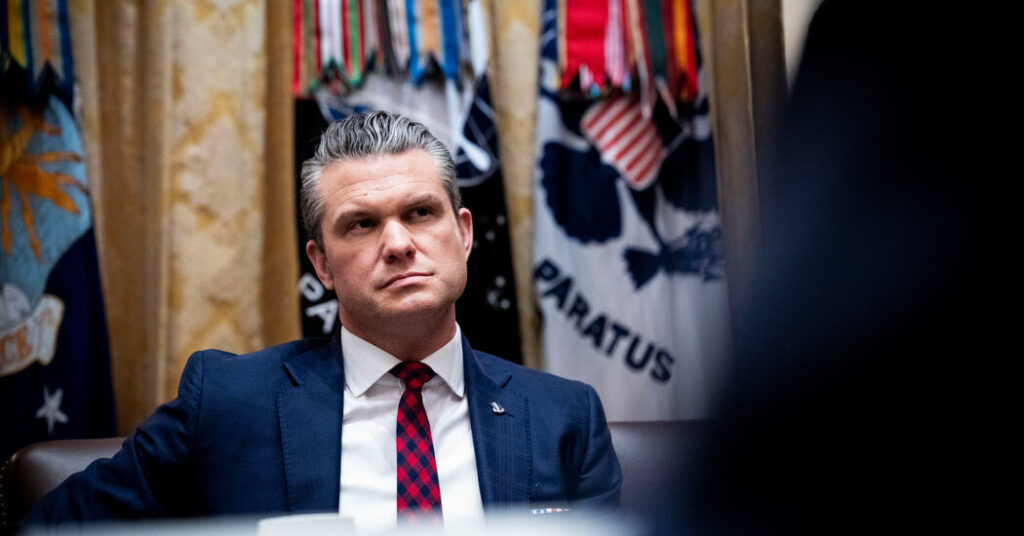
The Defense Department’s Inspector General’s office concluded in a report released on Thursday that Defense Secretary Pete Hegseth “did not comply” with the Pentagon’s policies when he used a private messaging app to discuss upcoming airstrikes by U.S. forces in Yemen earlier this year.
Mr. Hegseth sent “nonpublic” information that identified “the quantity and strike times of manned U.S. aircraft over hostile territory over an unapproved, unsecure network approximately two to four hours before the execution of those strikes,” the report said.
The information was shared with Mr. Hegseth in a secure email from U.S. Central Command, which executed the strikes against Houthi forces on March 15.
The report notes that Central Command’s message marked that email as “Secret//NOFORN,” meaning that its contents could not be disclosed to foreign nationals, and according to the Pentagon’s definition, their release could cause “serious damage to operations, assets or individuals.”
Here’s what else we learned from the report.
Hegseth declined to be interviewed by the inspector general’s office.
During the investigative process, Mr. Hegseth declined to be interviewed by the inspector general’s office. He instead submitted a statement on July 25 in response to investigators’ questions.
Mr. Hegseth acknowledged receiving information on March 14 from Central Command that was marked “Secret//NOFORN” about the planned attacks, and said in his statement to investigators that he had shared only “nonspecific general details” to create an “unclassified summary” for those in a Signal chat group.
The people in the chat included Vice President JD Vance, Michael Waltz, then the national security adviser, and the senior White House adviser Stephen Miller. Mr. Waltz had also mistakenly added Jeffrey Goldberg, the editor in chief of The Atlantic, to the group.
Mr. Hegseth also told the investigators that he had the authority to declassify military information.
Investigators had to rely in part on The Atlantic’s reporting.
The inspector general’s office requested all of Mr. Hegseth’s Signal messages but noted that it was able to obtain only a partial accounting of the exchanges because the group chat’s auto-delete function was turned on in the security settings.
The investigators had to rely, in part, on Mr. Goldberg’s published transcript of messages from the chat. The conversation included specific times that Navy warplane sorties would launch from an aircraft carrier in the region and when munitions were expected to hit their targets.
The information would have been useful to the Houthis.
The U.S. military typically classifies operational information of that sort as “secret” to preserve an element of surprise over an adversary.
That information would also have been useful in targeting incoming U.S. aircraft had the Houthis, who have robust air-defense radar and antiaircraft missile capabilities, obtained it in advance.
The only manned aircraft lost during the operation came when two Navy fighter jets fell off the aircraft carrier U.S.S. Harry S. Truman and sank in the Red Sea. The first was lost overboard after the crew lost control of the plane, according to the officials at the time, and the second was lost while trying to land on the ship.
Hegseth was faulted for using a private cellphone.
The inspector general’s report found that Mr. Hegseth had violated Pentagon instructions on using a private electronic device to share sensitive information.
It added that Mr. Hegseth did so from a secure facility installed at his home on an Army base in Washington while accompanied by “his junior military assistant and his personal communicator.”
Reaction from Congress showed a partisan split.
Before the report’s public release, Senator Robert Wicker of Mississippi and the Republican chairman of the Senate Armed Services Committee, said in a statement that “the secretary acted within his authority.”
Mr. Wicker added: “It is also clear to me that our senior leaders need more tools available to them to communicate classified information in real time and a variety of environments.”
“I think we have some work to do in providing those tools to our national security leaders,” he said.
The top Democrat on the committee, Senator Jack Reed of Rhode Island, had a different view.
“The report makes clear that Secretary Hegseth violated Department of Defense policies and shared information that was classified at the time it was sent to him,” Mr. Reed said in a statement before the inspector general’s report was publicly released. “These were precise strike timings and locations that, had they fallen into enemy hands, could have enabled the Houthis to target American pilots.”
The investigators recommended steps to facilitate secure mobile communications.
In a companion report released on Thursday, the inspector general’s office offered recommendations concerning the Defense Department’s handling of sensitive information.
One recommendation said that the Defense Department’s chief information officer should “source and maintain” a means of communication that the Pentagon controls, for use on mobile devices like cellphones, that would allow users to securely share classified information.
Such a means of communication should also preserve messages in order to comply with “governmentwide requirements to protect information and preserve official records.”
So far, the report noted, the chief information officer has not fully put into place that recommendation.
The continued use of apps like Signal to transmit sensitive information among government employees could, the report says, “jeopardize” U.S. military “operations or missions.”
John Ismay is a reporter covering the Pentagon for The Times. He served as an explosive ordnance disposal officer in the U.S. Navy.
The post Takeaways From the Pentagon Investigation on Hegseth’s Use of Signal appeared first on New York Times.