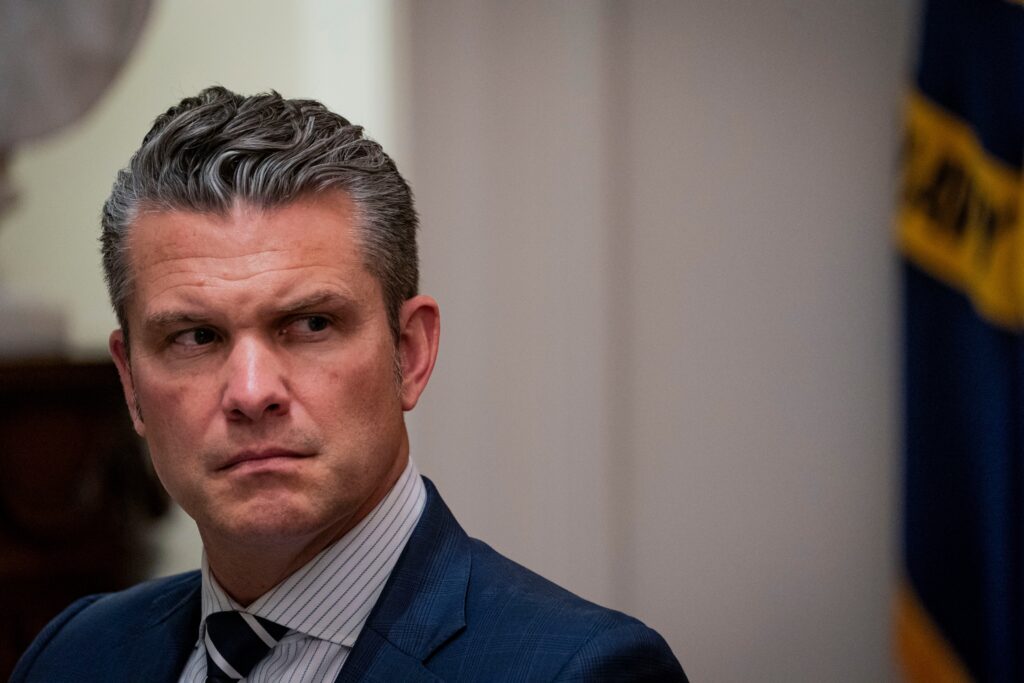
The Defense Department’s top watchdog assessed in a report released Thursday that Defense Secretary Pete Hegseth’s actions in the “Signalgate” affair “created a risk to operational security,” contradicting claims made by Hegseth and his aides that he received a “total exoneration.”
The highly anticipated inquiry by the Defense Department’s Office of Inspector General determined that by using the unclassified chat app Signal to share advance details about a forthcoming bombing operation in Yemen, Hegseth’s actions “created a risk to operational security that could have resulted in failed U.S. mission objectives and potential harm to U.S. pilots.” The report cited Hegseth, too, for using his unclassified personal device to relay that information via group chat to other top Trump administration officials and for not retaining all associated messages, in violation of federal recordkeeping laws.
Details of the inspector general’s finding emerged Wednesday, after lawmakers and congressional aides received access to the report. Hegseth’s spokesman, Sean Parnell, said in a statement Wednesday evening that the review is a “TOTAL exoneration of Secretary Hegseth and proves what we all knew — no classified information was shared.”
“This matter is resolved and the case is closed,” Parnell said.
Hegseth, a former Fox News personality who served in the Army National Guard, amplified the message on social media. Posting from his personal account on X, he wrote: “No classified information. Total exoneration. Case closed. Houthis bombed into submission. Thank you for your attention to this IG report.”
Hegseth’s team did not respond Thursday, after the inspector general’s office made the report public.
Hegseth’s falsehoods about the report’s conclusions underscore the extent to which he and his top aides have worked to downplay the seriousness of his actions. Former top military officials and other national security experts have argued since the scandal surfaced earlier this year that such handling of highly sensitive information almost certainly put American lives at risk — a point the inspector general’s team emphasized in its findings.
The episode, revealed in March by the Atlantic magazine, was deeply embarrassing for the new administration and led Democrats, primarily, to demand Hegseth’s resignation. The report’s release comes as he faces fresh scrutiny for his involvement in the Trump administration’s deadly military campaign in Latin America, and amid nascent congressional inquiries seeking to determine whether a war crime may have been committed there.
The inspector general’s report on the Signalgate affair details a situation much more complex than Hegseth’s claims suggest. It notes, for instance, that the defense secretary pulled sensitive information about a future military operation from a classified message that was sent through secure channels by a top general and labeled “SECRET/NOFORN,” a detail first reported by The Washington Post in July. Such a designation means the contents were classified at a level at which unauthorized disclosure could be expected to cause serious damage to national security and was not meant for anyone who is a foreign national, including close allies of the United States.
Hegseth declined to be interviewed by the inspector general or turn over his personal cellphone as part of its review, the report said. Instead, he furnished a one-page statement to investigators on July 25 stating that, as defense secretary, he is the “original classification authority” in the department, a responsibility which gives him broad latitude to declassify information — including what he put in the Signal group chat.
“I retain the sole discretion to decide whether something should be classified or whether classified materials no longer require protection and can be declassified,” Hegseth wrote. “On 15 March 2025, at 1144ET, I took non-specific general details which I determined, in my sole discretion, were either not classified, or that I could safely declassify, which I then typed into the Signal chat.”
Hegseth’s statement to the inspector general notes that he withheld other details from the group chat, focusing on “overt” actions “which would be readily available to any observer in the area and did not included details about targets or intelligence which may have been derived from other agencies outside DoD.”
The inspector general report concurred that Hegseth is the department’s top classification authority, but determined that his actions constituted a security risk nevertheless.
Top lawmakers on the Senate Armed Services Committee requested the inquiry in March, after the Atlantic’s top editor, Jeffrey Goldberg, reported that he had been inadvertently added to the group chat and bore witness to its contents. The other participants included Vice President JD Vance, Secretary of State Marco Rubio and other Cabinet officials under President Donald Trump. The group was established by national security adviser Mike Waltz, who was later removed from his job.
Hegseth has defended himself after the initial stories were published, primarily by attacking Goldberg, whom he called a “deceitful” journalist who “peddles in garbage.”
“Nobody was texting war plans,” Hegseth told reporters hours after the Atlantic initially reported on the Yemen group chat, “and that’s all I have to say about that.”
Other revelations about Hegseth’s use of Signal followed, including that he had shared the details about the bombing campaign not only with Trump Cabinet officials, but in a separate group chat, as first reported by the New York Times, that included his wife, Jennifer; his personal attorney, Tim Parlatore; and Hegseth’s brother, Phil.
Jennifer Hegseth has played an unorthodox role in Pentagon affairs this year, while Parlatore has served as a part-time military aide and legal fixer, and Phil Hegseth has served as a senior adviser.
Hegseth also directed the installation of Signal on a desktop computer in his office, effectively “cloning” the app on his personal cellphone so that he could use the unclassified messaging platform in a secure location within the Pentagon. That development, first reported by The Post in April, underscored the degree to which the defense secretary had become reliant on Signal to stay in touch with others in the administration, people familiar with the matter said.
Hegseth, in his memo to the inspector general, said he understood that investigators also were planning to examine whether he had “unsecured connections installed in my government computer.” He denied that he ever had, but acknowledged asking Pentagon officials to examine whether it was possible to get access to his personal phone in his office, a highly secure area, to receive “non-official communications.”
“The comms team prepared a compliant solution that would allow me this access while also maintaining proper security,” Hegseth wrote. The Post reported in April that while Hegseth had used Signal on his government computer, the messaging app was installed on a second computer in his office.
While Hegseth has at times seemed angry about the scrutiny, he also has made light of it. Speaking before a crowd at a November event organized by Fox Nation, the defense secretary pointed Waltz out in the crowd and said, “Mike, I’ll hit you up on Signal later,” drawing both laughter and groans from the crowd.
“Too soon?” Hegseth added. “C’mon!”
In screenshots of Signal messages that appear in an appendix of the inspector general’s report, it appears, too, that Vance also has made light of the situation. After Goldberg departed the chat and published his initial story about the issue on March 24, the vice president returned to the group and wrote: “This chat’s kind of dead. Anything going on?”
Noah Robertson contributed to this report.
The post ‘Signalgate’ report contradicts Hegseth’s claim of ‘total exoneration’ appeared first on Washington Post.