The New York Times filed a motion on Wednesday to quash subpoenas issued by the Trump administration to several of its journalists last week.
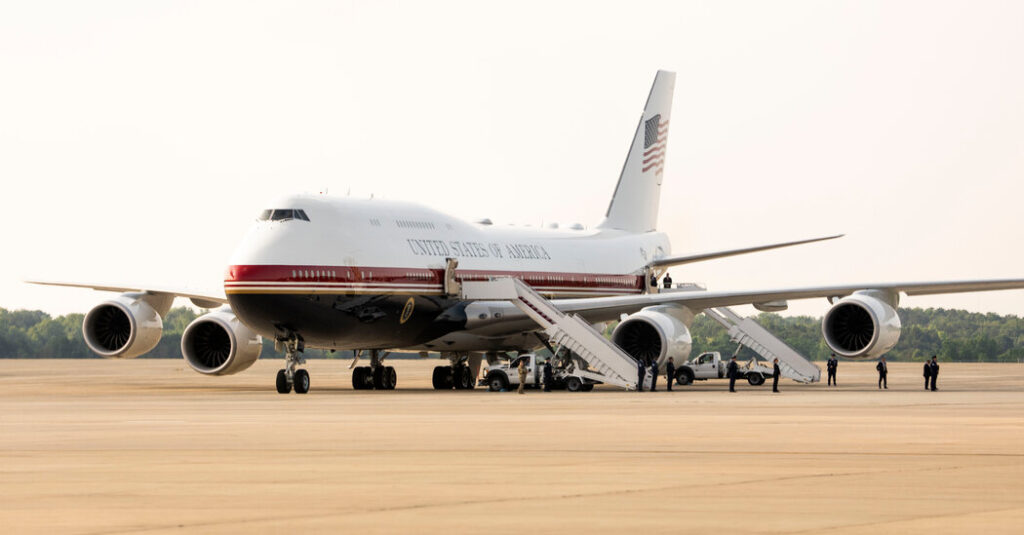
The Justice Department subpoenas, which were delivered Friday evening by federal agents who showed up at reporters’ homes, sought to compel the Times journalists to testify about their confidential sources before a federal grand jury in Manhattan. The reporters had recently published articles that disclosed security concerns about President Trump’s new Qatari-donated Air Force One jet.
In a statement on Wednesday, David McCraw, The Times’s top newsroom lawyer, called the subpoenas “abusive and improper” and said they had been “brought in bad faith to punish The Times for its coverage.”
“They violate the constitutional rights of The Times and its journalists,” Mr. McCraw wrote. “We are going to court to defend our journalists’ rights to report freely on the administration and to provide the public with stories that matter.”
The motion was filed under seal “pursuant to court order,” Mr. McCraw said. He wrote that The Times “believes that the public has a right to information about this case and is also seeking to have the papers unsealed.”
Contacted on Wednesday, a spokeswoman for the Department of Justice, Emily Covington, referred to her previous statement that the press plays an “important role” in the country, “but D.O.J. also plays an important role to make sure that the people entrusted with our nation’s secrets do what they’re supposed to do with that information.”
“We recognize there may always be natural tension there, but we are not going to ignore the law,” she added.
Representatives for the White House did not immediately respond to an inquiry on Wednesday evening.
The Justice Department issued the subpoenas after the White House instructed Kash Patel, the director of the Federal Bureau of Investigation, to supervise a leak investigation into The Times’s reporting. Mr. Trump had become enraged about the coverage of the security concerns surrounding the new Air Force One jet, which he used for a flight to Turkey last week. When Mr. Trump departed Turkey, he instead used the older Air Force One, at the urging of Secret Service officials.
It is highly unusual for the Justice Department to subpoena journalists at the onset of a leak investigation, which typically involves a hunt for federal employees who may have disclosed classified information.
The subpoenas were issued by Jay Clayton, the U.S. attorney in Manhattan, whom Mr. Trump recently nominated to serve as director of national intelligence. At his Senate confirmation hearing on Wednesday, Mr. Clayton said his office had consulted with the Justice Department in Washington and followed “procedures that we have in place to protect the First Amendment, and protect the freedom of the press, and not result in intimidation of journalists.”
But Mr. Clayton also said government leakers should not be able to get away with sharing classified materials by exploiting the protections afforded to journalists. In a pointed reply, Senator Michael Bennet, a Colorado Democrat, said the First Amendment was not a “loophole.”
Todd Blanche, the acting attorney general, whom Mr. Trump has nominated to lead the Justice Department, said at his own Senate confirmation hearing on Wednesday that he had authorized the subpoenas.
“We’re not targeting reporters — they’re material witnesses,” Mr. Blanche said. “Just like a reporter would be a material witness to a car crash.”
Three Times reporters received subpoenas: Julian E. Barnes, Eric Lipton and Eric Schmitt. The newspaper learned that subpoenas were prepared for two others, Adam Goldman and Tyler Pager, but neither received one.
In a video published by The Times on Wednesday, Joe Kahn, The Times’s executive editor, described the subpoenas as “a naked attempt to intimidate The New York Times and to keep us from reporting on matters that we think are essential to national security.”
Mr. Kahn, a former China correspondent, said he had “seen the way an authoritarian government can keep journalists from reporting on a huge amount of news and information that’s very clearly in the public interest.”
“It’s really essential to American democracy that that kind of erosion of press freedoms not happen here,” Mr. Kahn said.
Jonah E. Bromwich contributed reporting.
The post New York Times Files Motion to Quash Subpoenas of Its Journalists appeared first on New York Times.