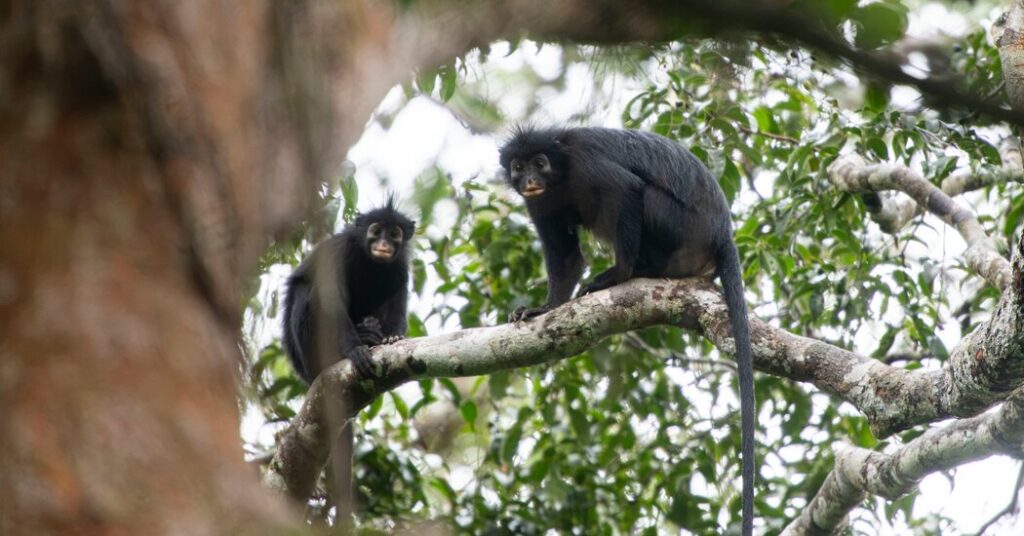
Blurry photos are often held up as supposed evidence of elusive creatures like Nessie and Bigfoot. But the subject of a fuzzy photo taken nearly two decades ago in remote forests of the Democratic Republic of Congo — a strange, orange-faced monkey — has turned out to be the real deal. Now, it has officially been recognized as a new species, only the fifth new African monkey described in the past 75 years.
In 2008, a team of researchers from the Lukuru Wildlife Research Foundation spotted an unusual monkey high in the treetops of a rainforest now part of Lomami National Park in Congo. But the photograph they managed to snap was blurry.
“Since it wasn’t a clear picture, no one paid attention,” said Junior D. Amboko, a Ph.D. student at Florida Atlantic University and an author of a paper in the journal PLOS One describing the new species.
A decade later, the mystery monkey came into sharper focus. Another field team took a photo of a medium-size monkey with shaggy black hair and an orange-colored patch around its nose and mouth. They shared the photos with Mr. Akombo and John Hart, the scientific director of the Lukuru Wildlife Research Foundation. It was clear that it didn’t resemble any known species in the area.
The researchers established a project, funded in part by the National Geographic Society, to find the peculiar primate. From 2018 to 2022, they surveyed Lomami National Park and its surrounding area, scanning the treetops, recording monkey calls at dawn and interviewing residents of 52 nearby villages. People at eight of those villages recognized the orange-mouthed monkey. Those from the Balanga ethnic group called it Likweli.
The researchers determined that the Likweli monkey is constrained to a small area in northeastern Congo, in a patch of forest roughly half the size of Rhode Island. The monkeys’ restricted range helps explain why they’re so poorly known even by local people, Mr. Akombo said. “They’re also kind of shy,” he added.
The researchers are not sure how many orange-lipped monkeys may be out there, but field observations revealed that the animal had tiny thumbs, which indicates that it’s part of a group of social, leaf-eating monkeys called colobines. At about 15 pounds, an adult Likweli is smaller than its colobus cousins. It communicates with a call reminiscent of a croaking frog.
To figure out for sure that Likweli was a new species, the researchers next had to do some classifying work in the laboratory. Rangers at the Lomami National Park confiscated three of the monkeys, two females and one male, from hunters, and the researchers used those specimens for an in-depth cataloging of the animals’ physical appearance, skeletal structure and DNA.
Kate Detwiler, an associate professor of biology at Florida Atlantic University and an author of the study, led the genetic analysis. She and her colleagues determined that Likweli split from its closest relative four million to five million years ago, and has been evolving independently since. “We were really, really surprised at how deep the divergence is,” Dr. Detwiler said.
The combination of physical and genetic differences between Likweli and its closest relatives led the researchers to describe it as a new species, formally named Colobus congoensis.
Likweli joins a very short list of African monkey species described since 1951, including the highland mangabey, which communicates with a “honk bark”; the sun-tailed monkey, named for its gold-tipped tail; and the lesula, the males of which have bright blue buttocks and testicles.
“This is a big deal for sure,” said Joshua Linder, a co-founder and president of the Forest Collective, a conservation nonprofit who was not involved with the study. “To find a relatively large-bodied primate that we’ve never seen before is really amazing.”
The study marks Likweli’s introduction to the world beyond Congo, but in their paper, the researchers recommended that the monkey be classified as endangered by the International Union for Conservation of Nature. They argue the species is a target for hunters and the forests where it lives are at risk of destruction.
For Dr. Detwiler, the discovery exemplifies the need to conserve Congo’s rainforest and study the wildlife living there. “I think it’s a pretty telling message that this area of the Congo Basin is really diverse,” she said. “It needs attention.”
The post Meet Earth’s Newest Monkey. (And Check Out Its Orange Lips.) appeared first on New York Times.