Dear reader,
Over the past few weeks, we’ve been looking at ways to see the opposite of violence. Violence itself is easy enough to see — wars and mass shootings dominate news headlines and spread through social media platforms. But it’s much harder to observe the forces that have led to lower rates of violence in many U.S. cities than they’ve experienced in decades.
In prior weeks, we’ve looked at indicators somewhat obliquely related to the prevention of violence — rates of socializing and communicating, graduating from high school and being covered by health insurance. This week, we conclude our series with a measure experts say is directly tied to the drop in violent crime: the number of philanthropic organizations working in our communities.
As many of you pointed out, no quantitative measure can adequately capture something as ineffable as the opposite of violence. But metrics are how we tend to understand our problems, and we measure violence somewhat exhaustively, so we wanted to pursue measures of the forces that oppose it.
When we asked readers to articulate what constitutes the opposite of violence, a notable cluster of respondents answered with variations on the themes of resources and investment. “Violence is not a choice but a reaction to scarcity,” wrote one respondent from West Philadelphia. “I believe that a more connected, neighborly, community that commits energy and resources (institutional resources and individual) promotes kindness, love, and peace,” wrote another, from Eugene, Ore.
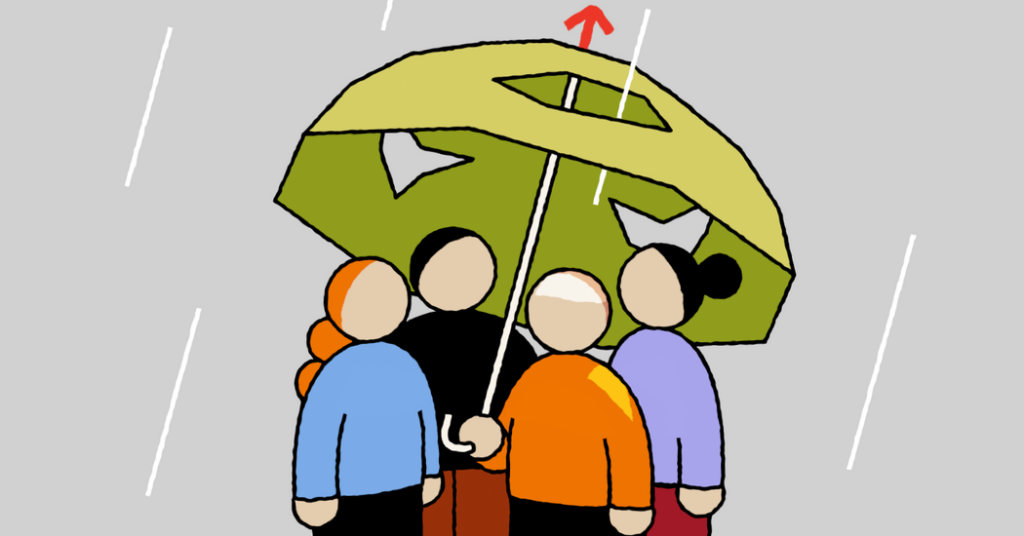
One of the biggest yet subtlest changes in how cities have approached violence prevention has been the rise of public safety ecosystems, in which community-based organizations, often philanthropic in nature, work alongside police departments to defuse and avoid conflict. As Ama Sarpomaa recounts below, studies have linked increases in organizations of these types working in cities to reductions in crime of all kinds, particularly violent crime.
Read on for Ama’s reporting on how investment in such organizations has grown, and why it’s now shrinking.
— Matthew Thompson
What’s the state of the nonprofit sector?
Philanthropic organizations of various kinds go back to ancient times, but the rise of the U.S. nonprofit sector began in the 1960s. Federal funding cuts to social services in the ’80s and the ’90s gave fuel to the emerging sector — in the span of 20 years, the number of nonprofits grew from 276,000 in 1977 to 693,000 in 1997, outpacing the growth of other types of organizations during this time. Today, according to I.R.S. estimates, there are roughly 1.6 million nonprofits in the country.
Many factors have been partially credited for helping bring rates of violence down from their peak in the early ’90s, but a recent summary of the literature by Patrick Sharkey and Timothy Ittner, sociologists at Princeton University, concluded that a significant contribution came from community-based organizations. Sharkey’s research in 2017 found that every 10 additional violence prevention organizations in a city led to reductions in murder and violent crime rates.
Mr. Sharkey said the influx of funding in major cities like New York and Los Angeles in the 1990s bolstered community organizations. “I do think that was a clear part of the reason why some of the biggest drops in violence happened in the largest cities across the country,” he said.
Little federal funding went toward supporting community violence intervention until the passage of the American Rescue Plan Act in 2021, which allocated $350 billion in federal funds to communities. In addition, the Office of Justice Programs provided millions in grants for violence prevention organizations.
“We really adapted our mission and the way that we gave out money to not only advance public safety and help build trust between law enforcement and communities, which we’ve done for a long time, but also to help strengthen the role of communities and community-based organizations as co-producers of public safety,” said Amy Solomon, the former assistant attorney general in the Office of Justice Programs.
What’s happening with nonprofits now?
The nonprofit sector is again facing significant federal funding cuts.
Last year, the Trump administration briefly froze federal grants to nonprofits and recently threatened to slash funding for programs that support what it calls “anti-American” values. The administration has also cut roles that oversaw nonprofit grants and other awards in the U.S. Department of Health and Human Services. The cuts hit nonprofits hard, particularly those classified as providing human services like violence prevention.
“For human services nonprofits, it’s kind of this double whammy where they were already struggling to meet demand in 2025, but they’re expecting even more demand in the coming year, which could present challenges for both the organizations and the communities they serve,” said Hannah Martin, a policy associate in the Center on Nonprofits and Philanthropy at the Urban Institute.
The White House under President Trump has taken particular aim at programs focused on gun violence prevention, as Times reporter Sheryl Gay Stolberg reported last week. A spokesperson for the White House said in that report that the cuts reflect the administration’s commitment to defunding programs that were “wasteful, misdirected or counterproductive.”
Sixty-eight percent of nonprofits this year said they expected demand to increase in the next 12 months, a notable decrease from 75 percent in 2024. But many say they do not have the resources to meet current demand.
Nearly half of nonprofits report significant job vacancies as a result of salary competition (average weekly wages for nonprofit workers are roughly 9 percent lower than government workers and 14 percent lower than workers at for-profit companies), budget constraints and stress or burnout.
Where do we go from here?
Experts say the loss of federal funding is not a gap private foundations or charitable giving can easily fill.
It has especially challenged minority-led organizations. Organizations with people of color, women and L.G.B.T.Q.+ people in leadership positions were more likely to lose at least 10 percent of funding from federal or state sources or both in 2025.
According to David Callahan, the founder and editor of the digital media site Inside Philanthropy, consolidation may be the strongest way to counter funding cuts. A lot of small nonprofits duplicate services, he said, and have services that are costly to maintain.
“There’s a lot of inefficiencies within the nonprofit sector,” he said. “If there’s fewer resources coming into the sector, the obvious question is, ‘How do you do more with the resources you have?’”
Some nonprofits have already initiated new partnerships or collaborations with other organizations, and others are using platforms like Charity Bridge Fund to find different funding opportunities.
“I don’t know how long philanthropy can hold on, which means we have to start thinking about how it fits in the local, federal and state budgets,” said Andrew Papachristos, a sociologist and faculty director at Northwestern University’s Center for Neighborhood Engaged Research & Science. “It’s the only way I think it survives in the long run. But I don’t know how you do that when cities are hemorrhaging budgets.”
What can I check out next?
-
Shayla Colon interviewed dozens of individuals involved in violence prevention — faith leaders, street outreach workers, police officers and more — about the emerging model of public safety ecosystems that go beyond law enforcement.
-
The Trump administration’s rollback of gun violence prevention initiatives and research are broad-based, Sheryl Gay Stolberg reports, and some taxpayer-funded reports have vanished.
-
In response to restrictions on D.E.I. initiatives, some arts nonprofits have refused state and federal grants, Michaela Towfighi reported in November.
-
In February, Zachary Small profiled a nonprofit in San Francisco that is striving to keep housing affordable for artists.
— Ama Sarpomaa
Your turn
Test your knowledge: According to a 2024 Feeding America report, how many Americans turn to food banks each year for emergency food assistance?
Tell us your thoughts: What sorts of organizations do you see involved in violence prevention in your community? Do you volunteer for any community organizations that play a role in promoting harmony? Please email your thoughts to [email protected].
Following up: Speaking of the opposite of violence, earlier this year, we wrote about the nation’s rising homicide clearance rate, the statistic that captures how successful police departments are at solving murders. We noted at the time a somewhat inverse relationship between homicide rates and clearances; when fewer murders are committed, each one gets easier to solve. As homicide rates have been falling across many metros this year, we’ve seen a drumbeat of stories about high clearance rates in places like Los Angeles and Milwaukee. But we haven’t seen as deep a dive into a city’s efforts as this one, by Mensah Dean from The Trace, looking at how the Philadelphia police department’s clearance rate nearly doubled since 2016.
The responses to last week’s send on health insurance rates mostly expressed a sense of befuddlement at the backwards nature of the U.S. health care system. “I can’t imagine how seniors can keep this process straight,” wrote one respondent who recently qualified for Medicare. “I don’t expect the system to improve.” Another respondent, a chiropractor, expressed a desire for “more analysis of why the USA ranks somewhere in the mid-40s for overall health of the population, while we rank number one in cost.” More on that in a future edition.
Ama Sarpomaa contributed reporting
The Headway initiative is funded through grants from the Ford Foundation, the William and Flora Hewlett Foundation and the Stavros Niarchos Foundation (SNF), with Rockefeller Philanthropy Advisors serving as a fiscal sponsor. The Woodcock Foundation is a funder of Headway’s public square. Funders have no control over the selection, focus of stories or the editing process and do not review stories before publication. The Times retains full editorial control of the Headway initiative.
The post How Charities Fight Crime appeared first on New York Times.