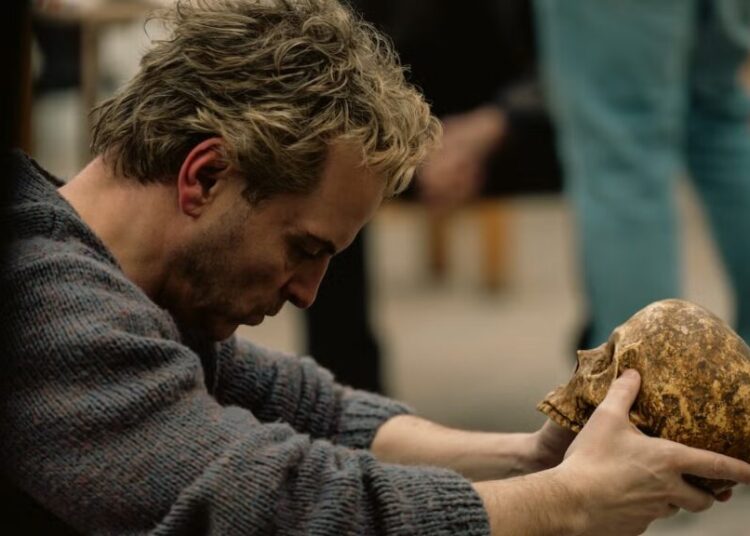
Throughout his career, Christopher Nolan has taken on big stories — though especially those of men, their struggles and their wars — and bent them to his virtuosic will. In movie after movie, in darkness and in light, his characters push against the limits of human endeavor and consciousness, testing themselves much like he tests the possibilities of the medium. If the line in his 2006 drama “The Prestige” about how a magician takes something ordinary and “makes it do something extraordinary” sounds like an artist’s statement as well as an article of faith, it is. For Nolan, that something extraordinary is cinema itself.
Nolan’s love of movies and commitment to them — to what they can do, what they can be, what they should be — runs like an electric current through his filmography, lighting it, and oftentimes you, up. That passion is in every frame of his monumental adaptation of “The Odyssey,” one of the most Nolan of Nolan spectacles in its thematic concerns, formal playfulness, kinetic thrills and unabashed showmanship. Few directors close the divide between the art film and the blockbuster like Nolan does; fewer still give the audience something to not simply look forward to but also be excited by. Even as he has continued to refine his filmmaking, notably in his narrative experimentation, he always aims to please.
It seems inevitable that Nolan would eventually take on “The Odyssey,” one of the foundations of Western literature. And why not? The story is a trippy, far-out blast, and has the kind of sinuous, complex layering that has become one of his signatures. Credited to Homer, the original poem consists of 12,109 lines of nonlinear, nonstop talk and action featuring gods, mortals, monsters, weird doings, hospitality rituals and oceans of blood, tears and wine. Whatever the adaptation, the tale is so ingrained in our cultural DNA that even those who haven’t read the original — or Joseph Campbell on the hero’s journey — will be familiar with it, having seen a movie or two. It’s Luke Skywalker’s path and WALL-E’s, too.
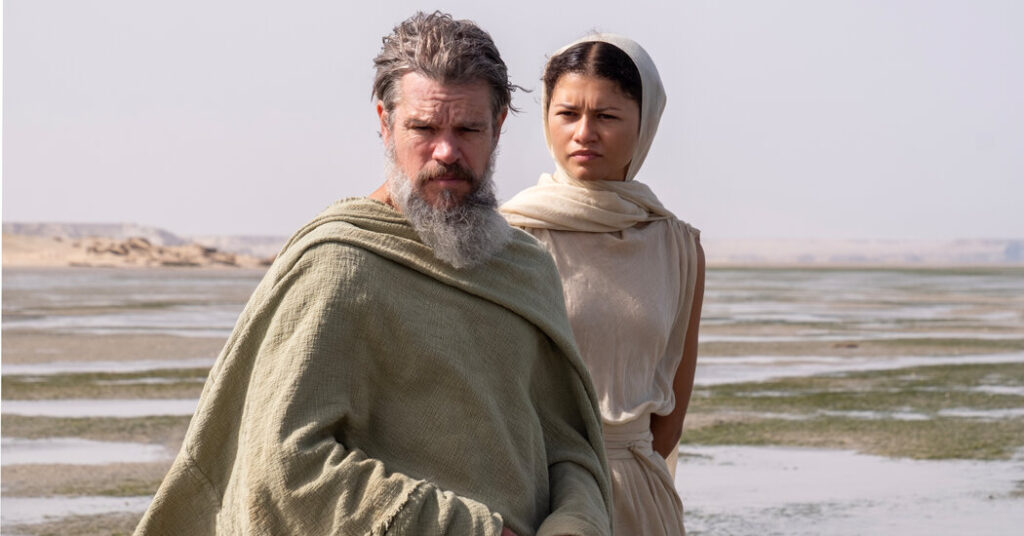
The most striking thing about this film, other than its being the first feature shot entirely in IMAX, is that it exists. It is an anomalous big-studio entertainment that Nolan has filled with stars — Matt Damon is Odysseus! Zendaya is Athena!— and polished to a high gleam, turning a 3,000-year-old poem into a smart, thoughtful film with Old Hollywood allure. It’s a throwback and of its moment, including in how it adjudicates the costs of war. (Who benefits, and who suffers?) Its hero is, to a degree, the cunning, complicated Odysseus who leaps off the page, but he’s been sweetened and made more psychologically legible for contemporary sensibilities. He’s also played by an appealing actor who excels at elevated everymen.
In outline, the story tracks Odysseus, who has been missing in action for two decades, having gone astray in the wake of the Trojan War. (For more on that, see: “The Iliad.”) He’s now a lost amnesiac. His absence has wreaked havoc on his family, leaving his wife, Penelope (Anne Hathaway), and their adult son, Telemachus (Tom Holland), bereft. Nolan dedicates far more of his version to Odysseus’s magical wanderings than the poem does. But true to the poem, Nolan insistently circles back to the family that Odysseus left behind, reminding you of the agonies of the domestic front that are often devalued or ignored in male-driven fantasies.
The casting of Damon helps shift the story into a more familiar movie register, as do some of Nolan’s other choices. He’s populated the story with many of the poem’s supernatural support team, including Cyclops (Bill Irwin), a giant with a single, hauntingly baleful eye, and Calypso (Charlize Theron), a goddess who evokes a 1960s James Bond vixen and keeps Odysseus as a sex prisoner. Athena periodically pops in to cast a sorrowful gaze on the proceedings, and while Zeus is invoked, he remains offscreen. Nolan’s Odysseus is the hero sung of in the poem’s opening line, but he’s less godlike and his multitudes — warrior, leader, lover, husband, father, trickster, liar — are contained in a sinewy, leathery, fallibly human man.
It goes without saying that this is very much a man’s story, and essentially about his twinned inward and outer journey home. Nolan wrote the screenplay and has largely retained the poem’s kinked narrative arc. He has compressed sections, jettisoned others and omitted many characters, a necessity given the event-packed original, which in its English-language translations, runs well over 500 pages. Even with these liberties, his version is recognizable in its sweep, fragmentation and multiple story lines, starting with Odysseus’s palace on the island of Ithaca. There, Penelope is weaving and reweaving the same cloth to fend off suitors like Antinous (Robert Pattinson) and Polybus (Corey Hawkins) who, eager to take her husband’s place, have camped out at the palace eating and drinking through its provisions.
Shortly after the film opens, after Nolan has taken the lay of this troubled land and made fast introductions, Telemachus clandestinely sets sail to learn the truth about Odysseus’s fate and it’s on. From the instant that Nolan cuts from a high-angle extreme long shot of Telemachus’s ship on the water to a similarly distant shot of Odysseus walking through the shallows on Calypso’s beach, the filmmaker has announced himself with a flourish. With one edit, two elegant images and a pair of men separately on the move, Nolan has connected the father and the son visually and narratively, while also suggesting the presence of the divine. In movies, these shots are called God’s-eye views; here, they’re unmistakably Nolan’s.
From here on in, the filmmaker is in his groove. Individually, Odysseus and Telemachus push the story forward as they head toward self-discovery and each other, but they also steer it into the past. Nolan is in his cinematic wheelhouse here and he slips among the time frames fluidly, folding in flashbacks of Odysseus in Troy languishing on its beach with comrades (Elliot Page, among them) and building the wooden horse that will doom the enemy. Like the film, the horse is elegant and massive — posed on its hind legs, it looks fashioned from the ribs of ship — larger than life and holding more than it seems. It’s a totem of Odysseus’s genius and cruelty; it’s also an emblem of Nolan’s filmmaking, imposing in its beauty and scale.
In some of Nolan’s movies, his virtuosity can seem like an end in itself, which makes the characters feel more like props, clever but instrumental. “The Odyssey” is also about a man trying to discover who he is, which means he must understand what he’s done. When the Trojans drag the horse off the beach, Nolan emphasizes the intense physical effort needed to haul this colossus. Here, as when Odysseus and his crew are flung about their ship during storms, Nolan turns a mythological tale into cinematic realism with creaking wood and straining rope, the grunts and cries of men. He brings characters who can seem exotically distant nearer to us, humanizing people, including those Odysseus will soon help slaughter.
As the saga hops and skips across time and space, characters enter and exit, some making a stronger impression than others. A few, like Samantha Morton’s enraged proto-feminist pig herder, Circe, and Jon Bernthal’s tough-talking King Menelaus, skew distinctly modern, which can feel like a sop to the audience. Others zip in and out so fast they scarcely register, including Menelaus’s wife, Helen, and her sister, Clytemnestra (Lupita Nyong’o, doing what she can with little). Clytemnestra’s husband, King Agamemnon, cuts a threatening figure if only because his black armor and helmet suggest a Homeric Darth Vader. It’s a minor role that becomes smaller once the armor is off, revealing a pale Benny Safdie flashing his rear.
The performances are uniformly good, though Damon’s Odysseus is tamped down and notably devoid of charisma, as if he were as hollow as the wood decoy. In action-adventure terms it’s a counterintuitive choice even if it serves Nolan’s tricky, more non-triumphalist ends. One upshot, though, is that few of the actors, Damon included, manage to hold you with the same emotional force that Nolan’s filmmaking does. Both Holland and especially Hathaway have bracingly strong moments, but his character has too little presence and hers remains shrouded in mystery, which Nolan expresses by filming her behind a latticed screen or the threads on her loom. Mother and son are sympathetic; they’re also routinely upstaged by Pattinson’s wildly enjoyable flop-sweating suitor whose demise you hunger for.
The imprint of “The Odyssey” on Nolan’s work can be startling, which, for all this movie’s spectacle, makes it uncharacteristically personal. There are echoes from his filmography throughout, including in the poem’s story and its telling (all that cross cutting!), in how it boldly leaps across time and space, in its doubling and its focus on identity. When Odysseus asks Calypso who he is, he recalls Guy Pearce’s existential search in “Memento” (2001), Nolan’s breakout about another amnesiac. Like Odysseus, Leonardo DiCaprio’s character in “Inception” (2010) struggles to reunite with family and uses a token to help anchor him.
After watching “The Odyssey” again, I flashed on something that Martin Scorsese once said about another film: “The emotion is the emulsion.” Nolan’s gifts are excessively obvious, and even when his characters don’t stir you, his filmmaking does. Among other qualities, he doesn’t know how to make an ugly image and this one is filled with rapturous beauty. Nolan employs beauty strategically, using it to seduce viewers into stories that can seem needlessly byzantine to some — especially by impoverished mainstream industry standards — more the provenance of the art house than the multiplex. Nolan asks us to dream bigger. His “Odyssey” is a classic in every sense, a transporting affirmation of the art and a work of pure cinema.
The Odyssey Rated R (absurdly) for violence and some language. Running time: 2 hours 52 minutes. In theaters.
The post ‘The Odyssey’ Review: Passion in Every Frame appeared first on New York Times.