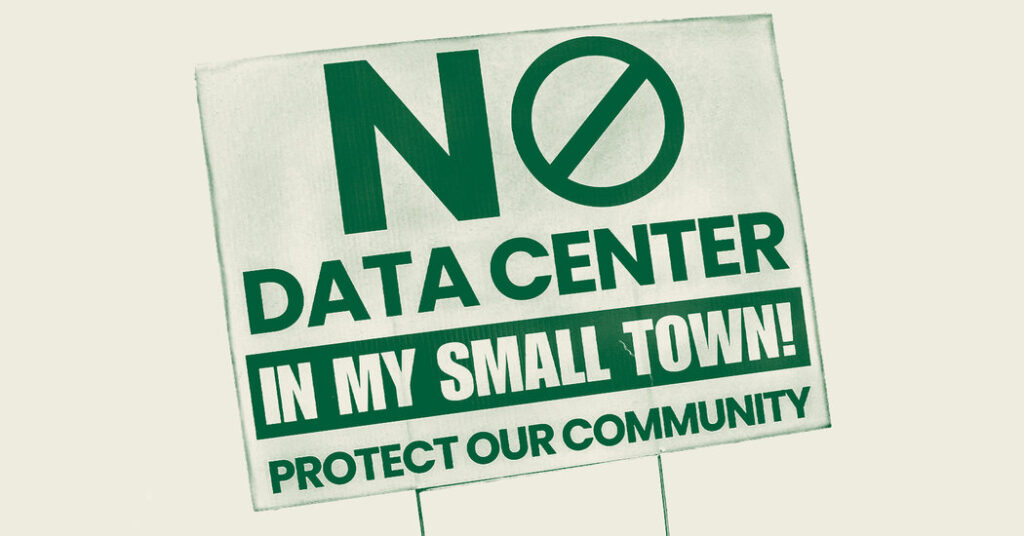
Seventy-one percent of Americans say they don’t want an A.I. data center built close to where they live. Why? In this conversation, the Opinion writer David Wallace-Wells and the contributing writer Robinson Meyer parse the backlash and explore whether the Democratic Party can capitalize on it in the years to come.
Below is a transcript of an episode of “The Opinions.” We recommend listening to it in its original form for the full effect. You can do so using the player above or on the NYTimes app, Apple, Spotify, Amazon Music, YouTube, iHeartRadio or wherever you get your podcasts.
The transcript has been lightly edited for length and clarity.
David Wallace-Wells: I’m David Wallace-Wells. I’m a writer for New York Times Opinion and a columnist for The Times Magazine.
This is an insanely polarized country, which means it isn’t very often that you see a political supermajority on any issue, let alone one that emerges almost out of nowhere to announce itself as a major new front in our politics.
But that’s exactly what has happened just over the last year with A.I. data centers. Around seven in 10 Americans now oppose the construction of local data centers to power artificial intelligence. Last fall, people were almost exactly evenly split when asked if they’d support a new data center nearby. Now there’s a 50-point gap. That is an absolutely crazy swing, much bigger than the reversals you tend to see when a new president comes into office or even when someone declares war.
So what’s actually going on here? Is there suddenly a new populist politics sweeping the country? Can it be channeled into something productive? And does the political economy around Big Tech and A.I. even allow for something like the democratic control that people protesting data centers seem to want?
I don’t know where all of this is heading, but I do think it’s really significant. And I wanted to talk this through with a friend of mine, Robinson Meyer. Rob is an Opinion contributor and the founding executive editor of the great environmental news website Heatmap, which has also been doing a ton of important work following the data center backlash. Rob, thanks for being here.
Robinson Meyer: Thank you so much for having me. It’s great to be here.
Wallace-Wells: We’re going to talk about the politics of the data center backlash, which are really interesting. But let’s just start with a sense of the scale and how fast it’s come together. Have you been as shocked as I am about what we’ve seen over the last year?
Meyer: It’s been so shocking, because I think it’s a scale of change in public opinion that I didn’t know was still possible in the U.S. I mean, you mentioned it in the intro, but I think we’re used to a new president coming in, and everyone — if it’s a Democrat — getting a little more conservative; if it’s a Republican, voters getting a little more liberal. But we’re not used to seeing these huge issues pop up on which the public goes from having one view, or probably not really having a view, to being very hardened in their opposition. And that’s what we’ve seen with A.I. data centers.
So to throw some numbers at this …
Wallace-Wells: Yeah, please.
Meyer: At Heatmap, we cover climate change, decarbonization and energy transition. Because of that, we started covering public attitudes toward, at first, renewables. And then, because of the scale of the A.I. boom, we started asking about A.I. data centers as well. And so every quarter, we poll about 4,000 Americans and we ask: Would you support or oppose a data center being built near where you live? We asked that question in August of last year, and Americans were very split. They were about 43 percent in support and 42 percent against.
We asked again in the spring, and this time, 21 percent of Americans said they would support a data center being built near where they live, and 71 percent said they would oppose it. So it is a staggering shift, basically, in how Americans feel about this industry and about this form of land use in their communities.
Wallace-Wells: And let’s walk through what that means in some more particular ways. I mean, this is a movement that draws on a lot of threads. You also see different intensities. Some people are really eager to go out to a town hall and protest a data center. Other people are just telling someone who’s taking a survey that they’re not sure that they want something being built down the road. So, beyond the top-line numbers, what else are you seeing over this relatively short timeline?
Meyer: Yeah, totally. So, at Heatmap, we also track data center opposition — basically, how many data center projects across the country are being opposed by their local communities, and then how many are being canceled. But what’s interesting there is that, first of all, the numbers have skyrocketed. Second of all, you tend to see an interesting landscape for why people oppose these things, or what comes up. In our data, the No. 1 reason that people oppose data centers in their community is water. They’re concerned about water use. The No. 2 reason is electricity.
What’s interesting is that when a data center project actually gets canceled, those aren’t the reasons it tends to get canceled. Why it tends to get canceled, when it comes up, is noise. But water and electricity are very unifying concerns, and what’s interesting is, among older Americans who are opposed to data centers and among younger Americans who are opposed to data centers, they kind of all agree on those elements. Among younger Americans who are opposed to data centers, you also see suspicion of A.I. and a mistrust of A.I. and a dislike of A.I. driving the reasons why they might oppose a data center in their area.
Wallace-Wells: It’s also the case that older Americans tend to be somewhat more supportive and younger Americans somewhat more skeptical, right?
Meyer: I think what’s interesting is that when you ask people: What are compelling reasons to support a data center? Like, Americans understand all the benefits, as they see it, that data centers bring to their life. They like that data centers enable streaming. They like that they provide local tax revenue. They like that they create construction jobs. What’s interesting is that they don’t like it as much when they are described as enabling A.I. And so it does seem to be A.I. data centers specifically that are picking up the backlash.
Wallace-Wells: I wanted to unpack this backlash ideologically and walk through, at least as I see it, the sort of comprehensive list of objections, which aren’t exactly contradictory, but also don’t line up in the most intuitive ways, or draw all the same people together in unison.
So you mentioned water objections. There’s also the effect on electricity prices, the burden on the local grid, local pollution from any extra power generation that’s required. There’s also noise. And that’s all sort of in one bundle, which is to say the local impacts of this construction.
And then there are objections to the purpose that this is being put toward. And to that end, I would say, anxieties about A.I. and what it means for the future of the economy, the future of employment; to some extent, the future of our social lives and our political lives; and even existential anxiety, to the extent that that’s playing a role.
There’s also worry that people have, about the particular political economy of this business and the fact that we have a few companies run by a couple of people who are insanely wealthy, and — through A.I. — seem to be laying claim to more and more control over the future of the country and the economy. People look at that development pattern and feel so powerless. And they think: If Sam Altman’s going to decide that my community is going to suffer water shortages and local pollution, and my electricity bills are going to go up, and me and everybody I know is going to be put out of work by this, and I have no lever to pull, my access to power in Washington feels really limited. What can I do? Here is a town hall I can go to and scream my ass off and get this project killed. And so there’s that piece of it, too. But I wonder if we could talk about each of these, both as sort of concrete claims — that is, how serious are the problems about water and pollution, for instance. And also what it means, politically, to be mounting a political objection on this ground.
My read of the research is that the environmental arguments — those claims are often a little overstated. There is an effect on water. In some cases, it can drive electricity prices up, although in other cases it drives them down. But it is interesting to me that this set of claims, which are the center of the political energy there, are most factually dubious.
Meyer: Yes.
Wallace-Wells: Is that how you read the research there?
Meyer: It can be hard to talk about this because every project is different. And so I hesitate to say, “Well, this claim is overstated,” because you can point to ——
Wallace-Wells: This particular project.
Meyer: A particular project or another particular project. I would say that my reading of the research here is that water tends to be where there are the most, let’s say, folk claims about data centers floating around that are not true. People have this idea that every time they use ChatGPT or Google something now, a whole water bottle is being poured out from some precious ecosystem. That probably isn’t true. And in fact, tech companies are very attentive to the water concerns — in part because they are so unifying. I think one thing we see in our data is that Americans across political parties, across age cohorts, agree that water and power prices are a problem.
Then we get into these questions of electricity, and potentially also local air pollution. To some degree, those questions are linked. I think what we haven’t yet seen in most of the country is data centers driving up power prices — with one exception, which is in the Mid-Atlantic. In the electricity market that covers New Jersey and Pennsylvania and Washington, D.C., and goes all the way out to Chicago, we actually do have pretty good evidence that local data centers have driven up power prices, and that’s partially because of how that electricity market is designed. But outside of that, we actually don’t really see — yet — evidence in the past that data centers have driven up power prices. What we do believe will happen is that they will increase in the future, as data centers basically bid for what could be quite scarce power over the next four years.
I think where data centers can be said to have a negative influence on the environment, more broadly, is on climate change — and that’s just because they’re a big electricity user and we haven’t decarbonized the electricity system yet. I think what’s perhaps most troubling is that in any world in which we decarbonize, we’re going to be using far more electricity than we use for data centers today. We’re going to be using electricity to run our cars. We’re going to be using electricity to heat and cool our homes ——
Wallace-Wells: Ideally for everything.
Meyer: Ideally for everything, exactly. And that’s all going to require far more electricity generation than we have today, but we’re struggling to meet the generation needs of data centers. We have to build so much more generation than we have right now, just to meet the needs of our economy in a decarbonized world.
Wallace-Wells: You and I talking about these issues, it can sound extremely technocratic. Like we’re designing this whole system in this little room. We’re working on a whiteboard and we can see the trade-offs, and we can then manage the trade-offs. It’s almost like we’re making a case for the A.I. build-out and that everything’s going to be OK. But of course, the energy on the ground is not technocratic, techno-optimist people in a room crunching the math. The energy on the ground is, at least as it seems to me, pretty heated. And that heat is pretty widespread. And I think that this goes beyond particular objections to water use or even local pollution.
There’s something deeper and larger that seems to be unfolding here, and it puts me in mind of Occupy Wall Street. It puts me in mind of the Tea Party. When you see videos of these town halls, people are pretty angry. And one thing I’ve been struggling with is trying to figure out just how thick that opposition is. We can see clearly, in poll after poll, that more people are opposed to local construction of data centers. We also see people are worried about A.I. more generally.
But to the extent that we’re then thinking about how this plays out going forward in the midterms, in a presidential cycle at the national level, I would love to have a clearer sense of how robust that opposition really is and what it points to when we think about the possibility of taking control or taking hold of this A.I. industrial revolution that we’re living through.
Meyer: It’s funny because, having looked at the data, I am less convinced of the thickness of this trend. First of all, this trend, so far, has mostly not congealed into something on the scale of Occupy. People are opposed to data centers in their communities; they’re beginning to talk to each other.
Here’s the challenge that any widespread data center movement would have to meet, which is that once you get past local projects, there is not as much agreement about why people are opposed to these things in an ideological or national way. And the coalitions that spring up around projects, or at least the coalitions that we see in polling, when you look under the hood, what you see is like, OK, there’s a lot of agreement about local electricity and water use; there’s less agreement about what we term in the data environmental impact. What we see is that environmental impact of data centers, which covers water and air conventional pollution, is a top concern for Democrats and younger Americans, and not a top concern for older Americans.
Wallace-Wells: To summarize all of that, what you mean is that this has a very strong NIMBY core.
Meyer: NIMBY is so pejorative, but I do think is ——
Wallace-Wells: But those are people who would object less if the proposed data centers were somewhere else, far away from there.
Meyer: I think that’s right, yeah. What we do see is that most people, No. 1, are pessimistic about artificial intelligence, and people who strongly oppose data centers are pessimistic about artificial intelligence. And that is true broadly. And perhaps from that, a movement could transfer energy around opposing local data centers into opposing A.I. or regulating A.I. in some enduring way.
But you start to lose parts of the coalition. You start to lose parts of these impressive numbers if you do that. What’s interesting is that, at this point, data centers’ net support — Would you support a local data center in your community? — is underwater among all parties: Republicans, independents, Democrats. If we ask, well, what if it was powered only by renewable energy? Then Democrats are more likely to like it, and Republicans are more likely to oppose it. And so all the old divisions of American politics are still there, embedded in the movement to oppose data centers.
I think the other thing that’s worth adding into this mix is that data centers are large, often land-intensive, and extremely energy-intensive facilities. When you talk about what uses that much energy with the acreage of a data center, you’re talking about things like aluminum smelters. You know, you’re not even ——
Wallace-Wells: Not hugely popular.
Meyer: Yeah, exactly. I mean, nobody wants an aluminum smelter. There’s very little support for, like, yes, I want an aluminum smelter in my exurban community.
Wallace-Wells: And telling people that those aluminum smelters were going to put them all out of work.
Meyer: Were going to put them out of work; were going to, maybe, kill everyone. We’re not really necessarily safe yet, but we have to do it for national security, or for ——
Wallace-Wells: Who knows why.
Meyer: Yeah, exactly. And on top of that, it’s not even like a manufacturing build-out or building out warehouses, where you can then turn around and promise people that, like, “Well, yeah, we’re going to be drawing 800 megawatts of power in your backyard, but everyone in your community is going to have a job here, and it’s going to be an engine of economic development in your region for the next 40 years.” We’re saying, “Yeah, this thing is going to go in your backyard. It’s going to have the equivalent of a small natural gas power plant in it. It’s going to maybe be part of this larger economic trend that puts you out of a job. And it’s going to employ maybe 20 people over the course of its lifetime.” And so it’s just not a very charismatic form of economic development, I think, is part of it.
Wallace-Wells: Although one of the most astonishing facts that I read about this recent pattern is that Loudoun County, Va., which is the epicenter, expects to get half of its local tax revenue from A.I. data centers by 2030 or so. So you’re talking about a significant expansion of local tax revenue. But I think one part of the A.I. story that feels so distressing to people is that a lot of people will say at these town halls that nobody asked for this.
“I wasn’t screaming about how I needed a chatbot to run my travel itinerary or do my taxes. Maybe I’ll find a reason to do that. Maybe it will even be a little bit better. But we’re living through this revolution.” I’m speaking in the voice of someone who is an activist. “We’re living through this revolution that none of us were agitating for because a select group of very rich and powerful people decided that it was absolutely necessary, persuaded the powers that be to take their hands off the system and let the money do its work.”
And personally, one of the things that I think is animating the local backlash is something that’s not all that local, which is just the sense of: My future is now being written by people who don’t have my interest at heart, who are completely insulated from the kinds of effects that they may be unleashing and who have bought off the at least tacit support of the federal government — and that powerlessness is quite enraging. And it does make you think: Where can I grab ahold of this story? Where can I take control? And I think that’s one reason it’s showing up so much more at the local level than at the federal level, because you can just storm into a town hall and you can just rally your neighbors against something in a way that you can’t necessarily make sure that your senator is going to vote for an A.I. data center moratorium or whatever.
There is some access point that is still visible to people in local communities — that even if it isn’t going to change the whole shape of the A.I. future, it allows them to feel empowered in a way that almost any other political activism toward A.I. is going to feel effectively like they’re engaging in some kind of fatalistic performance.
Meyer: I think that’s right. Well, I mean, I think that certainly, “think global, act local” has been true of many, many movements, and I think that this is definitely something that is driving part of the backlash to them. And I think there is a sense, in all of this, where if the American public believed the last several computing revolutions had really improved their life and had really allowed them to have a deeper existence, and had made them clearly happier than they were 10 or 15 years before it happened, then we probably wouldn’t be seeing a backlash on the scale that we’re seeing now.
Wallace-Wells: It is interesting that, at the international level, the U.S. is actually considerably more skeptical of A.I. and worried about A.I. than almost any other country, for reasons maybe having to do with the way that Silicon Valley has rescripted our lives over the last couple of decades. And maybe also, to some extent, because we’ve seen the fecklessness of our politics in trying to take control of that system.
Meyer: I think it’s almost, to some degree, when you see how politicians are thinking about Silicon Valley and the tech industry — it’s almost like they’re thinking about how to manage a resource curse. Right? That this is this huge, huge factor in the American economy, in American daily life, in American politics. And we know it’s driving a huge amount of the country’s wealth. We know it drives a huge amount of the country’s competitiveness. We know that it increasingly drives a larger and larger portion of ordinary people’s wealth, because it’s come to dominate the stock market so much. And yet it doesn’t feel like we really know how to get off the car. Where I want to be careful is that I think this set of sensations that we’re describing, when you look at the data, they leap out for younger Americans. They leap out for Democrats. If you look at the full scale of people who are opposed to A.I. data centers, I do think older Americans, you don’t see it — you see more classic NIMBY threats.
But there’s no way this happens without a mass public feeling that the past 20 years, or 25 years, of computing innovations have somehow left us with a shallower world, a less satisfying world — a world where local communities have less control over their own lives and where there’s less savor, I don’t know, in the American experience.
Wallace-Wells: Let’s move to the national politics. Let’s talk a little bit about what we’re seeing on the national stage. There is more rhetorical lip service being paid to the risks of A.I. and to the “problems” of A.I. data centers. But it still feels, to me, somewhat on the margins, and not yet cohering into something that looks like a viable policy agenda. Is that how you see it?
Meyer: I think that’s right. I think in our polling, what we see is that there’s national majorities among parties for a national data center moratorium, a state data center moratorium and a local data center moratorium — and yet it is not a mainstream policy.
The one thing I want to say here is that a movement doesn’t have to congeal as a movement to be good for a political party. And I think we’ve already seen this movement be good for Democrats. I mean, I think Democrats are already running against A.I., or against data centers, or against a sense that, under Donald Trump, the A.I. industry and the tech industry have been allowed to shape our lives. And I think what we’ve already seen is that when voters feel like there’s some industry or sector of the economy that’s out of control, they reach for Democrats. They believe that Democrats are the party that can help them, and I think we’re already seeing that in midterms.
Wallace-Wells: Yeah, I think that’s absolutely right — that the political story here makes sense for an out-of-power Democratic Party. But I also wonder where that leads. I mean, if we imagine some amount of A.I. backlash at least helping power — say, Democratic majority or majorities starting in 2027 — what policy flows from that?
Meyer: I don’t feel like there’s a clear policy menu on the table for these things. I think what’s interesting is that when you look at a politician like Bernie Sanders, he’s put forward a national data center moratorium. Other politicians have not quite followed. But when you look at how Bernie is expressing why he thinks a moratorium is the right choice, it actually has far more to do with the existential concerns around A.I., and the doomsday concerns around A.I., than it does with the local land-use concerns.
Wallace-Wells: It’s also a little bit contradicted by the fact that he’s proposed taking an ownership stake in the same companies.
Meyer: Yes, exactly, yes.
Wallace-Wells: I mean, he seems clear that there’s energy here, and it seems almost like he’s trying out different things to see what sticks.
Meyer: And I think that’s where a lot of candidates are right now. I mean, if you take a step back, I guess what I’d observe broadly is that most of the workers in the tech industry — and some of the executives — were seen as progressives for the past 10 to 30 years. And the Democratic Party saw part of its mission as empowering this new sector of the economy, in part to combat the old industrial forces that it believed were holding back the economy, or didn’t put environmental causes or labor causes at the center of their existence, right? There has been a long-term policy goal of empowering the technology industry as almost an economic development policy for the United States, in part because the technology industry was going to solve problems that we wanted to see solved — or the Democrats wanted to see solved.
Wallace-Wells: Or, at the very least, was just providing so much more growth than any other sector.
Meyer: Exactly. What changed during this Trump administration is that the tech industry identified itself with the Trump administration. It saw the Trump administration as being key to getting the outcomes that it wanted. All those C.E.O.s went to his inauguration. And now that’s partially because executives in the technology industry were annoyed or frustrated, or hated the policies adopted by the Joe Biden administration. But the connection of the Trump administration and the technology industry — and I think the Republican Party — with the technology industry is like a new thing that Democrats in power have never fully had to reckon with.
And I think there’s still some disagreement within the party about whether they heighten the contradictions further and try to regulate the technology industry and the A.I. industry as aggressively as, for instance, we regulate, say, the car industry or the power sector, or heavy industry. Or whether they try to seek some kind of compromise, or return to the status quo and say, “Hey, a lot of technology C.E.O.s are very important Democratic Party donors. They’re very important contributors to all these other causes that we care about. And we’re going to try to seek some kind of comportment — we’re going to seek some kind of compromise or deal with them, instead of heightening the contradictions and cracking down on them further.”
Wallace-Wells: One of the things that I’ve thought a lot about over the last few months is Pope Leo XIV’s encyclical. And one of the things that I read, in the immediate aftermath of that, was a piece in Compact Magazine, I think, where it used, as a sort of comparison point, the movement to ban, or at least sanction, the practice of human cloning in the 1990s, and the role that the Catholic Church and the Pope had played in organizing a global coalition around that prohibition.
It also reminded me that in the George W. Bush years, there was a movement to ban human embryonic stem cell research. It never got to the level of a total federal ban, but there was a ban on federal funding that really changed how much of that kind of research was possible. And it still felt workable that we could, in civil society and in our politics, take control of the force of progress in history represented by science and technology.
And, you know, it didn’t seem outrageous. And I just wonder whether we have any possibility like that today, or whether the tech companies in particular have just grown so rich and so powerful that they seem to operate beyond the reach of conventional politics in a way that doesn’t just dispirit the average voter, but makes it hard to imagine anyone to the right of Bernie Sanders pulling together a meaningful political response.
Meyer: I think a few things. I think to some degree, what we’re picking up on is not a lost moment where we believed that science and technology were governable, though that is part of the makeup. I think the other thing we’re picking up on is the transformation of the Republican Party from a party that represents religious values — and has a sense of clearly evangelical Christian values and virtues around life and what life should be, and the role of men and women — to a Republican Party now that, at least as embodied by Donald Trump, doesn’t have many virtues, except those around power. And doesn’t stand for much beyond self-aggrandizement, accumulation and power. So part of what we’re picking up on, I think, is just the transition from a Christian right to a post-Christian right. But I also think that there’s two other factors here, one of which is that it was particularly easy to govern global science and technological development in the 1990s, because only really the U.S. and Europe were at the forefront of global science and technological development. And so, if the U.S. and Europe agreed on something and they were allies, then everyone else wanted to work with them.
I think what makes this moment different is that we’re talking about Silicon Valley demanding no restrictions on its growth, often demanding government support for whatever its leaders want to do. That is made in direct comparison to China, right? And the fact that the U.S. is now under competitive pressure, I think, is driving a lot of the elite decisions here, and also makes any kind of global governance of these technologies both easier and harder to imagine. Easier in that if we are going to a bipolar world, where the U.S. and China have frontier labs and frontier A.I. capabilities, and if those two governments agree on reining in their technological development, their innovation, their work on A.I. in certain ways — I think that actually does enable governance.
I can see a future U.S. administration regulating A.I. or pursuing some kind of bilateral agreement with China, or trilateral with China and the E.U., reining in A.I. in some ways. I think when we talk about a national movement to rein in Silicon Valley, or to rein in the tech industry, or to convert the NIMBY energy around A.I. into something more enduring — something more like the environmental movement — where I’m skeptical is not actually around the public’s appetite for this, but around the repeated failure of movements in recent history to build anything enduring on that scale.
We’ve seen many, many moments over the past 15 years — climate change, I would say, is one of them — where it seems like there is building public anger, even cross-partisan anger, or building public support for a certain policy outcome. And for whatever reason, because publics are fickle, because people get distracted and move on, because I think there’s something about this moment in media, in public attention, in civics that makes it very hard to create sustained public focus on problems in a way that builds to the level of the environmental movement, or builds to the level of the civil rights movement. And that makes me doubtful that this will turn into something as enduring.
Wallace-Wells: So one last question for you, a little more pointed. If the main thing that just seems to be on the table policy-wise in the U.S. is a data center moratorium, do you think that’s a good idea?
Meyer: If that’s the main thing on the table — no. What I would like to see is closer to a policy where we take the immense amount of investment that companies want to do in data centers, we then point that investment — maybe with an excise tax, maybe with some kind of fund — toward making the upgrades that our economy needs anyway. And what our economy needs is a revitalized and much larger power grid.
What our economy needs is ways to build out transformers, ways to build out wires, ways to build out the physical goods of the economy. And I think all of that feels way more fruitful to me and way more likely to improve people’s lives than just saying stop to this, this one form of technology.
Wallace-Wells: We’ll leave it there. Rob Meyer, thanks so much for talking.
Meyer: Thanks so much for having me.
Thoughts? Email us at [email protected].
This episode of “The Opinions” was produced by Jillian Weinberger. It was edited by Alison Bruzek. Mixing by Carole Sabouraud. Original music by Isaac Jones. Fact-checking by Mary Marge Locker and Kelsey Lannin. Audience strategy by Shannon Busta and Kristina Samulewski. The deputy director of Opinion Shows is Alison Bruzek. The director of Opinion Shows is Annie-Rose Strasser.
The Times is committed to publishing a diversity of letters to the editor. We’d like to hear what you think about this or any of our articles. Here are some tips. And here’s our email: [email protected].
Follow the New York Times Opinion section on Facebook, Instagram, TikTok, Bluesky, WhatsApp and Threads.
The post Is This the Fastest Opinion Shift in American Politics? appeared first on New York Times.