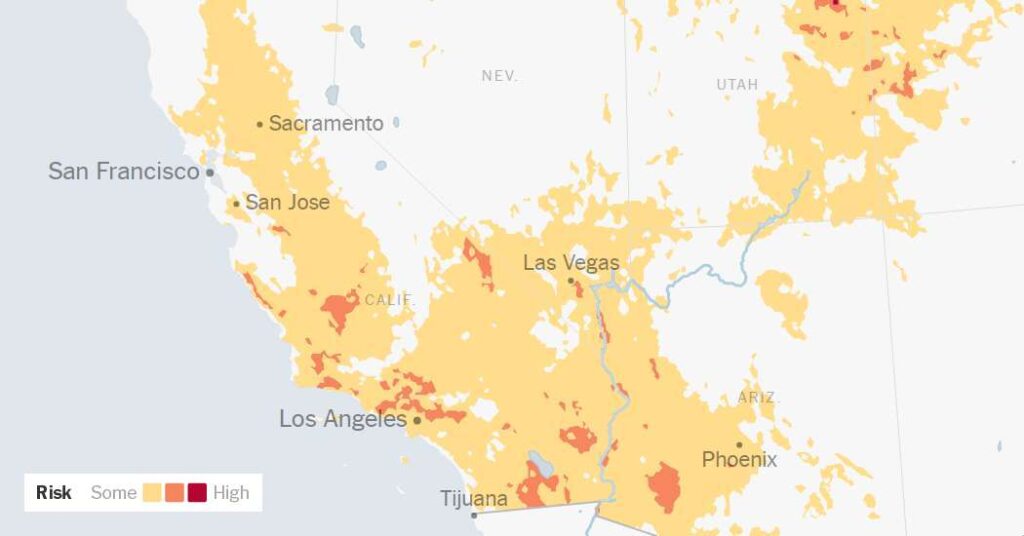
After weeks of mild weather, the temperatures in California cranked up this week, prompting heat advisories and dire warnings about the increased risk of wildfires on Wednesday.
Meteorologists in Southern California, where an extreme heat warning was in effect, said inland temperatures could reach as high as 110 degrees. The northern part of the state was cooler but still well above normal, with many areas likely to reach into the 90s.
And along a broad stretch in between, including the Central Valley, the San Francisco Bay Area and the coastal mountains of Central and Southern California, the heat has left vegetation so dried out that breezy weather on Wednesday could easily spread any wildfires that ignite.
At least one of the state’s National Weather Service offices issued a red flag fire weather warning, with forecasters saying that humidity as low as 10 percent and winds gusting up to 55 miles per hour would make parts of Santa Barbara County and Los Angeles County especially prone to wildfires through early Thursday.
Pacific Gas & Electric, California’s largest utility, said it might intentionally cut off power on Wednesday to 8,000 customers in 10 counties, including Alameda, Contra Costa and Marin Counties in the San Francisco Bay Area and Santa Barbara County north of Los Angeles. Winds can damage and knock over power lines, creating sparks that can start wildfires.
Wildfire season runs year-round in California, and this year has been quieter than usual. The California Department of Forestry and Fire Protection, better known as Cal Fire, reported that just over 100,000 acres had burned since Jan. 1, half as many as the five-year average for the same time period.
“I think it would be fair to characterize the fire season as slow so far,” said Jonathan O’Brien, a fire weather meteorologist with the U.S. Forest Service. “We have seen hardly any fires that have burned actively for more than a day.”
The few notable fires occurred last month, including one on Santa Rosa Island, part of Channel Islands National Park, which spread across 18,000 acres. In recent weeks, a cooler weather pattern and heavy coastal fog have helped reduce the fire risk.
Since Friday, though, there has been “a sudden uptick in fire activity,” said Brett Lutz, a fire meteorologist at the U.S. Wildland Fire Service.
The Summit fire started on Friday in Los Angeles County and has grown to 2,600 acres. The next day, the Elephant fire ignited west of Reno, Nev., and has burned more than 15,000 acres. In the Bay Area on Monday, the Hardin fire ignited and has burned nearly 80 acres in Napa County, and in neighboring Sonoma County, the Ledson fire singed 17 acres.
The fire activity arrived even as moisture spread across the state over the weekend. The cloud-draped skies were the perfect canvas for beautiful sunrises and sunsets, and the air outside felt similar to what might be expected in Florida or Hawaii.
Moisture can help reduce wildfire risk by dampening the landscape, but in this case, Mr. O’Brien said it had not helped much.
“It certainly is not what we would consider a fire-season-slowing event in the vast majority of our region,” he said.
The one exception was in the higher elevations of the Sierra, where up to an inch of rain was recorded, but even there the effect was minimal, and Mr. O’Brien said many areas that received rain hadn’t been at a high risk for fire to begin with because they were covered more with rocks than with trees.
Heat has been the more prevalent weather feature in recent days, and temperatures on Tuesday soared up and down the state, reaching triple digits in inland valleys. On Wednesday, temperatures were expected to decrease a little compared with Tuesday in Northern California, but they will peak in Southern California, with inland areas of Los Angeles predicted to record afternoon highs in the high 90s to 110 degrees.
“The heat isn’t breaking records but it has been persistently warmer than normal,” Mr. Lutz said.
Warm weather and fire risk will continue into Thursday, with Friday bringing more cooling, coastal fog and a lower threat of wildfires.
The post California Weather Shift Brings With It a Risk of Unhealthy Heat and Wildfires appeared first on New York Times.