This personal reflection is part of a series called Turning Points, in which writers explore what critical moments from this year might mean for the year ahead. You can read more by visiting the Turning Points series page.
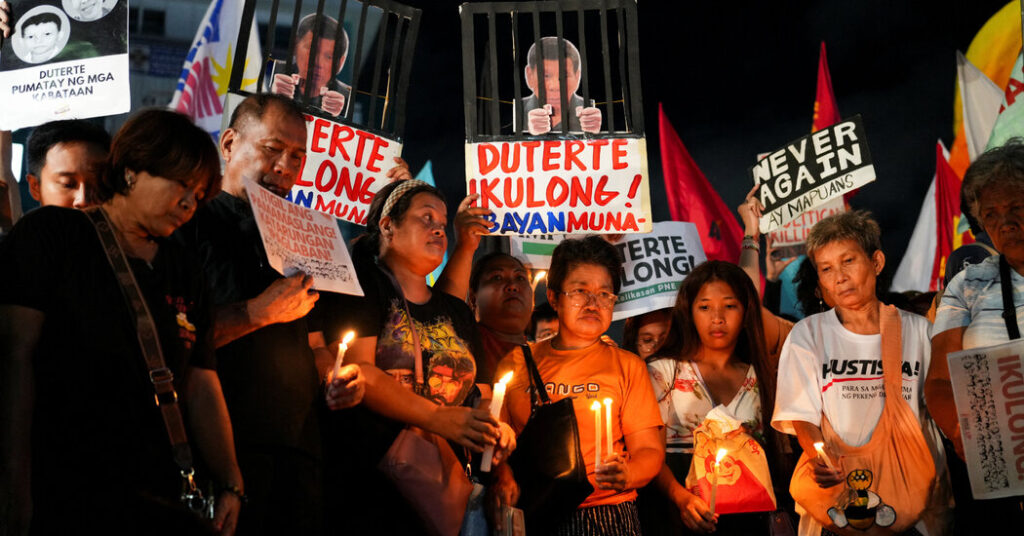
Turning Point: In March, former President Rodrigo Duterte of the Philippines was arrested on a warrant issued by the International Criminal Court.
The day I learned of the arrest of Rodrigo Duterte, the former Philippine president who is now awaiting trial on charges of crimes against humanity at the International Criminal Court, I was teaching Philip Roth’s “The Plot Against America” in New York. As my students connected Roth’s fascist America to our times, wondering about their role, I told them Duterte’s arrest meant it was vital to resist. I said, don’t just take Roth’s prescient imagination for it: The fruit of a people’s resistance is happening in real time.
In March, Filipinos were transfixed online as they followed the flight path of Duterte’s plane from Manila to Dubai to The Hague, bending toward possible justice. His arrest and extradition were thrilling because, after years of impunity, he was finally set to be prosecuted for the extrajudicial killings of an estimated 30,000 people during his so-called war on drugs. Although the I.C.C.’s case outlines how these killings — bounty hunts for which policemen allegedly gained bonuses — were part of a nationwide, and effective, presidential directive, Philippine courts have yet to deliver justice for the vast majority of victims.
This watershed moment in international justice comes from the yearslong work of ordinary Filipinos who braved the state’s violent machine to challenge a popular, albeit killer, ruler. Churches protected widows; lawyers died taking cases to court; journalists nightly documented package-taped corpses dumped on streets; photographers kept vigil. In the journalist Patricia Evangelista’s powerful book, “Some People Need Killing,” an 11-year-old watches vigilantes kill both her parents; an “addict” lives through a grandchild’s collateral death; neighbors risk lives to speak up; gunmen talk. The I.C.C. document’s plain language implies this bold witness of orphans, activists, repentant assassins. Key is the confession of a hit man whom nuns, priests and even military personnel kept in safe houses for years so he could tell his story — and name names in The Hague.
Paramilitary-like dragnets, called “death squads” in the I.C.C. filing, have eerie resemblances to current ICE raids in the United States. Duterte’s bounty hunters targeted vulnerable neighborhoods, mostly the working poor stigmatized as “gang members” or “criminals,” and even wore masks. One sees not only how the embrace of one man’s law-and-order propaganda, stigmatizing the victim as “other,” became a portal for authoritarian rule, but also how the state’s production of fear manufactured consent to intolerable abuse. Duterte’s command was to kill. That ICE only structurally mirrors Philippine fascist policing — state-sponsored arrests targeting the vulnerable with impunity, often without warrants or probable cause — gives no great comfort as I read today’s American news. Too much is familiar to me.
As a Filipino, and as a novelist who has studied how the United States occupied the Philippines, I see an imperial boomerang striking America: Anti-democratic governance that marked the Philippines’ two fascist eras, first under Ferdinand Marcos and most recently under Duterte, has come to roost in President Donald Trump’s America.
I grew up with fascism — a loss of rights by executive order and fabricated military urgency, buttressed by patriotic rhetoric to construct a convenient enemy — which ultimately installed one-man dictatorial rule. I also grew up with resistance. In 1971, fierce students and faculty at the University of the Philippines Diliman barricaded the campus for nine days during the Diliman Commune to denounce then-President Marcos. A year later, Marcos declared martial law, using executive powers in our U.S.-styled Constitution to suspend the writ of habeas corpus, jail citizens without trial and shut down the media. He reconstituted the Philippine Constabulary, a police power first created by the United States to capture resistant Filipinos when we were its colony, to track down his preferred enemies, labeled “communists” (student activists, journalists, protesting farmers, satirical poets and labor leaders), in a prolonged regime of fear he called, in his book’s fantastical title, “Today’s Revolution: Democracy.”
Legalized terror, upheld by a handcuffed constitution and an obedient Supreme Court, tortured and killed thousands and bankrupted the nation to enrich the despot and his crony oligarchs. Supported by the United States’ Cold War geopolitics, it lasted until 1986, when the People Power Revolution, hundreds of thousands of us Filipinos occupying the streets, chased out the dictator, who was airlifted to Hawaii through the kindness of his friend, Ronald Reagan.
I was on those streets as a teenager, and in my novels, I’ve reflected on that history. Marcos’s fascist rule didn’t appear out of thin air, and neither did Duterte’s: The Philippines’ fascist regimes merely recycled their former colonizer’s ploys. Between 1898 to 1946, U.S. colonialism constructed the framework for entrenching oligarchic monopoly and capitalist greed, with seemingly no care for the immiseration of the ruled. The United States occupied the Philippines through vicious policing by executive fiat, laws silencing dissent, disregard for its own Bill of Rights in the occupied islands and patriotic propaganda built on lies and white supremacism. The Philippine-American war, which killed thousands of Filipinos, was fought under the pretense of “benevolent assimilation” of “our little brown brothers,” a derogatory term used for Filipinos that was coined by William Howard Taft.
Colonization is a template of racist anti-democracy, which lies deep in America’s bones, and the specter of fascism that hangs over America today has its precursor in America’s colonizing past. Trump’s America isn’t aberrant; it’s historical.
But the mirror Duterte’s arrest holds up to Americans is that resistance matters. I never felt helpless when I was on the streets of Manila in the ’80s, despite the tear gas, water cannons and rifles aimed at us. I experienced and believe in people power. If we demand our rights, call out the president’s lies, value professional integrity, protect each other, act for our neighbors — if we resist, as Filipinos have, then and now — we can bend a dark arc toward justice.
I’m not surprised that fascism can happen in the United States, but I also believe that people, even if they voted for it, never deserve it. No one deserves the cruelty of fascist rule, and my experience tells me everyone must fight it.
Gina Apostol has written five novels, including two on the Philippine-American war: “Insurrecto” and “La Tercera.”
The post Bending a Dark Arc Toward Justice appeared first on New York Times.