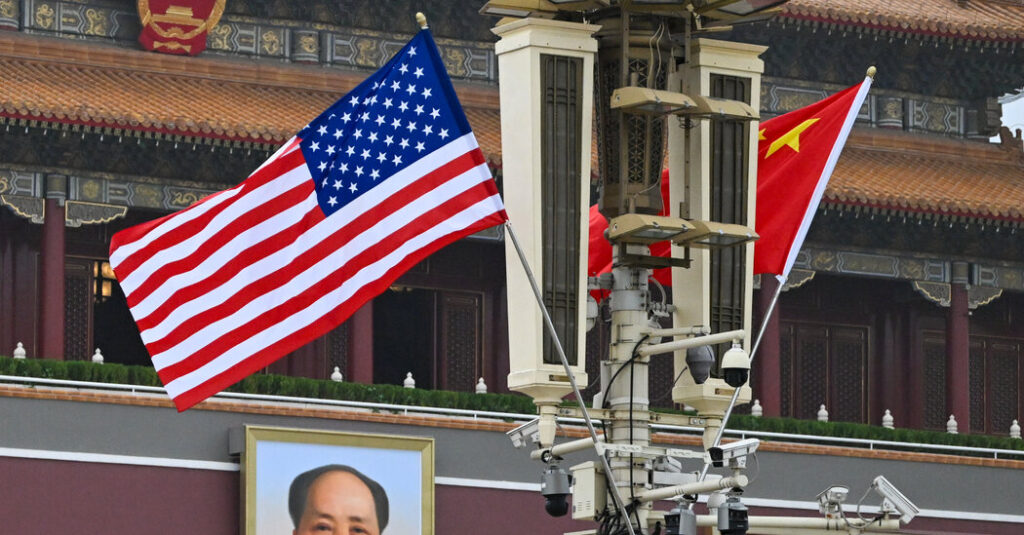
China is one of the biggest stories in the world — and one of the most complex. That’s why The New York Times has always tried to have correspondents on the ground who can get under the surface and report out the nuances.
But the Chinese authorities have long been wary of foreign journalists. They restrict their access, surveil their movements and sometimes expel them outright. My colleague Vivian Wang, our brilliant China correspondent, recently had her visa revoked.
During her time in the country, she talked to a cross-section of Chinese society — migrant workers, academics, college students, retirees. Today, Vivian tells the story of how the Chinese authorities expelled her, what in her reporting made them unhappy and why being on the ground matters.
How I was kicked out of China
By Vivian Wang
In February, I left my home in Beijing for a work meeting in Seoul. It was supposed to be a quick trip. I packed just a few days’ worth of clothes.
At the airport for my flight out, a border control officer looked at my passport, then at her screen, then back at me. She summoned another colleague, who asked me to follow him into a screened-off area.
There, he informed me that my visa had been canceled by order of the Chinese Foreign Ministry. I could get on my flight to Seoul, he said, but I could not come back.
It all took just a few minutes. I walked to my gate, stunned. I had been expelled from China.
There are some topics Beijing is obviously sensitive about: the personal lives of top leaders, for example, or large-scale human rights abuses, like the repression of ethnic minorities. I have reported on some of these issues, but they were by no means most of what I wrote about. My focus as a correspondent had been the lives of ordinary Chinese people, and how they processed the huge changes happening in their country.
But that reporting also got me in trouble. The Foreign Ministry had been threatening me for months, making false accusations about my reporting practices after I wrote about people’s experiences with surveillance or coronavirus lockdowns. I had been followed or physically blocked from doing interviews — even for totally innocuous stories, like one about a rock band.
So while my expulsion stunned me, I wasn’t totally surprised. The Chinese government is opaque. We don’t know exactly why it chose to cancel my visa. But what became clear throughout my time in China is that the old assumptions about what is “sensitive” no longer apply.
Big Brother is watching
I moved to Beijing in 2022, after waiting two years for a visa and reporting on mainland China from afar. I was thrilled to finally be on the ground. The stories I get most excited by are hard to report from the outside. I wanted to meet sheep herders making a living by livestreaming, recent graduates crashing in youth hostels while job hunting and young women discovering feminism while the government tried to suppress it.
I wanted to show the diversity and complexity of China, a country where huge progress and creativity sit side by side with intense inequality and authoritarianism.
I quickly learned that just about any story could be contentious. When I interviewed an organic farmer who moonlights as a rock star, local officials insisted on sitting in on the entire interview, interjecting whenever they felt he was about to say something negative. (In one case, it was just an observation that many of his neighbors still used pesticides.) Other times, police or plainclothes officials followed me as I tried to talk to people on the street, scaring off potential interviewees.
They could do that because of a system of extensive surveillance, which allowed the authorities to track whom I was messaging and where I was traveling. Sometimes, officials would already be waiting for me when I got off a flight or train.
Usually, these officials didn’t give an explicit reason for their interference. But the central government has made it increasingly clear that certain broad topics are off limits. As the economy has slowed, the government has warned that people who point that out might be national security threats. Censors have even targeted people who are “excessively pessimistic.”
So I was always deeply grateful to the people who still shared their stories with me. There was little upside for them — except helping others better understand their country.
Not black and white
In May, the Chinese government briefly let me back in to pack up my home, which had been unoccupied for four months. During my few weeks back, I was reminded of all the details of daily life that you just don’t see when you’re not in China — retirees watching A.I. anchors on the evening news, or taxi drivers complaining about being squeezed by ride-hailing platforms.
Without those details, outsiders might only look at China through the prism of its competition with the United States. Or they might only see the takes of influencers on how China is a futuristic wonderland of high-speed trains and skyscrapers. Neither of those stories is wrong — but they’re incomplete.
And I know that readers are hungry for a fuller picture. My stories always got people asking for more, precisely because the narrative about China has become so black and white.
My colleagues and I will still be trying to report those stories, though most of us are now outside the country. I’ll also be writing about Chinese people outside China and Beijing’s global influence. But there’s really no substitute for being there.
MORE TOP NEWS
Trump backs down on Hormuz fees
President Trump abruptly reversed his plan to charge a steep fee on every ship passing through the Strait of Hormuz, the latest in a series of dizzying shifts in policy that have caused oil prices to fluctuate wildly.
The U.S. military bombed more Iranian targets, returning to the kind of intensive attacks that marked the start of the war. The U.S. said it had restarted its naval blockade on Iranian ports. Iran said it struck a U.A.E.-registered oil tanker in the strait, killing an Indian sailor and injuring dozens more.
TOP OF THE WORLD
The most clicked link in your newsletter yesterday was the Times exclusive on Israel’s secret operation to cultivate Mahmoud Ahmadinejad. His office has denied our report.
OTHER NEWS
-
An Israeli airstrike on a Hamas-led police post in northern Gaza killed seven people, including the director of the station, according to the authorities in Gaza.
-
Israel and Lebanon held a new round of talks mediated by the U.S. in an effort to pave the way for Israel to withdraw from the south of the country.
-
The Chinese Communist Party expelled Ma Xingrui, one of its most senior officials, over corruption and sex charges.
-
A South Korean company that was facing a U.S. trade investigation made a $2 million payment to Trump’s holding company last year.
-
The British counterterrorism police said that the killing of Ann Widdecombe, a prominent member of the right-wing Reform U.K. party, was a “targeted attack.”
-
Bloomberg News lost a landmark libel case in Singapore closely watched for its implications for the country’s press freedoms.
-
The Trump administration ordered ICE to halt most vehicle stops after its officers killed two people over the past week.
WHAT ELSE IS HAPPENING
-
Sotheby’s sold a T-Rex fossil, nicknamed Gus, for a record $50 million.
WORLD CUP
A surprise exit
Spain comfortably delivered France a major upset, handing the tournament favorites a 2-0 defeat. Spain will face either England or reigning champions Argentina in Sunday’s final. See the highlights.
An unlikely star: Erling Haaland’s brand of weird resonates in China, where fans call the Norwegian striker “Baby Ha.”
In photos: See some of the best images from the tournament.
RETRO FASHION OF THE DAY
Culottes are cool again
Just two years ago, the more fashionable among us were embracing hot pants. Now, shorts have grown long again. In fact, the pendulum has swung all the way back to an 1800s invention: the culotte.
MORNING READ
Since retaking power in 2021, the Taliban have enforced rigid rules on religious practice, dress and daily life. Afghan women and girls face restrictions on access to education, most jobs and travel. But in some parts of Herat, the country’s third-largest city, men still kept their beards short and women wore heels and makeup. Now, that’s changing.
My colleague Elian Peltier traveled to Herat last month and found that these pockets of quiet resistance to the Taliban are disappearing. Read more about how the Taliban are tightening their grip.
AROUND THE WORLD
One town. Two bulls. An endless beef.
For a century, people in Parintins, a small town deep in the Brazilian Amazon, have been divided by a fierce rivalry over which local mascot they support: a blue bull or a red one.
The debate, which started in the town’s backyards, has grown into an enormous stadium spectacle. Competing troupes representing each bull perform for three nights before one side is judged the winner.
And the competition goes far beyond the festival days. Banks and shops and crosswalks are painted half red, half blue. Friends and neighbors on opposite sides skip barbecues, birthdays and baby showers. Couples split over mismatched allegiances. Read more, see bulls and watch videos from the festival.
RECOMMENDATIONS
Peek: Justin and Hailey Bieber’s new $12 million condo in Manhattan has two kitchens.
Read: These age-gap love stories are full of fiery desire and so-wrong-it’s-right drama.
Discover: A museum in Rotterdam spread 360 kilograms of peanut butter on the floor to honor a Dutch artist.
Guess: Do you know these Greek plays and poems that were turned into movies? Take our quiz.
RECIPE
This za’atar and labneh spaghetti is creamy like an Alfredo, but with a bright tang. Labneh, a Middle Eastern yogurt, provides a rich, luscious texture. Greek yogurt or skyr works, too.
WHERE IS THIS?
Where is this view?
TIME TO PLAY
Here are today’s Spelling Bee, Mini Crossword, Wordle and Sudoku. Find all our games here.
That’s it for today. See you tomorrow! — Katrin
Vivian Wang was our guest writer today.
We welcome your feedback. Send us your suggestions at [email protected].
The post Expelled from China appeared first on New York Times.