In the summer of 2015, Donald Trump gave out Lindsey Graham’s cellphone number at a campaign rally, leading to a flood of calls. The South Carolina senator replied with a video in which he alternately dropped the phone into a blender, whacked it with a golf club, stuck it in a toaster oven, set it on fire with lighter fluid and found other amusing ways to destroy it.
Vintage Lindsey: witty, folksy, angry and on point. Everyone knows what came next.
Graham flipped from being Trump’s most brutal Republican critic to his most ingratiating minion. He claimed to have come around after playing a round of golf with the president and learning he was “funny as hell.” But sometimes the mask would slip just enough to show that Graham knew he was trading honesty for influence, a classic devil’s bargain. Never was that clearer than on Jan. 6, 2021, when Graham denounced Trump’s tactics from the Senate floor: “Count me out. Enough is enough.”
Given that Graham’s public relationship with Trump began over a phone, it’s sadly fitting that it ended with a friendly call between the two men on Saturday, hours before Graham’s death and just after the senator had returned from an overseas trip that had taken him first to the NATO summit in Ankara, Turkey, and then to Kyiv for a meeting with Volodymyr Zelensky, the Ukrainian president.
That trip represented a string of policy triumphs for Graham. He helped secure Trump’s support, after long resistance, for a bipartisan sanctions bill on Russia. Trump had his own friendly meeting in Ankara with Zelensky, in which the president supported Kyiv’s deep strikes into Russian territory and agreed to grant Ukraine a license to build desperately needed Patriot interceptor missiles — a striking contrast to last year’s calamitous encounter of the two presidents in the Oval Office.
No less important, Trump had a mostly positive meeting with America’s NATO partners, after palpable European fears that he would use the summit to withdraw from the alliance. For anyone who values the free world, perhaps no longer hanging on by a thread, these were no small achievements — and, at least in part, they were almost certainly a function of the ardently Atlanticist Graham’s steadying influence on the president.
They also raised a difficult question for those — including me — who spent years publicly ridiculing Graham for his repeated about-faces on Trump. To wit, would the world today be better off if Graham had stuck to his anti-Trump guns, keeping up a steady fire of rhetorical barbs until the president found a way to unseat him by supporting a primary challenge? If Graham had gone from the Senate to, say, a professorship at Clemson and an occasional seat on a CNN panel, would Ukrainians be safer?
Two years ago, I would have answered both questions with a loud yes. Freedom mustn’t be secured abroad while abetting demagoguery at home. Conservatives won’t serve their movement’s long-term interests by abandoning half of their policy positions, most of their moral principles and all their good sense, simply to curry favor with a capricious narcissist. There is nobility, as I wrote about Nikki Haley’s losing bid for the 2024 Republican nomination, in fighting to the last ditch.
Then again, I’m a pundit. I have the luxury of affecting high-mindedness.
This was not a luxury Graham enjoyed. It’s easy to fault politicians for being willing to do nearly anything to stay in politics, but that’s true of most anyone who loves his or her line of work. The thornier question, for Graham and anyone else in political life, is how flexible their methods can become before they not only obscure their original convictions but completely erase them.
Liz Cheney offers an honorable example of principled inflexibility, except that today her opinions effectively count for nothing. JD Vance is the opposite case: infinite flexibility with no honor. But his views, depressingly, count for a lot. Graham followed a middle path. He wanted power and influence and was willing to abase himself publicly before Trump (and endure the scorn of his former friends) to do it. But he didn’t abandon his core belief in the unity of interests of democratic nations against tyrannical foes, or in the need for American power to serve just causes beyond our borders.
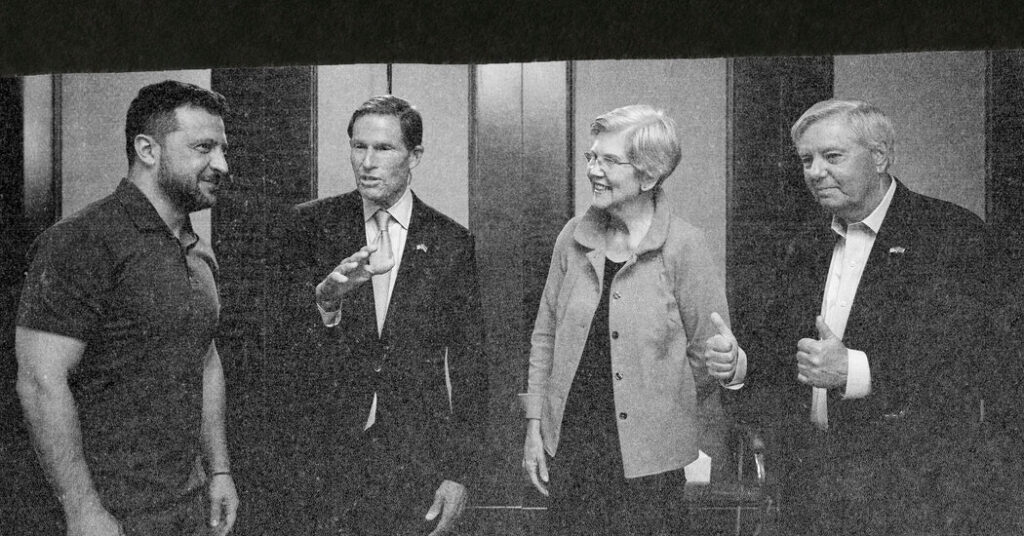
Nor did he lose sight of the fact that, in democratic politics, you cannot have absolute enemies no matter your larger ideological differences. In Kyiv in 2023, he walked side by side with the Democratic senators Elizabeth Warren and Richard Blumenthal, united, if nothing else, in their shared commitment to the defense and freedom of Ukraine.
That image, a rare moment of agreement between Trump’s closest Senate friend and two of his bitterest Senate opponents, may be the right capstone for Graham’s consequential and colorful career. He believed in big things, many of them important and true, and he didn’t let his moral or intellectual self-respect get in the way of advancing them. There’s a nobility in that, too.
The Times is committed to publishing a diversity of letters to the editor. We’d like to hear what you think about this or any of our articles. Here are some tips. And here’s our email: [email protected].
Follow the New York Times Opinion section on Facebook, Instagram, TikTok, Bluesky, WhatsApp and Threads.
The post Lindsey Graham’s Choice appeared first on New York Times.