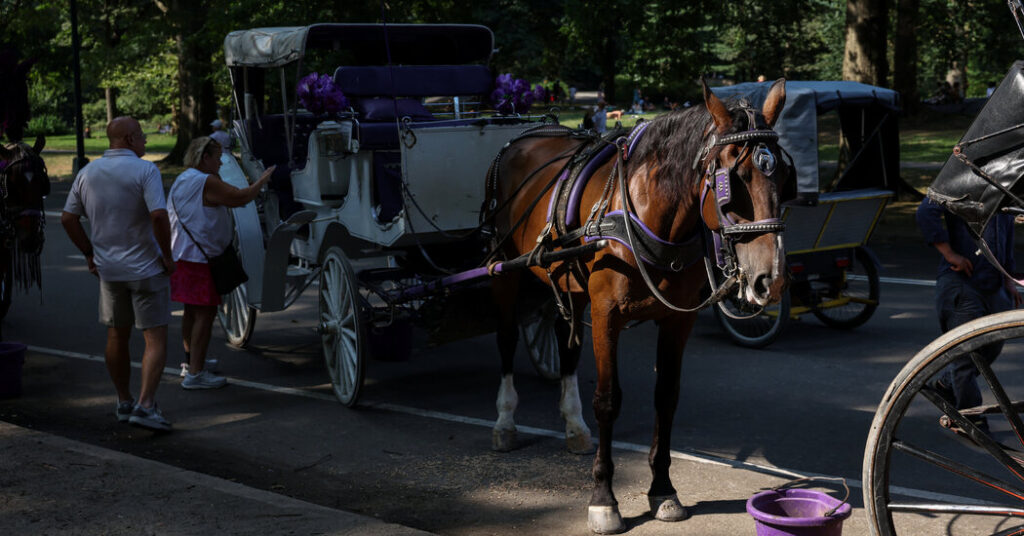
Julie Menin, the speaker of the City Council, has decided to support legislation that would abolish horse-drawn carriages in Central Park by June 2028, positioning animal rights activists for a victory that had long seemed out of reach.
Her move, ahead of a public hearing on Wednesday, follows the death last month of a teenage tourist who was riding in one of the carriages with his family, as well as the death of a carriage horse that tests showed had eaten a toxic plant in the park.
“The death of a tourist really was the tipping point for me,” Ms. Menin said, referring to Romanch Mahajan, an 18-year-old visiting the city from India. The driver had stepped out of the carriage to snap a photograph of the family when the horse bolted and Mr. Mahajan’s mother fell out of the carriage. When he jumped down to help her, he fell and hit his head.
The incident, Ms. Menin said, “clearly was preventable.”
“There have been so many instances of horses breaking free, galloping through the park, injuring pedestrians,” she added. “It is an unsafe situation for pedestrians, for the horses, for the riders, for everyone.”
The hearing on Wednesday is before the Health Committee, which will decide whether to send the bill for a full vote by the City Council. The bill has 21 sponsors, excluding Ms. Menin, who hasn’t yet signed on, and will need another five supporters to pass. Given Ms. Menin’s powerful role as speaker, her backing gives the legislation a much stronger chance of passing.
Transport Workers Union Local 100, which represents carriage owners and drivers, says the horses are well cared for; that they were bred to work and are doing an appropriate task; that banishing them would be financially devastating to those employed in the industry; and that carriage rides remain a popular tourist attraction.
John Samuelsen, the union’s international president, has vowed to continue fighting any move to ban carriage horses and has accused supporters of a ban of exploiting the tragedy of Mr. Mahajan’s death to achieve their goal.
As of last summer, the city’s carriage trade included 68 licensed carriage owners, 183 licensed horses and 231 licensed drivers, according to city records. There are about 170 active drivers, according to the union, with some stablehands also part of the work force.
In an interview, Ms. Menin vowed to secure new jobs for the drivers and to ensure a safe future for the horses, but she did not provide details on how she would accomplish either goal. The bill includes a clause requiring a work force development program “to facilitate the transition of such drivers and workers to other fields of employment.”
She said she was in talks with people in the hospitality and tourism industries about finding jobs for the drivers. Ms. Menin has a longstanding relationship with the city’s influential hotel workers union, which could help in the endeavor.
Supporters of a ban gained a notable ally last year when the Central Park Conservancy, the nonprofit organization that manages the park, formally asked city officials to enact a prohibition. It was the first public stance the group had taken on the issue.
Horse-drawn carriages have been a fixture in Central Park since it opened in the 19th century, but the question of whether that should continue has long been contentious — and, in the case of one mayoral election, possibly decisive. Some people view the industry as offering a taste of old-world charm. Others see it as an anachronistic form of animal cruelty.
To advance their cause, animal-rights activists and their supporters, including the conservancy, have seized on several recent episodes involving horses dying or running off. The push for a ban gained steam last month with examples of both.
The death of Mr. Mahajan led carriage drivers to halt operations for several days while they revamped their safety measures, and appears to have galvanized public opposition to the carriages in a way that complaints about animals being treated inhumanely had not.
Nearly 70 percent of New York City residents surveyed for a poll commissioned by the Central Park Conservancy in the wake of the death said they favored banning horse carriages, while 20 percent opposed a ban, the group said.
“There is broad consensus that no tourist attraction is worth risking another preventable tragedy,” Betsy Smith, the conservancy’s president, said in a statement accompanying the release of the poll results.
Tiffany Townsend, a spokeswoman for New York City Tourism and Conventions, the city’s tourism agency, declined to comment on the possibility of a ban.
Rides cost $72.22 for the first 20 minutes and $28.89 for each additional 10 minutes. Carriages may pick up and drop off customers only at specific spots in the park.
Ms. Menin said soon after Mr. Mahajan’s death that the Council would hold the hearing on the bill, which was introduced by Councilman Christopher Marte. Originally called Ryder’s Law for a carriage horse that collapsed in Hell’s Kitchen in summer 2022, the bill has since been renamed for Mr. Mahajan. Similar legislation failed to win enough support to secure a hearing in the Council’s previous term.
In addition to banning horse carriages as of June 2028, the bill would prohibit the horses now working from being sold or transferred for slaughter or use in another carriage business.
Mayor Zohran Mamdani has said he favors a ban and hopes to work with all interested parties “to deliver a just transition that protects workers.”
Asked about the legislation at an unrelated news conference on Tuesday, Mr. Mamdani said he supports “the spirit of the bill.” He added, “We are, however, critical of the insufficiencies of the worker protections, and we look forward to working with the Council to address those concerns.”
In a letter to the Council, Alexander Kemp, a Local 100 official, called a potential ban “the wrong move.” Acknowledging the tragedy of Mr. Mahajan’s death, Mr. Kemp noted that it was the first fatality in the industry’s 167-year history and that at least 28 people had been killed in crashes in New York City involving two-wheeled motorized vehicles in the first six months of this year.
Rather than imposing an outright ban, Mr. Kemp wrote, the city should regularly dispatch inspectors to the park to ensure that drivers are fully complying with rules meant to prevent horses from getting loose, and should install hitching posts and other infrastructure for tethering horses when they are idle.
“We aren’t running from government scrutiny,” he wrote. “We welcome it.”
The post N.Y.C. Council Speaker Backs Ban on Horse-Drawn Carriages appeared first on New York Times.