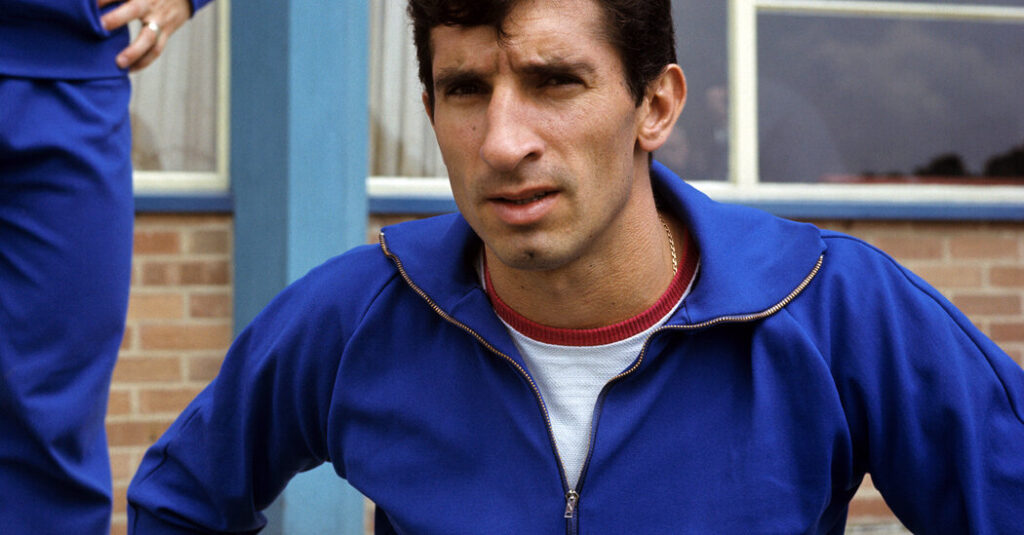
Antonio Rattín, an Argentine soccer star whose impassioned run-in with a referee during a match against England in the 1966 World Cup led to the creation of the sport’s system of yellow and red penalty cards, died on July 11 in Vicente López, a suburb of Buenos Aires. He was 89.
The Argentine Football Association announced his death in a statement. It did not provide a specific cause or location.
On Saturday, the Argentine team wore black armbands in Rattín’s honor during their quarterfinal World Cup game against Switzerland. Argentina won, 3-1, and will face England on Wednesday in the semifinals. The match will be the latest in a decades-long rivalry between the two countries that began during the 1966 World Cup quarterfinals, at London’s cavernous Wembley Stadium.
Standing six-foot-three, the commanding and charismatic Rattín — a midfielder who also served as the team captain — told his squad to be on their guard for an intensely physical game. Both teams played rough, but Rattín felt the referees were not calling enough fouls on the English.
At the 35-minute mark, a German referee, Rudolf Kreitlein, awarded a penalty kick to England. Rattín, who did not speak German, demanded an explanation for why Kreitlein had not also penalized similar English misconduct.
Kreitlein, who did not speak Spanish, ejected Rattín from the game for what he called “violence of the tongue.”
After the game, when asked how he could know what Rattín was saying if he didn’t speak Spanish, Kreitlein said he didn’t have to. “I believed seeing in his face” that he was “insulting me,” he said in a statement.
Rattín refused to go. He walked to the sidelines and sat on a red carpet reserved for the queen’s viewing area for several minutes.
Finally, two police officers escorted him off the field under a hail of chocolates hurled by English fans. He grabbed one, ate it and threw back the wrapper.
As he approached the exit, he grabbed a pennant that featured the British Union Jack flag and rubbed it between his fingers. Fans started throwing beer cans. He paused again when his path was blocked by a Shetland pony belonging to the English marching band.
Rattín later explained that he was simply trying to bring order to a chaotic scene.
“I was only trying to show him my captain’s emblem,” he told The Los Angeles Times in 1967. “I wanted him to know that I was the one to whom he should speak about the penalty against our side. But before I could get him to understand, he threw me out of the game.”
Argentina, down a player, lost the match 0-1. England went on to beat West Germany in the championship game.
The confusion around Rattín’s expulsion convinced the match’s head referee, Ken Aston, that reform was needed. Inspired by traffic lights, he created the system of yellow (warning) and red (expulsion) cards that are now used at every level of the game.
Rattín said that after his team lost, he went walking around central London, unsure whether he would be ignored or attacked by English fans. Instead, he said, he was embraced by cabdrivers and shop owners.
“I found out very quickly that the Englishman is a very special person,” he told The Evening Standard.
In much of the soccer world, Rattín is remembered only for that 1966 game. But in Argentina, he is revered as one of the country’s greatest soccer players.
Antonio Ubaldo Rattín was born on May 16, 1937, in Tigre, a town north of Buenos Aires. His father, an immigrant from Italy, was a ship’s engineer, and his mother managed the home.
Though he trained as an electrician, by the time he was a teenager, Rattín showed enough promise as a soccer player to be recruited to the youth squad of the Boca Juniors, a major team in Buenos Aires.
He played his entire career for Boca, winning five national titles with the team and playing in two World Cups, in 1962 and 1966. He retired in 1970 and returned for a brief stint as a manager in the early 1980s.
Rattín later worked as an insurance executive. He served as a member of the National Assembly from 2001 to 2005, as a member of the right-wing Federalist Unity Party, and as a council member in Vicente Lopez from 2005 to 2009.
A list of survivors was not immediately available.
Rattín said that even decades later, the only thing people asked him about was that 1966 game. Time had tempered his anger, and during a visit to Britain in 2000, he insisted that everything was behind him.
“I always did stand out,” he told The Evening Standard. “Well, that was my way. I’d always been a passionate figure, never afraid to say what I thought. Yet what happened on the field and what happened afterwards was always very separate with me.”
The post Antonio Rattín, Whose World Cup Expulsion Led to Penalty-Card System, Dies at 89 appeared first on New York Times.