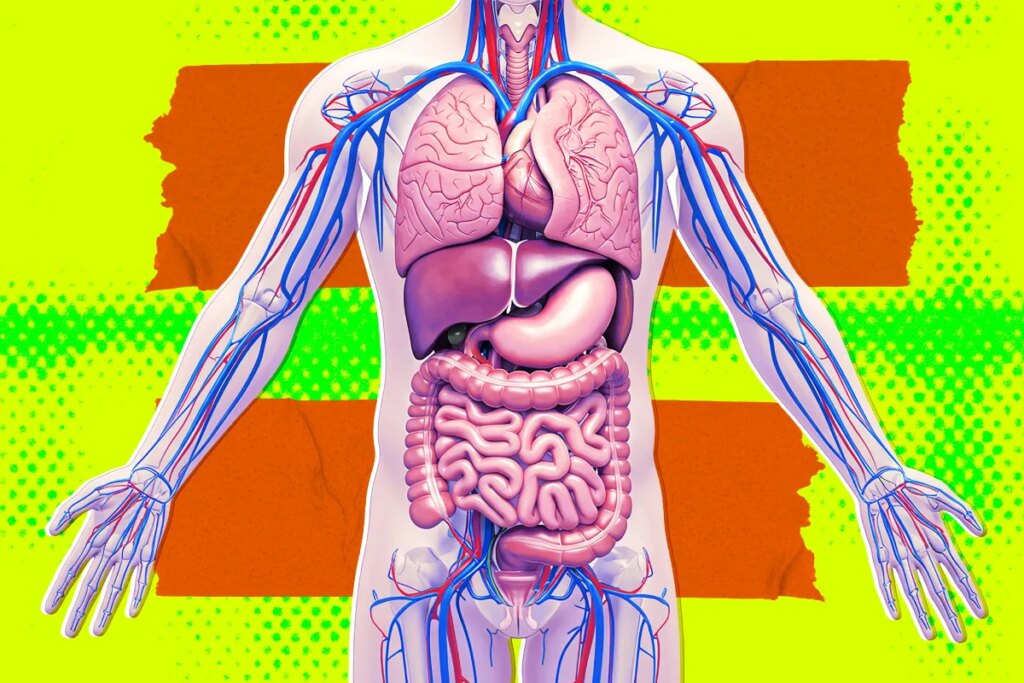
Last February, Alice Gilman, the cofounder and chief operating officer of a secretive Silicon Valley longevity startup called R3 Bio, sat for an interview with podcast Skyline Drive. In the interview, she discussed R3 Bio’s aspirations to grow nonsentient humanoid life-forms — from which, in theory, they can grow and harvest organs for implantation into human bodies, or to test future drugs and other treatments without the need for live animal testing.
“It’s just pretty much a heart, lungs, and everything that you would find in a body,” Gilman tells host and journalist Mangesh Hattikudur. “But it’s not technically alive because it’s exclusively the organs. And they’re in this little biological platform that you can test on and you can map out the cross-organ interactions.”
Throughout their conversation, as Hattikudur notes, Gilman refers to these imagined unfeeling meat suits — which will ideally be born without brains — as “organ sacks.” Needless to say, it’s an ambitious (and to many, fundamentally unsettling) concept that raises plenty of nagging bioethical questions — a reality that the company is clearly wrestling with as it entertains the idea in public.
“I try to not be scary to an average person,” Gilman told Hattikudur.
Months after this interview took place, however, Gilman fought to keep it under wraps, as Skyline Drive told Futurism. Why? It’s not exactly clear.
About a week before the podcast episode was set to air, producers for the Skyline Drive reached out to Gilman to fact-check the conversation. To their surprise, Gilman requested that the episode be postponed. Despite describing imagined “organ sacks” in detail, she denied that R3 Bio was working on the concept “for now, period,” and declined to say what it was working on instead.
Gilman didn’t argue that the interview was factually incorrect. Instead, the podcast team said, she vaguely referred to R3 Bio as a “federal asset,” seemingly implying that she had to tread lightly due to government involvement. To be certain, “federal asset” usually implies some kind of ownership or domain over something held by the federal government. Which would imply that the federal government is investing in a company that’s claimed to have worked on “organ sacks.” She also insisted that what she said in her nearly two-hour-long interview was all theory and opinion.
R3 Bio only recently burst into the public sphere. In March, it announced its existence in a buzzy Wired article, in which R3 Bio told the magazine that it was specifically working to create “organ sacks.” Company investor Boyang Wang elaborated on the idea, telling Wired that “replacement is probably better than repair when it comes to treating diseases or regulating the aging process in the human body,” and that “if we can create a nonsentient, headless bodyoid for a human being, that will be a great source of organs.”
But R3 Bio’s ambitions seemingly go far beyond “organ sacks.” A few days after Wired’s piece ran, MIT Technology Review published a deep dive about R3 Bio’s apparent aspirations and its cofounder John Schloendorn — a self-described “biological designer” who has given confidential talks about “full body replacement” and “recent lab progress towards making replacement bodies.” Generally speaking, replacement bodies refer to physical clones that will allow for humans to transplant their heads onto a whole new human body, a still-theoretical idea that’s attracted the fascination of several scientists. (In response to the MIT Tech piece, R3 Bio issued what the outlet described as a “sweeping disavowal” of its findings, and said that “any allegations of intent or conspiracy to create human clones or human beings with brain damage are categorically false.”)
In her interview with Skyline Drive, which took place before Wired or MIT Tech published their respective pieces, Gilman says that the company has “a few milestones that we’re hoping to achieve. The first milestone being we are working on replacing animal testing by using skin stem cells.”
“It’s mostly a stealth project, but the essence of the surface level of what we do is we take skin cells from monkeys and we reprogram them and do some Yamanaka miracles,” she said, referring to the Nobel Prize-winning scientist Shinya Yamanaka’s transformational stem cell research, “that result in fully grown organ systems.”
In its March reporting, Wired found that the company had put out a job listing for a veterinarian in Puerto Rico who could “implant embryos, monitor pregnancies and help deliver healthy births” in nonhuman primates. On its website, however, R3 Bio states that it does “not work with live primates.”
Gilman gave the Skyline Drive interview from an island in Puerto Rico. R3 Bio wanted “monkey access,” Gilman told Hattikudur, but didn’t want to put monkeys in cages, a practice that the cofounder believes is unethical; after all, one goal of her company is to eliminate the need for animal testing.
So instead, they picked an island with a lot of monkeys.
“I’m a big animal rights advocate… I don’t want to keep monkeys in cages,” she told Hattikudur. “And there’s an option to have them run around the island with bracelets on.”
“We wanted monkey access and there’s a lot of monkeys here,” she added. “After negotiating with local companies that are supervising them, we can walk up to them, get some of their skin cells.”
During the conversation with Skyline Drive, Gilman also discussed one very big scientific problem the company is facing: that the less sentient an “organ sack” is, the less likely it is to function effectively.
“So do these organ sacks have the stem of a brain?” Hattikudur asked.
“So the mice models can exist with a very limited set of nervous systems… but then there are other constraints on the ability of the organs to preserve themselves,” Gilman responded. “So there’s a way in which you can skew towards social acceptance and make less nervous system, and then when you scoot towards social acceptance, it looks better, but it’s less scientifically feasible.”
“So we are still making observations about how that would work,” she added.
How far along R3 Bio is right now is murky at best. Gilman cryptically noted that she lives in a “contextual world,” and in that world, “just because we don’t talk about a lot of things, that doesn’t mean they’re not happening.”
On its website, R3 Bio says that while it “would be excited by the future prospect of full-scale human organ fabrication, it views “the science as currently not ready.”
“We have no ongoing work in this area,” the website notes.
During the interview, Gilman remained confident about the positive impact she believes her company will have. She told Hattikudur that her “worst case scenario” is that she saves “millions of lives,” and that’s a “bet worth taking, regardless of any kinds of blows that are gonna come our way.”
We reached out to R3 Bio to ask why it pushed to postpone the podcast, if it’s currently or planning to obtain skin cells from cage-free island monkeys — and if so, how — and if it has indeed stalled its efforts to create the “organ sacks” it’s now repeatedly discussed in the press. We also asked the company how it defines having “no ongoing work” in the realm of “full-scale human organ fabrication.” We did not hear back at the time of publishing.
In an interview with Futurism, Hattikudur said he was “surprised” by Gilman’s push to suppress the interview.
“The company hasn’t been exactly transparent about what they’re doing,” said Hattikudur. “There’s a lot of mix between the hype they’re telling people and what they’ve actually achieved in the lab, which is not very clear.”
“If they were honest that this is what they believe in, and this is what they’re working on, it would actually be less of a big deal,” he added. “It’s more that they awkwardly seem to be hiding something which everyone kind of knows about.”
More on R3 Bio: A Startup Has Been Quietly Pitching Cloned Human Bodies to Transfer Your Brain Into
The post Secretive Silicon Valley Startup Tries to Quash Interview, Says It’s Definitely Not Working on Growing Brain-Free “Organ Sacks” appeared first on Futurism.