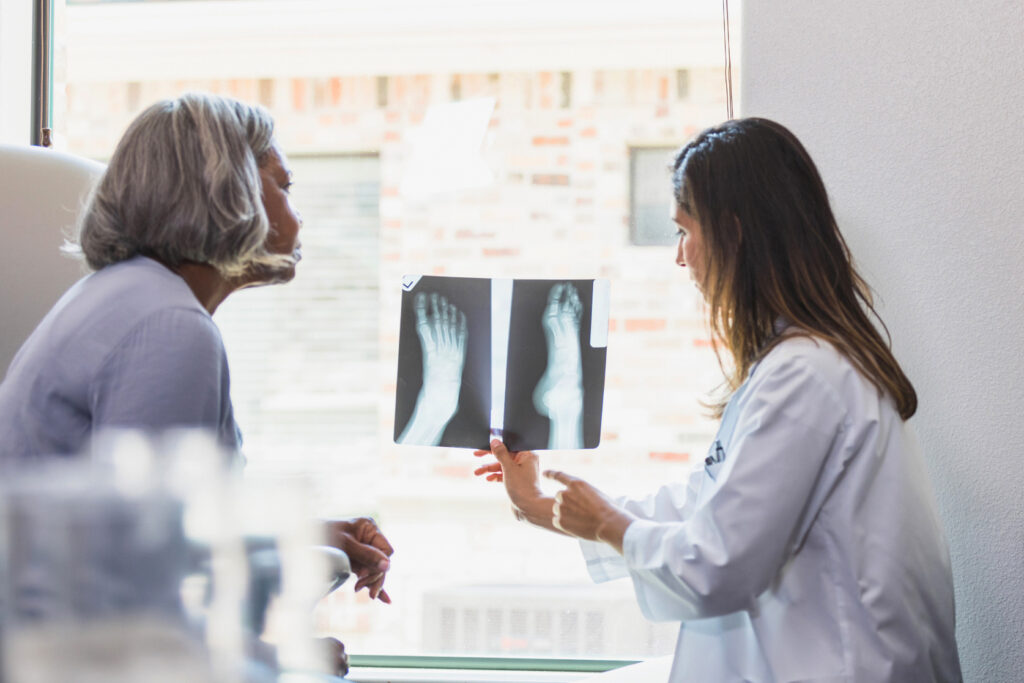
In March, Melissa Graybill, 52, watched her mother, who is 69, begin an arduous recovery journey after trippingwhile getting off a horse. “It was just a simple fall, but it shattered her leg, and she’s had two surgeries, a lot of metal in her leg, and she’s still not walking,” Graybill said. The experience got her thinking about her own bones, and she asked her doctor in April for a DEXA (dual-energy X-ray absorptiometry) scan, which assesses bone density.
Graybill’s doctor said it probably wasn’t necessary because she was under 65, which is when the U.S. Preventive Services Task Force (USPSTF) guidelines suggest women start bone density screening, and when insurance coverage for it begins. But bone thinning can start earlier. That’s especially true for women, due to estrogen loss during menopause — which most women hit around age 50, said Kim Templeton, professor of orthopedic surgery and sports medicine at the University of Kansas Medical Center.
Graybill decided to pay for the test out-of-pocket and was shocked to learn she had osteopenia, or early-stage bone thinning, in her left hip and spine. “It was confusing because I didn’t feel like I fit the stereotype of someone who would hear ‘osteopenia,’” Graybill said. She’s a registered nurse who tries to eat healthy and exercise.
“I’m not like a bodybuilder by any means,” she said. “But I do work out and strength train and watch what I eat.”
Her doctor didn’t give her a treatment plan, other than to repeat the test in two years. “It was like, ‘This is not that big of a deal,’” she said. That’s a common refrain in the setting of osteopenia because “you don’t technically have a disease — you have a precursor, in the same way that someone with prediabetes doesn’t yet have diabetes,” said Vonda Wright, an orthopedic surgeon and author of “Unbreakable: A Woman’s Guide to Aging With Power.”
Osteopenia is defined by a DEXA scan T-score between -1 and -2.5, which represents a minor dip in bone density compared to peak bone mass of a healthy young adult. If bone is like a sponge, picture the holes within it becoming slightly bigger, Templeton said. Medical treatment — for instance, prescription bisphosphonates to slow bone breakdown — is usually reserved for those with osteoporosis, or highly porous bone, reflected by a T-score of less than -2.5.
But Graybill was scared about her future bone trajectory. And it’s a valid fear: Without intervention, osteopenia often progresses to osteoporosis, raising the risk of a break, Templeton said. And with age, there’s a greater chance that a fracture precipitates a downward health spiral. About one in three people over age 50 who break a hip die within the year because of complications of the fracture, and more than half of those people do not regain pre-fall function in that time, Wright said.
The good news is, that path isn’t inevitable. If you have osteopenia, there’s plenty you can do to help not just slow down bone loss but also build some back.
Do weight-bearing activity
Any weight-bearing activity can benefit bones by forcing them to resist gravity, Templeton said. Jogging or playing racket sports are good examples and she recommends walking as much as you can every day.
Many experts also recommend increasing the load on bones with jumping. The additional impact changes the environment within bones, which prompts a signal to the osteoblasts, or bone-building cells, to lay down more bone, Wright said.
Just make sure you start slowly (with heel taps or little hops) if you’re new to high-impact activity, and work your way up progressively to avoid injury.
Build a strong base
Focus on strength-training “the muscles below the belly button,” Wright said. “There’s a big craze right now of having buff arms — but nobody dies of an arm fracture.”
Midlife influencers also push heavy lifting, and while there is utility to lifting progressively and heavier, “all lifting matters,” Wright said. Research suggests many kinds of weight training can build muscle, which may improve your balance and ability to catch yourself if you fall, Templeton said. That can be the difference between a stumble that leaves you bruised and one that leaves you bedridden.
Start with a handful of core, back and leg exercises a couple times a week, and increase the weight for any exercise once you can easily get through 12 or so reps.
Templeton just recommends that anyone with osteopenia avoid exercises for the trunk that involve bending at the waist, such as crunches, “because one of the most common places to break is along your spine,” she said.
Fill up on protein
“Bones are, structurally, 50 percent protein,” Wright said, so it’s a good idea to have a protein-forward diet. She recommends 0.8 grams of protein per pound of body weight, which translates to, for instance, 120 grams of protein for a 150-pound person. To get 120 grams of protein you might aim for 25 to 30 grams at each meal — these dietitian-recommended options featuring foods such as Greek yogurt and grilled chicken are great places to start — and then sprinkle in snacks or bars containing 10 to 20 grams each.
That may sound like a lot. In fact, it’s about double the recommended dietary allowance (RDA) for protein, which is 0.8 grams per kilogram of body weight, or 0.36 grams per pound. Some experts believe that the RDA for protein should be thought of as the minimum intake, so aiming for more may help support bone health.
Adjust your diet to get more calcium
Calcium is a key building block of bones, and experts emphasize getting 1,000 to 1,200 milligrams daily, ideally from food. Loading up via a calcium supplement can cause calcium deposits on the walls of blood vessels, Templeton said, which may increase the risk of heart disease. The same risk doesn’t occur when getting calcium from dietary sources.
It’s easy to hit your daily goal if you eat dairy — a cup of yogurt, a serving of milk and three slices of cheese each have about 300 milligrams of calcium, Templeton pointed out. Otherwise, some non-dairy milks, juices and cereals are calcium-fortified, and you can get modest amounts in green, leafy vegetables like broccoli.
Be sure to spread out your intake over the course of each day, as your body can only absorb about 300 milligrams of calcium at a time, Templeton added.
Consider upping your vitamin D intake
Vitamin D is essential for calcium absorption in the gut — but it can be tricky to get from food. The main foods that contain it are ones that most people don’t often eat, like liver and fatty fish, Templeton said.
An enzyme in the skin turns sunlight into vitamin D, but over the age of 50, “that enzyme really isn’t doing much,” Templeton said. It’s even less effective if you’re wearing sunscreen, she added, which is essential for avoiding skin cancer when spending time in the sun.
To boost vitamin D, consider adding certain foods to your diet that contain it, including eggs, salmon and some types of mushrooms. Other foods are fortified with vitamin D, including most types of milk (including some dairy-free milks), cereals and juices.
While the research on vitamin D supplements is mixed for healthy adults, both Templeton and Wright said they often recommend their patients with osteopenia take a supplement — the standard recommendation is around 1,000 international units daily.
Quit smoking or vaping
Cigarettes and vapes are bone poison, Wright said. Nicotine and other chemicals in tobacco smoke and E-cigarette vapor can harm osteoblasts and may reduce absorption of key minerals like calcium. Multiple studies have shown an increased risk of fracture in smokers of various ages and genders vs. non-smokers.
Plus, nicotine narrows blood vessels, which can limit the blood flow necessary for bones to recover in the wake of a fracture. As a result, smokers may take longer to heal from a break and are at twice the risk of nonunion (a bone that doesn’t fully heal) compared to non-smokers.
If you’re menopausal, ask your doctor about menopause hormone therapy
Menopause hormone therapy (MHT) — which involves replenishing lost estrogen and progesterone, typically through a patch or a pill — has been shown to reduce the risk of fractures and help prevent osteoporosis in menopausal women. “Without estrogen, we break down more bone than we build,” Wright said.
That doesn’t mean MHT is right for everyone; it may not be recommended for women with a history of breast cancer, for example. Whether to use MHT is a personal decision to make with your doctor, “but it must be made based on facts, not fear,” Wright said.
Graybill, for one, began MHT a few months before her DEXA scan. Since getting her results, she’s also started challenging herself with heavier weights and ratcheted up her protein intake to 130 grams a day. She’s grateful to have learned about her declining bone density now, with time to reverse course. After watching her mom’s difficult recovery, she said, “I didn’t want to brush off bone loss as just part of aging.”
The post Concerned you have bone thinning? Here’s what experts recommend. appeared first on Washington Post.