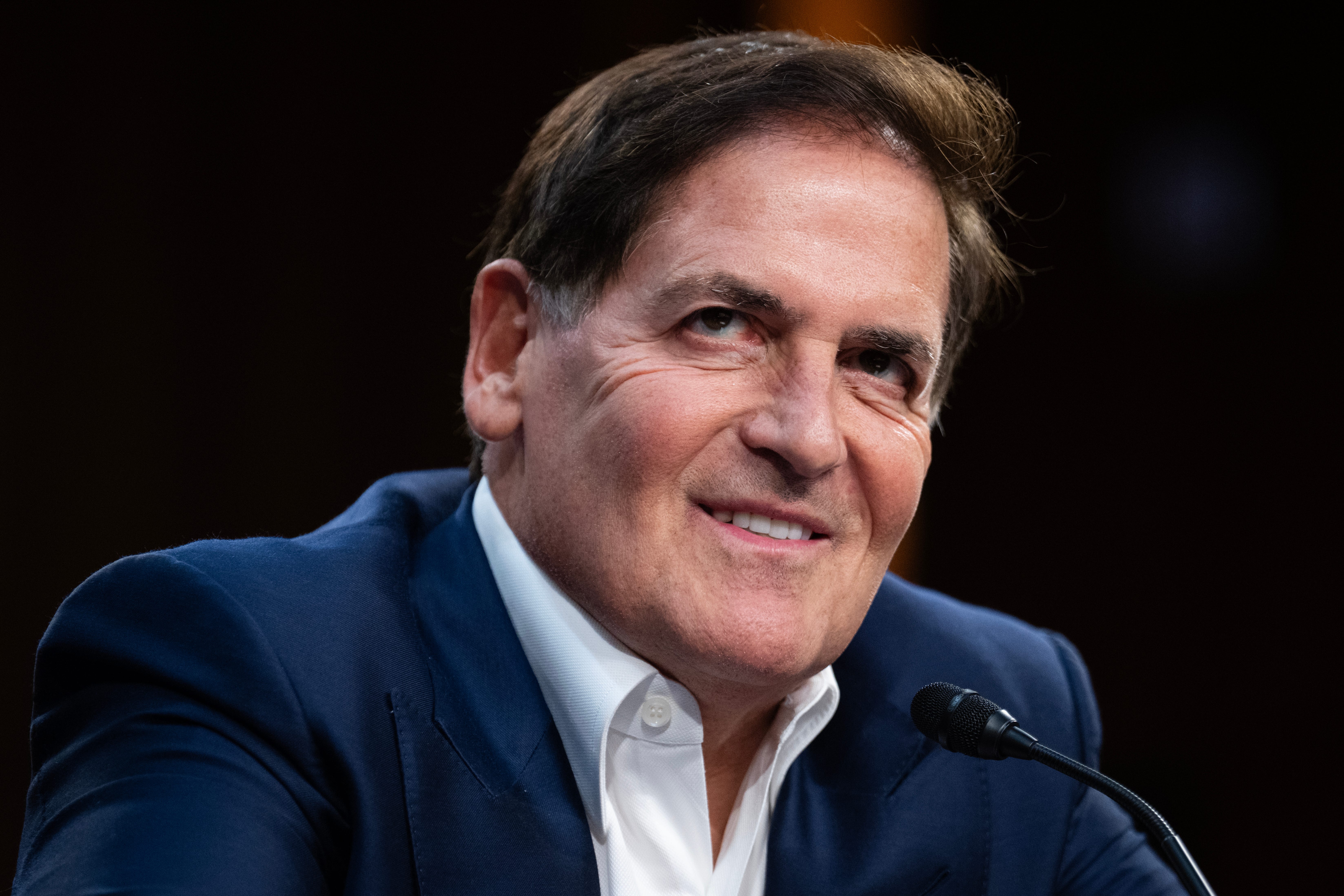
Tom Williams/CQ-Roll Call, Inc via Getty Images
Many teachers worry that AI could make students lazy thinkers. Mark Cuban thinks it could do the opposite — if used the right way.
The billionaire investor and former Shark Tank star said kids who learn to use AI properly will "be best equipped to lead" in the future workplace.
In an interview with CNBC published Monday, Cuban argued that students who collaborate with AI — rather than rely on it — will build stronger critical-thinking skills.
"Students using AI effectively know how to ask the right questions," he said. "They use strong inputs and apply critical thinking to evaluate results. AI helps students think bigger, but it doesn't make decisions."
That perspective contrasts with the concerns of most educators.
A new Samsung "Solve for Tomorrow" study of 620 US middle and high school teachers, conducted online by HarrisX in October and released on Monday, found that 88% believe AI will be important to their students' futures, yet 81% worry that overreliance on the technology could weaken critical-thinking skills.
Educators fear AI is reshaping how kids think and warn of an 'outsourcing' crisis
Across classrooms and campuses, educators are sounding alarms that contrast sharply with Cuban's optimism.
Last month, researchers at Oxford University Press said AI is creating a generation of faster but shallower thinkers.
Their study of 2,000 UK teenagers found that while eight in 10 students use AI tools for schoolwork — many to "think faster" or "solve difficult questions" — a growing number admit the tools make learning "too easy."
That loss of depth is what worries professors as well. Across universities, many say students are no longer just using AI — they're outsourcing thought itself.
Anitia Lubbe, an associate professor at North-West University in South Africa, wrote in The Conversation last month that higher education is "focusing only on policing" AI use instead of teaching students to critique it.
Kimberley Hardcastle, a business professor at Northumbria University, warned that the problem runs deeper.
"Students can produce sophisticated outputs without the cognitive journey traditionally required to create them," she wrote in The Conversation in September.
That, she told Business Insider last month, risks an "atrophy of epistemic vigilance," the ability to question, verify, and think independently.
The split screen: AI as threat or tool
Cuban, however, envisions a different future — one where students' ability to work with AI becomes their greatest competitive edge.
He's backing that vision with action: a partnership with entrepreneur Emma Grede and Samsung's "Solve for Tomorrow" program, which aims to provide AI funding to US schools.
For him, AI is the next great literacy.
"Every single company needs that," he said on the TBPN podcast in August. "There is nothing intuitive for a company to integrate AI — and that's what people don't understand. That is going to be jobs left and right."
Still, Cuban's optimism sits uneasily beside educators' warnings.
Oxford researchers warn that this marks a turning point in how students think and learn, while professors like Hardcastle and Lubbe fear that AI is hollowing out the very skills it promises to enhance.
Read the original article on Business Insider
The post Teachers fear AI could weaken critical thinking — Mark Cuban says it can do the opposite and build better leaders appeared first on Business Insider.