ARLINGTON, Texas — Before it could rise in the World Cup, France first had to fall.
And the fall was spectacular.
In 2010, four years after reaching the final for the second time in three tries, the players revolted against coach Raymond Domenech during the tournament. In response, the managing director of the country’s soccer federation resigned in disgust, and the team left South Africa winless after scoring just once in three games.
That matched France’s worst World Cup performance in 76 years. The team, outsiders agreed, had become impossible to coach.
Four years later France made the quarterfinals, beginning a streak in which it has reached the final eight in four consecutive World Cups for the first time. If France, ranked No. 1 in the world, beats Spain in the semifinals Tuesday — Bastille Day in France, a patriotic holiday that is the equivalent of the Fourth of July in the U.S. — it will advance to the final for a third straight time.
Only Brazil and Germany have done that.
The base for that success was laid a generation before the collapse in South Africa, when a series of poor performances led the French Football Federation to create a series of 16 government-subsidized academies known as Centres de Formation. The main training center opened in 1988 in Clairefontaine, about 30 miles southwest of Paris, and many players from the 1998 championship team — including Zinedine Zidane, Thierry Henry and Robert Pires — passed through its doors.
“What is true about French football is that they started building academies very early and structuring them very early,” said Rudi Garcia, who played 10 seasons in France before becoming a coach of the Belgium national team. “A lot of the good work that’s being done by French football in general is due to the academies.”
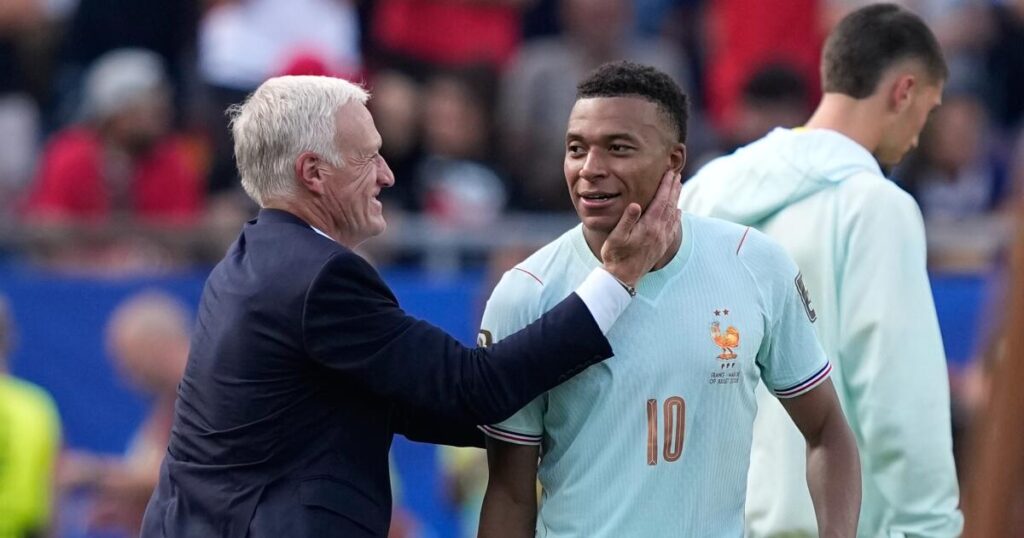
But if Clairefontaine set the foundation, Didier Deschamps, the coach who took over the “uncoachable” team in 2012, built much of what went on top.
“It’s not luck,” Henry said on Fox. “This guy is a serial winner. I can also tell you how hard it is to have a lot of alphas and make sure that only one will be the alpha.”
Deschamps was a lunch-bucket player, a hard-working defensive midfielder who excelled at winning back possession in a 16-year career that saw captain France to both a World Cup and European Championship before retiring to become a coach, guiding Monaco to the Champions League final in his first stop. If he has a super power, both as a captain and a coach, it would be his ability to manage big egos and get them to buy into the team concept. He did that first as captain of the star-studded 1998 squad and has been even better at it as the team’s head coach.
“The collective spirit,” Deschamps said “is our strength.”
“He’s got credit in the bank,” added former World Cup goalkeeper Kasper Schmeichel, another Fox analyst. “Who can question him? His record speaks for itself as a player and as a coach.”
About that record. He heads into Tuesday’s semifinal with 20 wins and just two losses in 25 matches as a World Cup coach. He has won more World Cup games and more knockout-stage games, 10, than any manager in history. And he was unbeaten in the tournament as a player, going 6-0-1.
Add those wins together and Deschamps, 57, has been on the field or in the technical area for 26 of France’s 48 all-time World Cup victories. Before him, France had never won a World Cup.
By Sunday, they could be lifting the trophy for the third time in 28 years. Only Brazil has won that many titles in so short a span. And this summer’s team could be France’s best ever.
All that is thanks in large part the FFF and government investment in the Centres de Formation, France is now the greatest developer of elite soccer talent in the world. Of the 1,248 players chosen to play for the 48 teams in this World Cup, 99 — nearly 8% — were developed in France, according to Opta. At least 13 teams in this summer’s tournament had at least one French-born player, among them Spain and Cape Verde. No other country comes close.
There are several reasons for that. The Ile-de-France region for France, which includes Paris, is home to several large communities of working-class immigrants from the country’s former colonies. Eleven of the 26 players on this summer’s French team came from these banlieues, as they are called, among them captain Kylian Mbappé, the leading scorer in the last two World Cups.
The talent pool there is so deep, France could probably have fielded a B team in this World Cup and made it to the quarterfinals. And because the competition to make the national team is great, it raises the level of play for everyone.
For those who fall short, their immigrant backgrounds allow them to play for other countries. For example Riyad Mahrez, a former African player of the year, was born in Clichy, France, but plays for Algeria while Senegal’s Ibrahim Mbaye is from Trappes, Yvelines.
“It’s quite an incredible pool of talent in a relatively small area,” Hubert Fournier, technical director of the French Football Federation, told the New York Times. “There’s a high concentration of players with very well-structured clubs. And then everyone draws from this Ile-de-France pool because afterwards they go to other clubs; they don’t all stay in Ile-de-France.”
The energy and diversity of the banlieues also fuels the French national team. Nine of the 11 starters in France’s win over Morocco either immigrated to France or are the children of immigrants from Madagascar, Lebanon, French Guiana and Cameroon, Guinea-Bissau and elsewhere.
And Deschamps, who grew up in modest circumstances in Basque country, is the one who has made all those disparate parts work together. If France wins its next two games, he’ll become the second man to coach two World Cup champions.
But when asked for the secret to his success after France’s quarterfinal win over Morocco, a team with six French natives, Deschamps praised the French team, one thought to be uncoachable when he took over.
“Having great, great players, excellent players. My credit goes to the players,” said Deschamps, whose team hasn’t allowed a goal in its three knockout-stage wins. “But maybe I do my job well.
“The human aspect is of paramount importance. I am extremely happy on a personal level as well as seeing my players enjoy themselves.”
The post How France went from World Cup embarrassment in South Africa to soccer super power appeared first on Los Angeles Times.