Days before the United States launched its war on Iran in late February, a senior official from an Arab nation was being escorted through the West Wing when the Oval Office door swung open to present three familiar faces: Secretary of State Marco Rubio, Defense Secretary Pete Hegseth, and Senator Lindsey Graham of South Carolina.
“What are you doing here?” the official asked Graham, half in jest. (He’d sat down with the senator just days before.) “I’m always here!” Graham shot back with a smile, the official told me.
Graham had spent weeks arguing that war with Iran was not only justified but necessary, shuttling between Israel and the White House to help Prime Minister Benjamin Netanyahu’s government press its argument for war. Arab officials had repeatedly warned Graham of the perilous consequences war could unleash. Graham remained unmoved.
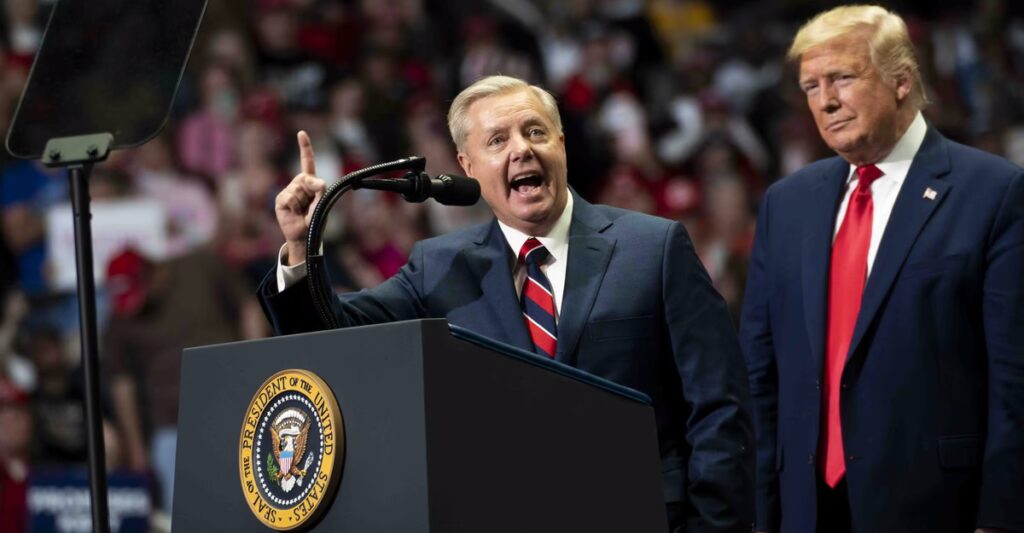
It’s hard to overstate Graham’s influence in shaping President Trump’s second-term foreign policy. Washington has never lacked Republicans eager to advocate a more muscular approach to foreign affairs. What distinguished Graham, who died Saturday, was his ability to persuade Trump. He understood the president’s instincts, his political incentives, and his aversion to open-ended military commitments—and learned to frame intervention in terms Trump found appealing. Graham’s death removes one of the few figures who functioned as a translator between two competing Republican foreign-policy traditions: Trump’s “America First” tendency toward isolationism and the Ronald Reagan–era interventionism Graham never abandoned. Graham was successful in part on Ukraine, persuading the president not to abandon Kyiv for the Kremlin. He also was successful in persuading Trump to launch a war with Iran, an endeavor that has so far proved to be a major miscalculation.
Graham transformed himself—famously and awkwardly—from a Trump opponent and critic in 2016 to a presidential ally and golfing buddy. By 2024, with Trump the presumptive presidential nominee, it was clear that the battle over Republican support for Ukraine would be won or lost at Mar-a-Lago. Trump was complaining on the campaign trail about the billions of dollars the U.S. gives to foreign countries rather than addressing problems at home. He had frequently criticized Ukraine as corrupt, and was angry that what he termed his “perfect call”—in which he asked President Volodymyr Zelensky in 2019 to announce an investigation into Joe Biden and his son Hunter—resulted in Trump’s impeachment. Trump had often described Ukraine to European leaders as “your Ukraine,” calling it “part of Russia,” U.S. and foreign officials told me.
[Read: Zelensky makes his pitch to Trump]
Republican support for Ukraine aid was rapidly eroding. Trump opposed simply writing another check, and, with Kyiv running short of supplies, congressional Republicans scrambled to win him over. The problem, Graham told me at the time, was that Congress kept taking Trump too literally. When Trump talked about taking the oil in Iraq, Graham argued, Trump wasn’t suggesting the U.S. seize oil fields; he was demanding something in exchange. The same logic applied to Ukraine. If Trump wanted “payback,” Graham reasoned, the answer wasn’t to abandon Kyiv; it was to structure U.S. assistance as a loan. Graham, along with Republican Senators Kevin Cramer of North Dakota and Markwayne Mullin of Oklahoma, floated the idea. Graham’s contribution, he told me, was to frame the proposal as Trump’s. Campaign officials later confirmed Trump was receptive to providing a loan as long as the U.S. got something tangible in return.
“Trump’s foreign policy has always been about leverage—what is in America’s interest,” Graham told me in April 2024. “He’s trying to get Europeans to do more, but the loan concept goes way back to Iraq,” Graham said, referring to a 2003 program he proposed, with a bipartisan group, that pushed to turn $10 billion in reconstruction funds for Iraq into a loan rather than an unconditional grant. Graham and others also explained to Trump that Ukraine is rich with minerals and has the potential to repay its debts. But that payback was contingent on defeating Russia, since most of those resources were in occupied territories.
On April 18, 2024, Trump wrote on Truth Social, “As everyone agrees, Ukrainian Survival and Strength should be much more important to Europe than to us, but it is also important to us! GET MOVING EUROPE!” Two days later, the House approved a bipartisan $61 billion aid package to Ukraine. I asked Graham at the time how he had persuaded the president. “It’s important to know how to speak Trump,” he told me.
In Trump’s second term, Graham believed that the time was ripe for U.S. strength to be applied somewhere else: Iran.
In early January of this year, Graham hitched a ride aboard Air Force One as Trump returned from a holiday break in Palm Beach. Graham made no secret of his objective, later posting a photo of himself standing with the president and holding a hat signed by Trump that read: Make Iran Great Again. A week later, Trump wrote a message on Truth Social directed at the Iranian people, who by then had kicked off mass protests against their government: “KEEP PROTESTING,” Trump wrote. “HELP IS ON ITS WAY.”
[Read: What Lindsey Graham wanted]
Hawks such as Graham saw opportunity in those protests. Netanyahu argued that the time was right for an attack. In the weeks before the war, Graham traveled from Washington to Jerusalem to Munich, arguing that Iran posed an imminent nuclear threat and that many of America’s allies were making the same mistake Trump had once made: underestimating the danger. The belief that much of Europe had become complacent about a more menacing world became a defining theme of Graham’s final months.
Graham believed the opportunity to attack Iran hadn’t existed during Trump’s first term. Although he had long argued that Iran’s clerical regime posed a threat to both the U.S. and Israel, he didn’t think Trump was prepared to use force. The president, Graham told me, had less confidence in the military and a more limited view of America’s leverage abroad. His return to office had changed Trump, Graham argued, making the president more pragmatic, more willing to take risks, and more prepared to project American power. Trump, he told me in a brief call in September 2025, had learned how to make the government work for him, had a Pentagon he trusted, and “knows how to get what he wants.” Graham told Trump that this was his opportunity to eliminate Iran’s nuclear threat—something, he argued, President Obama had tried and failed to do—and to make history.
Israel also saw opportunity in Graham. After Trump grew frustrated with Netanyahu last year over a series of military operations that the White House believed went too far and undermined efforts to bring calm to the region, Netanyahu turned to his friend of many decades for help. As a new senator, Graham had forged a bond with the seasoned hawkish senators John McCain and Joe Lieberman, and they became known in Washington as the “Three Amigos.” Together, they made repeated official trips to Israel, bringing Graham directly into Netanyahu’s political and personal orbit. On Sunday, Netanyahu eulogized Graham on various American networks, noting that Graham lobbied his colleagues to provide more military aid or funding for missile defense than Israel requested. (Graham’s push for Israel earned him many critics within his own party.)
Earlier this year, Graham traveled to Israel to meet with officials from Mossad, the country’s foreign-intelligence agency. Mossad shared intelligence assessments claiming that the Iranian threat was more imminent than what U.S. intelligence revealed. Graham then used those same arguments in conversations with Trump in an effort to convince the president that military action had become unavoidable. Arab officials told me that Graham, in the weeks leading up to military operations, was using Israeli assessments to support his argument on the merits of going to war. But military strikes were never Graham’s end goal. Regime change was.
In February, on the sidelines of the Munich Security Conference, Graham engaged in an impromptu call-and-response with me and a few other reporters.
“What does Lindsey Graham want?” he asked, before answering his own question. “Regime change!”
He continued: “When does he want it?”
Silence.
“Now!” he answered.
Trump launched the war alongside Israel two weeks later, on February 28.
Graham’s campaign for war in Iran reflected his conviction that much of Europe—and some of America’s Arab partners—had fundamentally misread the world after the Cold War. At Munich, Graham argued again and again that too many European governments were still obsessed with the concept of a “rules-based order” that was disconnected from the real world. Russia was waging war on Ukraine. Iran remained, in his view, the Middle East’s central destabilizing force. China was becoming more assertive. Graham believed many of America’s allies were still treating these challenges as problems to be managed through summits, communiqués, and diplomatic processes against adversaries who recognized none of those procedural niceties. “You have a dinner here, you give a nice speech and go have a nice meal,” Graham told reporters. “That ain’t working. No bad guy cares about your rules.”
He argued that sometimes military force had to come first. He dismissed what he saw as Europe’s fixation on Trump’s interest in acquiring Greenland as a distraction from far more consequential threats. “Nobody in South Carolina gives a shit about who owns Greenland,” he told us. “People in South Carolina would like to feel safe. They don’t like Putin, and they don’t like the Ayatollah, and they love Trump. We missed the big picture here.”
Graham, once a stalwart advocate of multilateral alliances, was echoing the displeasure with Europe that is prevalent among the president’s core supporters. But Graham remained devoted to helping Ukraine. “We disagreed a little bit,” Trump said of Graham on CNN’s State of the Union yesterday. “I wanted to see the war with Ukraine end very quickly. I think he was more into keeping it going.”
As Ukraine seizes the initiative against Russia, Trump has signaled more support for Kyiv, which Graham visited last week. But Trump’s Graham-influenced approach to Iran has proved much less successful and led to frustration at the White House.
Graham long argued that Trump would be doing the world a favor by assassinating the ayatollah and those who serve him. (Ayatollah Ali Khamenei was killed on the first day of the war; his son Mojtaba is now the country’s spiritual leader.) Graham saw the key to Middle East stability in the normalization of relations between Israel and Saudi Arabia. But that normalization could work, Graham said, only if the Iranian regime were to change. “I believe my niece could do a deal between Saudi Arabia and Israel—she’s very sharp; she’s 16—if Iran falls.” If the Iranian regime remains in power, he added, “nobody can do a deal.”
But he acknowledged that using American ground forces would be a hard sell. “I’m not an isolationist by any means, but I have learned from Iraq. Entanglements can be difficult,” he told me and a handful of reporters in Munich. “Trump somehow has been able to manage a robust Lindsey Graham/Reagan foreign policy without getting us entangled.”
I asked Graham how regime change could be achieved without a ground invasion. “The boots on the ground are the Iranians,” he said, suggesting that the Iranian people would secure their own country after the regime was ousted. Trump echoed that line in the first hours after launching the war, calling on Iranians to rise up once the U.S. and Israeli militaries had pummeled their leadership. Graham also said the U.S. could lean on its allies in the region—however reluctant they may be—to help. “We’ve got Saudi Arabia, United Arab Emirates,” Graham said. “They can be a tremendous help to the people of Iran. They can help build the infrastructure.”
Once the war began, he accused America’s European allies of expecting U.S. leadership without assuming enough risk themselves, a sentiment the president shared. After speaking with Trump about what Graham described as “our European allies’ unwillingness to provide assets to keep the Strait of Hormuz functioning,” Graham said on X in March that he had “never heard him so angry in my life.”
“The repercussions of providing little assistance to keep the Strait of Hormuz functioning are going to be wide and deep for Europe and America,” he added in that post. “I consider myself very forward-leaning on supporting alliances, however at a time of real testing like this, it makes me second guess the value of these alliances. I am certain I am not the only senator who feels this way.”
He aired similar irritation with U.S. allies in the region, particularly Saudi Arabia. “Americans are dying and the U.S. is spending billions to dislodge the terrorist Iranian regime that threatens the region,” he wrote on X earlier that month. “If you are not willing to use your military now, when are you willing to use it?”
[Read: Trump loses his wingman]
By April, Iran’s closure of the Strait of Hormuz posed a threat to the global economy, and the regime in Tehran was still intact. The U.S. launched talks, led by Vice President Vance and mediated by Pakistan, in the hope of securing a cease-fire and opening the strait. Graham was skeptical. “I don’t trust Pakistan as far as I can throw them,” he said at a May Senate hearing. “No wonder this damn thing is going nowhere.” He also supported increased military spending and insisted the fall of the Iranian regime would lead to the U.S. making “a ton of money.”
As the months passed and Graham’s initial optimism about the war proved unfounded, he privately signaled an openness to talks, several congressional aides told me, but only after October’s elections in Israel and November’s U.S. midterms—and only if traffic resumes through the Strait of Hormuz. After weeks of negotiations, the U.S. and Iran signed a memorandum last month aiming to address a list of grievances on both sides. But a lasting deal has proved fickle, too. Trump last week declared the cease-fire “over,” and fighting resumed. Graham died on Saturday from an aortic dissection, according to the medical examiner’s preliminary findings. That same night, Iran again declared the Strait of Hormuz closed.
The post How Lindsey Graham Persuaded Trump to Attack Iran appeared first on The Atlantic.