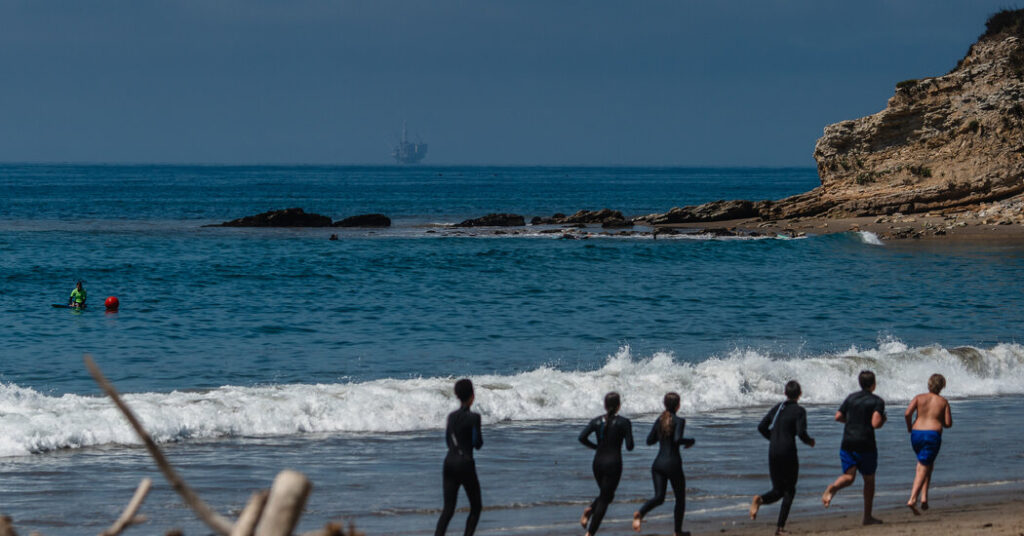
On a hillside trail near Santa Barbara, Calif., songbirds chirped in the arching branches of oak trees. The bright blue Pacific Ocean lapped at the secluded cliffs below. Given the breathtaking views, it was easy to miss a knee-high sign on an orange pillar.
Warning: Crude Oil Pipeline.
For decades, state and federal officials had halted new offshore drilling here on California’s coast to protect its shoreline. But in March, amid an oil shortage during the war in Iran, the Trump administration ordered the reopening of a Santa Barbara pipeline that had been dormant since 2015 after a major spill.
The reboot has spawned enormous backlash locally, as well as several lawsuits against Sable, the pipeline’s Texas-based owner, from environmental groups and California officials. The pipeline initially burst in 2015 because of corrosion, and it remains vulnerable to another rupture, opponents say.
It is a twist of nature that this region, nicknamed the American Riviera for its postcard-perfect beaches and red-tiled roofs, overlooks one of the world’s richest offshore oil reserves. And it is perhaps a twist of politics that the bounty of petroleum sits next to California, a liberal state where environmental protections are held sacred.
President Trump has made increased domestic oil production a central part of his platform, and the “drill, baby, drill” mind-set tends to be popular with his base for its near-term economic and national security benefits. But the opposition to the pipeline is an example of how his agenda plays out on a local level, challenging the identity and ideology of Santa Barbara.
For the people who live here, coastal beauty takes precedence over almost anything else. On a breezy Santa Barbara beach, Amber Armistead walked her pug, Nacho, under palm trees and swooping sea gulls. Beachgoers nearby snacked on guacamole and fish tacos while others dragged their surfboards into the waves.
President Trump “doesn’t care if there’s another spill,” Ms. Armistead, 65, said. “We have such a beautiful place here on the coast. I don’t know why you would jeopardize it.”
Ms. Armistead, who manages a clothing store, said her daily strolls on the beach were helping her become “unwaterlogged” after years of living in Seattle. The beach is the reason she came to Santa Barbara, and why she has stayed, she said, echoing many residents.
Santa Barbara County, roughly 90 miles northwest of Los Angeles and with about 442,000 residents, is beloved for its Mediterranean climate and south-facing beaches that make for some of the calmest waters in California. Celebrities such as Oprah Winfrey and Prince Harry live here in multimillion-dollar estates perched in the scrubby mountains peering above the shore.
Pipeline or not, Santa Barbara’s beaches have never been completely pristine. Black goo has washed ashore here for thousands of years as natural seepage from the abundant oil reserves below the ocean floor. The Chumash tribe waterproofed their canoes and baskets with the sticky tar. Locals know to keep baby oil in their cars to scrape it off their feet.
The tar has a darker connection, too. The nation’s first offshore rigs were built here in the late 1800s, and in 1969 came the nation’s first large oil spill, which brought about the modern environmental movement and radicalized many Santa Barbara residents against fossil fuels.
“Seeing dying birds, seeing the oil, it really affects you deeply,” said Joan Hartmann, a Santa Barbara County supervisor who became an environmental studies professor after witnessing the destruction firsthand in 1969. “It was just a wave of a sense of shame, of what have we wrought?”
So there was plenty of opposition from Ms. Hartmann and others when Sable wanted to restart the pipeline.
The company purchased it from Exxon Mobil in 2024, but several state agencies denied permits to Sable to perform repairs and to restart operations.
After hitting a dead-end with California regulators, Sable appealed to the Trump administration. The president has said he wants to boost domestic energy supplies by expanding oil drilling on and offshore in California. And after going to war with Iran, Mr. Trump invoked the Defense Production Act, a 1950s-era law that has typically been used in national emergencies, saying that the oil was needed.
That order allowed Sable to resume pipeline operations.
A number of lawsuits have not stopped Sable from pumping oil. The pipeline is now producing about 43,000 barrels daily, according to Sable, roughly increasing California’s in-state oil production by about 20 percent.
While visiting the Sable oil facility in Santa Barbara last month, Chris Wright, the U.S. energy secretary, said that turning on the pipeline was necessary to protect the nation’s military operations. California has 30 military facilities, more than any other state in the country, but they are at risk because California currently imports the bulk of its oil, he said.
“California was once one of America’s top oil producers, but with Gavin Newsom doubling down on Democrats’ failed anti-energy agenda, more than 60 percent of the state’s oil is now imported from foreign countries,” Taylor Rogers, a White House spokeswoman, said in a statement. By allowing Sable to drill, President Trump was “unleashing American energy dominance,” she said.
Gov. Gavin Newsom, who opposes the restarting of the pipeline, has countered that the amount being produced is a tiny fraction of the global oil supply. The state of California is suing the Trump administration for invoking the Defense Production Act in a case that is pending.
“Sable turned to the Trump administration to illegally invoke emergency powers, trample over the law, and put communities at risk by forcing a restart without all required approvals,” said Anthony Martinez, a spokesman for Mr. Newsom.
A federal investigation into the 2015 spill found that the pipeline ruptured because of severe corrosion and poor monitoring by the owner, pouring tens of thousands of gallons of crude oil into the Pacific Ocean and significantly damaging wildlife.
That corrosion is a symptom of a design flaw in that kind of pipe, said Bill Caram, executive director of the Pipeline Safety Trust, a nonprofit in Bellingham, Wash. The Santa Barbara pipeline is “more susceptible to failure than most pipelines,” he said.
Sable and the Trump administration denied that risk, both saying that the company had upgraded its leak detection system, added new shut-off valves and performed thorough tests before restarting.
“Sable Offshore is being held to safety and environmental requirements that exceed the normal federal standards,” a spokesman for the U.S. Department of Transportation said in a statement.
Bob Nelson, the only member of the board of supervisors to support Sable’s efforts, said that he would have preferred a new pipeline rather than using the one that previously ruptured. But he felt confident that the safety valves Sable had added would prevent a leak from ever becoming as big as it did in 2015.
And he said the project would bring tax benefits to the region. Mr. Nelson, who represents the northern, more working-class part of the county, said he was regularly stopped by Sable employees at the gas station and Costco food court who thanked him for helping to restart the project.
Was he surprised the Trump administration became involved? “A little bit, pleasantly,” he said.
Donald Lewis, wearing a wet suit and goggles as he assembled his kite surfing board on a Santa Barbara beach, said he had noticed more tar on the sand in recent months.
There’s no reason to believe that increased pumping is releasing more oil into the ocean, experts say, yet locals are on high alert for spills. Neighbors had been anxiously discussing whether the recent accumulation was from the Sable pipeline, Mr. Lewis said.
Mr. Lewis, who has lived in Santa Barbara for three decades, isn’t totally against fossil fuels — he drives a gas-powered car — but doesn’t want Sable to drill near the shoreline where he hangs out everyday.
“This is why I live here, for the beach,” he said.
The post California Blocked an Oil Pipeline in Santa Barbara. Trump Forced It Open. appeared first on New York Times.