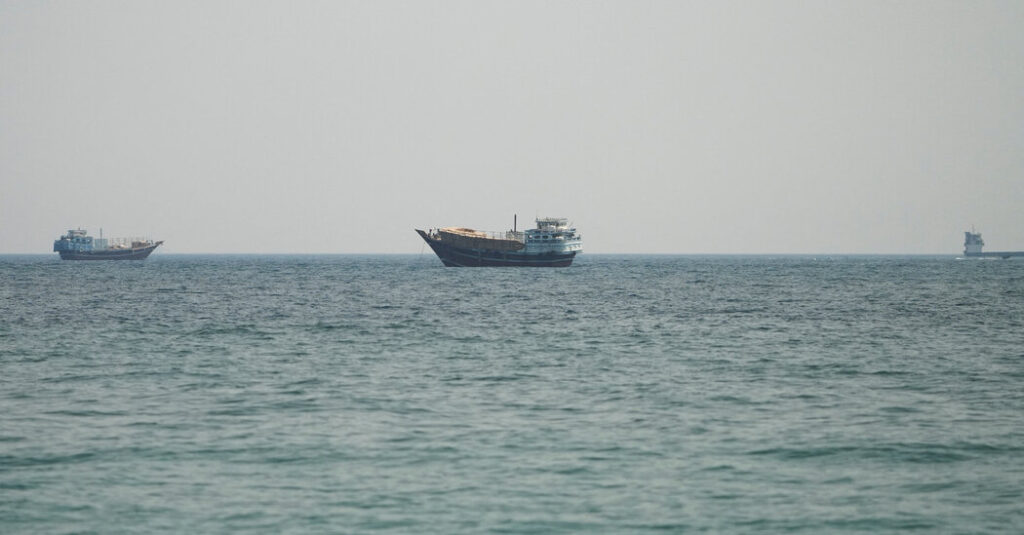
The continued cycle of attacks between Iran and the United States in the Persian Gulf posed fresh risks to ships seeking to navigate the Strait of Hormuz, testing markets on Sunday.
Brent crude, the international oil benchmark, rose 2 percent on Monday, to between $77 and $78 a barrel. That is 7 percent higher than its prewar price.
Daily ship traffic through the strait, which normally carries a fifth of the world’s oil, recently dropped to the lowest level in a month, with the latest data showing only 14 ships braving the passage on Sunday, according to Kpler, a maritime data firm. More than 130 vessels passed through daily before the war.
In the latest round of attacks, the U.S. military said it had hit about 140 targets in Iran over the weekend after Tehran attacked a container ship in the strait. Iran’s military said on Monday it had responded by firing at U.S. military targets in the region, including in Bahrain, Jordan and Kuwait.
Amena Bakr, head of Middle East research at Kpler, said any assurance that commercial vessels had gained with the ability to pass through the Strait of Hormuz over the past few weeks was gone.
“That confidence eroded very, very quickly,” Ms. Bakr said. “We’re back to square one when it comes to that situation.”
Although oil prices are far below the peak of nearly $120 a barrel during the worst of the war, the market shifts that follow each round of strikes have shown Iran’s capacity to move energy prices.
A recovery in shipping traffic after the United States and Iran signed a preliminary cease-fire agreement last month had led to a “sharp” increase in global oil supplies, the International Energy Agency said in a report released on Friday. Oil exports from the Persian Gulf jumped by 6.5 million barrels per day in June, to around 16 million barrels per day, helping to bring down prices.
Still, last month’s export pace was only about two-thirds of prewar levels. A more comprehensive recovery is “contingent on a swift de-escalation of renewed hostilities,” the I.E.A. said.
If ships become more wary of plying the strait after recent attacks, the talk among economists may turn from forecasts of an impending oil glut to worries about “demand destruction” as high energy prices squeeze businesses and consumers. The average price of a gallon of gasoline in the United States remains 30 percent higher than before the war. It was $3.87 a gallon on Monday, up from $3.80 a gallon a week earlier, according to the AAA motor club. Diesel was $4.88 a gallon, up from $4.76 a gallon.
Futures for the S&P 500 fell about 0.25 percent on Monday, signaling that U.S. stock markets were set to open lower at the start of trading in New York. Stocks in Asia, where countries import vast quantities of oil and gas from the Middle East, fell broadly. Stocks in Europe were also lower.
Worries about energy-induced inflation have pushed up yields on U.S. government bonds, with the yield on the 10-year Treasury hovering around 4.57 percent on Monday, about a tenth of a percent higher than a week ago — a big move in a short time for that market.
Ms. Bakr of Kpler said that oil markets appeared to have grown accustomed to volatility and on-again, off-again hostilities between the United States and Iran. She said oil prices were more likely to fall at any hint of renewed negotiations toward peace than they were to surge with new strikes.
“The market has adjusted to this new normal,” Ms. Bakr said, adding, “The movement of prices hasn’t really reflected the reality of the situation or the level of geopolitical risk.”
Iran insists that its waters are the only viable route through the Strait of Hormuz for commercial vessels. Ships instead taking a route close to Oman’s coastline, guided and protected by the U.S. military, have drawn Tehran’s wrath. The vessel attacked this weekend was in Omani waters, as were the ships hit last week, setting off the latest cycle of tit-for-tat retaliation.
The middle of the strait, where ships traveled before the war, is considered dangerous because of the risk of mines laid by Iran’s military.
The post Oil Prices Rise After Back-and-Forth Strikes by U.S. and Iran appeared first on New York Times.