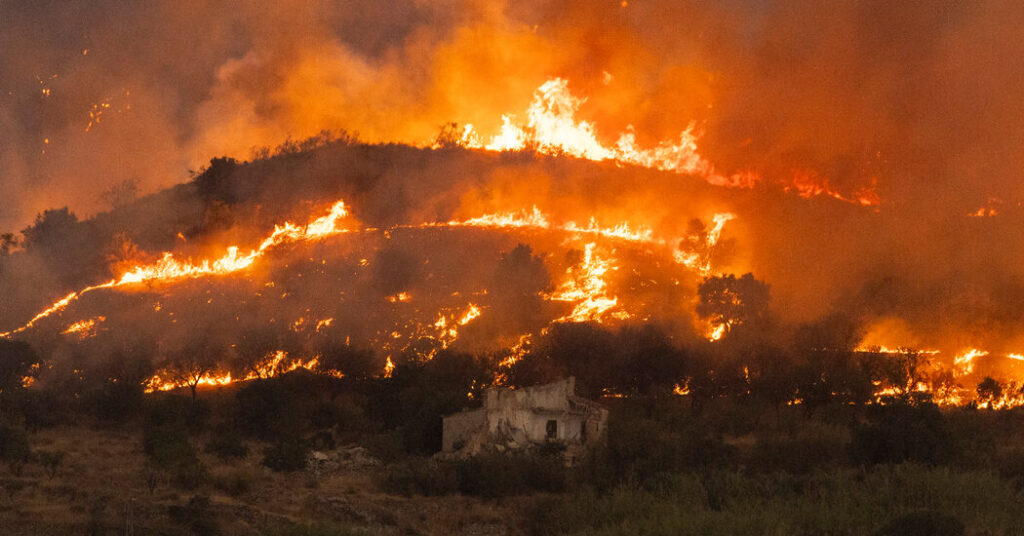
Lucinda Curtois was cooling off in the pool of her vacation home outside Bédar, a green oasis in the desert of southern Spain popular with British and Belgian expatriates, when a neighbor stopped by with news of flames on a distant hillside.
Ms. Curtois, 52, wasn’t alarmed. She had been coming from Britain to the area near the Mediterranean Sea for 17 years, and hadn’t received any kind of warning from the local authorities. When her father called from Britain, saying he had seen reports of a raging fire in the area, she told him there was nothing to worry about.
But soon after she had hung up the phone, she heard her teenage son shout that flames had reached a ridge near their villa. Suddenly seized with panic, Ms. Curtois, her husband and two teenage children ran to the car and drove down the hill to the sea. It was a mistake.
“We were just faced by a wall of fire,” Ms. Curtois said.
The family had never received the official recommendation to turn the other way. Although they eventually made it to safety, not all their neighbors were so lucky. The fires, driven by fast, dry winds and fed on esparto grass and low scrub dried out by weeks of scorching temperatures, killed at least 12 people in Bédar, which is in Almería Province. Another 23 people, mainly British and Belgian retirees, are unaccounted for as the wildfire has emerged as one of the deadliest on record in Spain.
Concerns are spreading across Europe about increasingly frequent heat waves and soaring temperatures making wildfires all the more common, and deadly. Blazes have already torn this summer through Greece, France, Portugal and now Spain.
And around Bédar, where the blackened and ashy hillside still smoldered this weekend, questions are being raised about how the disaster started, whether the deaths could have been averted and whether the residents’ verdant Spanish paradise had been consumed, as one local parish priest put it, by “the fires of hell.”
“We are experiencing wildfires in our country unlike anything we have seen before,” Félix Bolaños, Spain’s deputy prime minister, said on Saturday. “Climate change — the climate emergency — is evident. A wildfire like this advanced at 100 meters per minute. We have never seen such ferocity here.”
On Sunday, the president of Andalusia, Juanma Moreno, announced that the fire had finally been “stabilized” and he also authorized the return of 1,000 neighbors who had been initially evacuated from their homes.
Mr. Moreno blamed the blaze on a downed electric wire that fell Thursday afternoon into a roadside ditch, causing what he called a “small urban fire” that spread on strong winds nearly 10 miles in just two hours. But the electric companies have said the wires there were not live. The police continue to investigate other causes, according to local Spanish newspapers.
Mr. Moreno has said the deaths resulted from a failure to properly evacuate or shelter in place. “Unfortunately,” he said, “a number of residents did not heed these appeals. Their failure to follow those recommendations is likely what led to the tragic loss of life.”
But some locals said in interviews that, even as the church bells rang nonstop in Bédar, the communication was chaotic, and it wasn’t clear what they should have done. The town has 973 residents, of whom 570 are foreigners, most British retirees. Some of the foreigners said they turned to expatriate Facebook groups for information.
The Andalusian authorities did not send an alert to mobile phones through the official Spanish national emergency warning system because, they said, different areas required different instructions, and the system could not target the small, scattered communities precisely enough. Instead, mayors, police officers, Civil Guard agents and volunteers warned residents door to door or by telephone, loudspeakers and sirens.
Ms. Curtois and her family did not receive the official recommendation because Bédar’s lone policeman had not yet reached their house. When they encountered the fire on the first road they tried, they turned to the only other exit road and found themselves in a nightmarish traffic jam, with two buses and a motorcycle also trying to turn around amid licking flames and blinding dark smoke.
As her children screamed, she said, they finally managed to get through the traffic, but “a black mushroom cloud of smoke” loomed as the flames seemed to chase them, jumping over the freeway, burning everywhere they looked.
Among the dead in Bédar were seven victims who veered from a designated evacuation route and followed a farm track used to tend beehives. It was a dead-end that Antonio Sanz, the region’s health and emergencies minister, called a “trap.”
The authorities found the bodies of four other people in Bédar inside a charred vehicle. Mr. Sanz believed they were British, because the burned steering wheel was on the right-hand side.
Sophie V. Vandebroek, whose brother Stanislas Verdonckt, a Belgian national, is believed to have died in the fire, said in a message that her brother had been on the phone with his son while trying to escape Bédar. The son, Thomas-Wolf Verdonckt, wrote on social media that his father, who lived on a dead-end road, “attempted to follow” the official evacuation route “but was stopped by the flames and forced to turn back.”
His father and others, he wrote, “did not lead themselves into a trap; they were already trapped.”
As most of the 1,400 evacuees from Almería Province, many of whom had huddled in local recreation centers, slowly returned to their homes on Sunday, the families of the missing back in Britain and Belgium desperately awaited updates, and the results of autopsies and DNA tests. Some, including Mr. Verdonckt, traveled to offer their DNA.
In the towns around Bédar, survivors shuddered at a fire that climbed with deadly speed, as if the area’s steep slopes were the walls of a chimney.
Residents said they turned off their air conditioning to avoid inhaling the smoke. They shut the blinds and brought cushions and other flammable materials inside. Some older local residents stayed and drank in bars, or went near the highway to watch the fire turn the blue day dark and red.
Many talked of how fast the flames moved.
Scott Durling, 52, a Canadian banker who spends about a quarter of the year in his home in Bédar, said his family initially saw only a small plume of smoke while swimming at a friend’s house on Thursday. About an hour later, after dinner, his sons called him to the rooftop terrace, where they could see flames approaching the village. Still, he finished washing the dishes before going upstairs.
“As soon as I went upstairs and saw the flames, I came right back in and said, ‘Guys, we’ve got to go right now.’”
An avid hiker and mountain biker, he knew the local paths, and didn’t wait for any official evacuation order. “For us,” he said, “there was no communication.” His family reached safety in a neighboring town, Mojácar.
“I’ve never seen a wildfire like this in my life,” said Antonia García, 61, who works at a hotel in Alfaix, a village near Bédar, where the authorities on Friday ordered an evacuation. She said the gravest danger was not to the towns, but to the foreigners who had bought isolated houses in the hills.
Another local, Luisa Cintas Contreras, 55, who has lived in Bédar all her life, said the town had long lured foreigners with the promise of “having it all.” She said that while the first arrivals were hippies and artists, retirees soon followed, and started building houses outside the village, in isolated areas with gardens and almond groves.
“They liked the houses in the countryside, away from the village,” she said. “It is a bit of a paradise. There is a lot of water, it’s very good, and when it rains on that land, it holds the moisture.”
But the scorching temperatures of the past weeks had apparently dried Bédar out, experts said, turning it into kindling for a fire borne on whipping winds. And the narrow dirt roads to isolated properties were highly susceptible to the fires.
“Where were they supposed to go?” she said.
Koba Ryckewaert contributed reporting from Brussels.
The post Residents of Spanish Towns Caught in Fierce Blazes Recount Harrowing Escapes appeared first on New York Times.