Victor Menaldo is a professor of political science at the University of Washington.
Artificial intelligence can increasingly perform a white-collar employee’s tasks. What it cannot do is vouch for the result.
Yet a new slasher genre, the jobs apocalypse, threatens that AI will displace the regular nine-to-five and claims to be scarier than your grandfather’s zombie flick. Executive interviews menacingly forebode that AI is about to make a lot of high-paying jobs obsolete. Dario Amodei, chief executive of Anthropic, famously warned that AI could eliminate up to half of entry-level white-collar jobs within five years. Not to be outdone, executives at JPMorgan, Ford and Amazon (whose executive chairman, Jeff Bezos, owns The Washington Post) have forecasted leaner payrolls.
As with all good horror flicks, the fears fueling them are not baseless — Jaws, after all, drew on real-life shark attacks, and recent graduate unemployment has been running above 5 percent, against roughly 4 percent for all workers. Worse still, early-career workers in the most AI-exposed fields — software development, customer service — have seen a 16 percent relative decline in employment since generative AI arrived.
But the doomsday case rests on a flawed arithmetic: If AI can do 40 percent of a job’s tasks, then 40 percent of the work must go. But a job is not a to-do list of separable chores. Firms employ people for bundles of work held together by judgment, coordination, client trust and accountability. When a job’s tasks complement one another, automating the pieces does not reduce the job’s scope. It raises the value of the human work that remains.
When power looms automated much of weaving in the 19th century, they devastated many handloom weavers. But in the mechanized mills, the workers who learned to tend the new looms grew more valuable, not less. They still had to tie the weaver’s knot, swap a spent shuttle in seconds, adjust the warp tension so the threads wouldn’t snap and mind several looms at once. The workers who mastered these skills earned more even as the looms multiplied and cloth grew cheap.
For all its fluency, AI is not an all-knowing mind that does your job for you or better than you. It is a prediction engine that has digested a vast share of human writing.
That gives this machine astonishing reach — and several crippling gaps. It cannot tell you how biased its sources are, cannot show its work in a way you can audit, and can sound just as confident when it invents a citation as when it reports a fact. It is, in this sense, the near opposite of its closest ancestor, statistics, the tool that shows how much to trust a prediction. Statistics implies error bars; AI offers none.
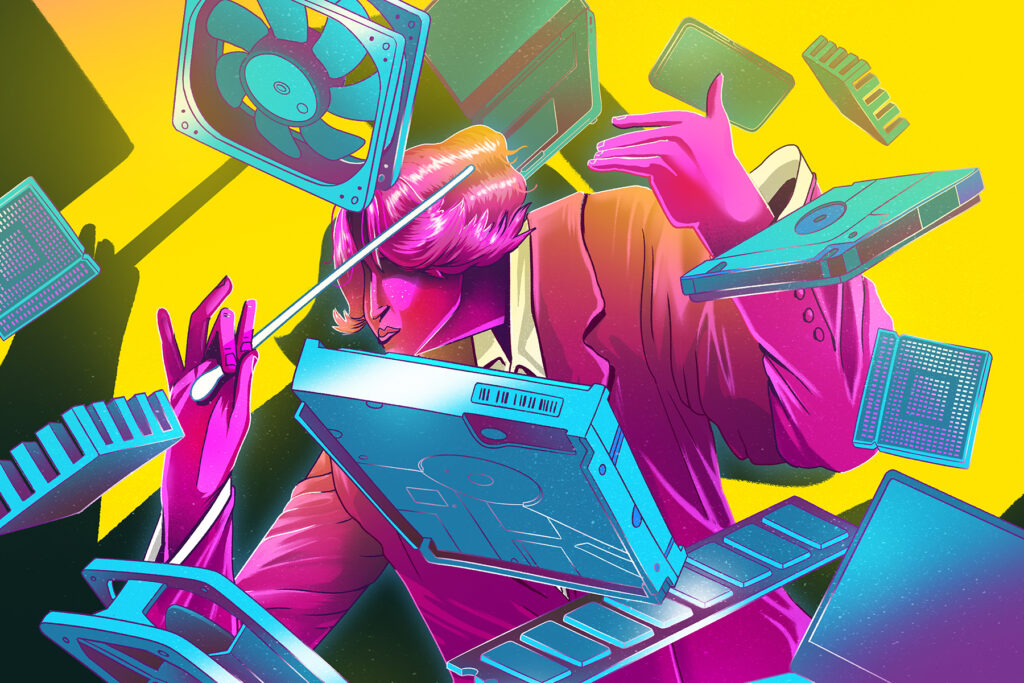
Because AI cannot flag its own margins of error, an organization that deploys it widely can find itself operating in a fog of uncertainty — and that is where the true economic bottleneck emerges. When plausible-sounding output becomes cheap and instant, the premium shifts to the judgment required to tell whether a flawlessly formatted answer to a chatbot query is a breakthrough, a dead end or a hallucination.
The editor who can tell a sound argument from filler, the physician who flags a prescription for an impossible dose, the lawyer who knows the cited case does not exist — in a world flooded with plausible, confident, frequently wrong machine output, the premium rises for each.
A firm that fires the worker who can figure out whether to trust the output is automating away its quality control. It will look efficient for a quarter or two, until a well-formatted falsehood makes its way into a decision that matters. Accountability does not transfer with the task: When a fabricated citation reaches a legal brief or a bad figure reaches an audit, the liability stays with the humans who signed off. A board cannot answer to a regulator with “the model said so.”
The error in the doomsday predictions is treating AI as a product that arrives and subtracts. Because AI is a general-purpose technology, like electricity or the computer — not a one-off device, like a toaster — the economy will be rebuilt around it. Electricity did not transform the factory merely by replacing steam power. Its payoff came when production was reorganized around the new technology — small electric motors driving individual machines; flexible layouts; and reliable and safe power that workers could deploy across the production process.
The same is happening with AI. Someone has to fold these models into workflows; connect them to existing systems; decide which judgments they may touch and review the ones they do; and retrain staff and clean up when they fail.
The transition won’t be painless. The entry-level squeeze is real, and firms that mistake automation for strategy will do real damage on the way to improving.
But the answer to a tool that is fluent, fast and frequently wrong is not to chase an AI-proof major or let the machine do the thinking. It is to become the person who knows when the machine has made an error, when it can be made better and when its output is worth putting your name on. In that, AI is like every powerful tool before it — the worker who can master it is worth more, not less. It has only raised the price of judgment.
The post The apocalypse that isn’t coming appeared first on Washington Post.