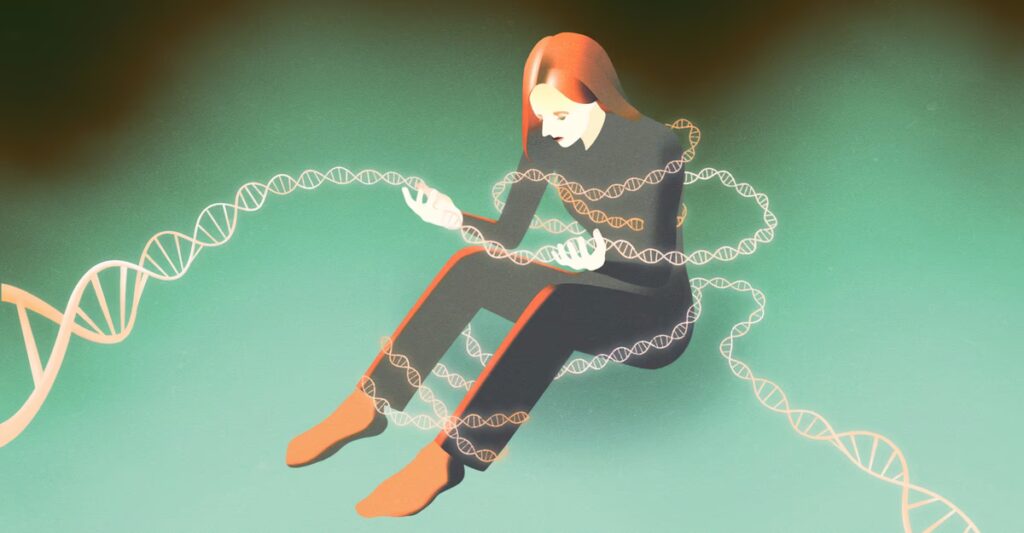
I was pregnant with my first baby when my grandmother died. The last time I saw her, she had moved into an assisted-living facility where all of her worldly possessions were condensed down to two small rooms. She had been condensed down, too, from the tall southern woman of my childhood memories into a pale and thin ghost of herself curled in an armchair. She was 80 years old and had been battling metastatic breast cancer for 15 years.
She must have known when she was diagnosed that the cancer would be what killed her, just as it had killed the other women in her family—her mother at age 58, her sister at 65. What she did not know when she touched my belly, just weeks before she died, was that my mother, standing nearby, had breast cancer too.
My mother told me that the only thing that got her through the grueling radiation treatments to eliminate her own cancer over the next several months was the thought of holding my baby. She pulled through and arrived at the hospital just in time for the delivery. I remember the way she peered over my shoulder at my bedside, gazing down at the face of the baby girl resting on my breast.
Three years later, I gave birth to a second daughter. Both of them have my husband’s wavy hair and my dark eyes. As my girls grew older, I began to wonder about what else they may have inherited from me.
Breast cancer is the most common cancer among women in the United States, and is the second most common cause of cancer-related death among American women, after lung cancer. Roughly one in eight women—or 13 percent—will be diagnosed with the disease in their lifetime, with risk rising as they age.
Sensing that breast cancer ran in certain families, the geneticist Mary-Claire King and a team of researchers at UC Berkeley spent 17 years hunting for a genetic marker for the disease. After analyzing interviews with thousands of women—half of them breast-cancer patients—her team developed a statistical model that supported her theory that risk was hereditary. In 1990, they identified a mutated gene linked to breast cancer, which they labeled BRCA-1. Scientists discovered a second breast-cancer gene five years later, which they called BRCA-2. More than 60 percent of women who carry these mutations will develop breast cancer in their lifetime.
[Read: The genes that could cancel out a fatal diagnosis]
Before this breakthrough, genetic testing had been the preserve of couples who hoped to identify any risk they bore for having a baby with a genetic disorder, such as Down syndrome, cystic fibrosis, congenital deafness, and Huntington’s disease. King’s discovery radically transformed the field of genetic counseling by introducing the prospect of predicting ailments in living adults.
The advent of genetic testing helped make breast cancer seem like something that could be predicted and therefore controlled: a known quantity rather than a spectral danger striking at random. In a 2013 New York Times essay, Angelina Jolie announced her decision to get a prophylactic double mastectomy after losing her mother to breast cancer and discovering that she carries the BRCA-1 gene. Demand for genetic screenings for breast cancer duly spiked.
I was thinking of Jolie’s essay earlier this year when my new primary-care doctor offered me a genetic screening. I said yes. Surely I owed it to myself and my daughters to take a proactive approach to a disease that had killed so many women in my family. Weeks later, I went to a women’s clinic at my local hospital for a simple blood draw. The genetic counselor told me that the results could take a few weeks, and that I would get a call if they found reasons for concern.
I was in the car about a month later when the clinic’s caller ID flashed on my phone. I picked up and immediately recognized the voice of the genetic counselor, who was kind, calm, and ready to have a conversation that I had not prepared for.
Her news was initially and unexpectedly encouraging: Despite my family’s history of breast cancer, I carry no mutations known to elevate my risk for the disease. Whatever predisposition is responsible for my family’s medical history, our genes would neither determine my own destiny, nor that of my daughters.
But there was something else. The analysis had also located a “variant of uncertain significance,” or VUS. The counselor gently explained that this meant the laboratory simply had not seen enough instances of this mutation to know whether it was a normal variation with no harmful consequences or something more concerning. The mutation, she said, was on a gene called WT-1, which is associated with a rare childhood kidney cancer. What, I asked, did this mean for my children? Should I take them to see a specialist? Set up regular screenings? Was there anything I could do with this information? The counselor patiently told me that the lab didn’t have enough information to dictate any particular course of action, or even to estimate the actual risk. The mutation might be meaningless, or it might be something much worse. It was just too soon to say.
The counselor was measured and reassuring, but this new revelation of a possibly looming cancer threat for my children settled like a thick sheet of ice over my mind. Genetic counselors are trained to help patients navigate difficult information, but no amount of training ensures that patients are ready and able to hear it. My eyes flashed to the rearview mirror, which reflected the faces of my sleeping children.
The expansion of genetic testing, though a success of modern medicine, nevertheless poses complex ethical questions for medical professionals. The ubiquity of genetic information has well outpaced scientific clarity about the implications, which means that a great deal of uncertainty typically surrounds these tests. Clinicians and patients confront seemingly worrisome omens of possible ailments, with little clarity about the actual odds of getting them or the chance of preventing them.
“It’s not gene equals disease,” Valerie Reyna, a professor and neuroscience researcher at Cornell University, explained to me. Although a specific gene may elevate the risk for a particular ailment, she noted that plenty of people will have the genetic mutation and not get sick, whereas others will get sick without the genetic mutation. “Those are very confusing ideas to people,” she said. The information itself can also be awkwardly—and hauntingly—vague, as in the case of my own test.
Some patients are able to use the results of genetic tests to proactively safeguard their health, perhaps by getting regularly screened for early signs of trouble or removing organs before cancer can grow, as in the case of a prophylactic mastectomy to prevent breast cancer. For others, evidence of an alarming mutation can trigger psychological distress, even despair.
“Genetic information is not psychologically neutral,” Matthew Lebowitz, a professor of medical psychology and psychiatry at Columbia University, told me. “People don’t just learn facts; they sometimes construct narratives about themselves based on genetic information.” He noted that some patients interpret a genetic predisposition to a particular condition as evidence that they are doomed or broken. People are “natural storytellers,” Lebowitz said. “We don’t necessarily experience genetic information as a spreadsheet of numbers and probabilities; we experience it as information about who we are.”
Some medical professionals argue that patients should be required to opt in to receive secondary or incidental findings from genetic tests. Others insist that it is irresponsible to deny patients potentially valuable information about what their genes might reveal. Benjamin Berkman, a bioethics researcher at the National Institutes of Health, told me he suspects that in some situations, giving patients a comprehensive report of every genetic finding might cause more harm than good, particularly in cases that suggest a higher risk for inheriting an untreatable disease, such as Huntington’s, a neurodegenerative disorder.
[Read: Your genes are simply not enough to explain how smart you are]
Berkman allows that sharing information about treatable conditions, such as mutations that raise the risk of certain cancers, may justify the stress and anxiety, because precautionary measures could save lives. Yet he has found that genetic results are sometimes too ambiguous to be of much use at all, leaving clinicians to reckon with information that they either don’t trust or don’t understand. Like some of the other health officials I spoke with, he suggested that telling patients about genetic variants “of uncertain significance”—such as the mutation in my own results—can be particularly problematic, because “it might create more anxiety than assurance.”
When I talked with my mother about my test results later that same day, we were both relieved that we had not passed on to my daughters any mutations known to cause breast cancer—even though we knew that our family history likely still raised their risk of developing the disease. I hesitated to tell her about the mutation associated with childhood kidney cancer; it had alarmed me, and I was ambivalent about alarming her too. But in the end I shared it with her because I was afraid.
That night, after I put the children to bed, I sat down to research the disease in a dark room lit by the glow of my laptop screen. I told myself that I would look only into prevention measures, but the results were daunting. Recommendations included subjecting the kids to abdominal ultrasounds every few months and regularly palpating their bellies in a way that would surely generate anxiety and discomfort for all of us. I researched early symptoms, concrete warning signs I could discreetly monitor, but there’s nothing discreet about checking your kids’ urine for blood. I found myself investigating treatments—chemotherapy and surgery—and, finally, survival rates, which were promising but cold comfort. After spending hours imagining worst-case scenarios, I went to bed, but I didn’t sleep much at all.
As researchers learn more about the meaning of various genetic mutations, they may be able to designate variants as either benign or pathogenic; most mutations may even turn out to be harmless. Until then, the field of genomics is discovering data faster than scientists can interpret them. Each day, I hope for the call that puts all of my worries about the health of my children to rest. In the meantime, I research fruitlessly, hoping for some certainty about what might lie ahead.
In the end, there are few certainties in nature and there is little sense in meditating on the unknown. Every spring, my children and I scatter wildflower seeds in our front-yard flower beds without tilling the soil or covering them over, then trust in regular sunshine and rain to nourish them. The birds steal some seeds, and the squirrels and chipmunks take others, but wildflowers are hardy by nature, content to be laid down by wind and raised up by chance. And each year by June, the blooms emerge in a dense thicket, crimson poppies and black-eyed Susans and woolly blue violets, which my daughters pluck and drop in drinking glasses all summer long.
One afternoon, I sat at my kitchen table once more researching my mysterious mutation and its associated disease while my girls snapped pictures of each flower in the yard using my phone’s plant-identification app, reading the results aloud one by one. I looked up from my screen when I heard them calling my name through the open window. They wanted me to come out and play.
The post You Can Know Too Much About Your Genes appeared first on The Atlantic.