Long before Agatha Christie popularized it in several books, poisoning was a favored means of dispatching enemies in past centuries. But unlike, say, the conspirators behind the “affair of the poisons” in Louis XIV’s court, Giulia Tofana just wanted to help.
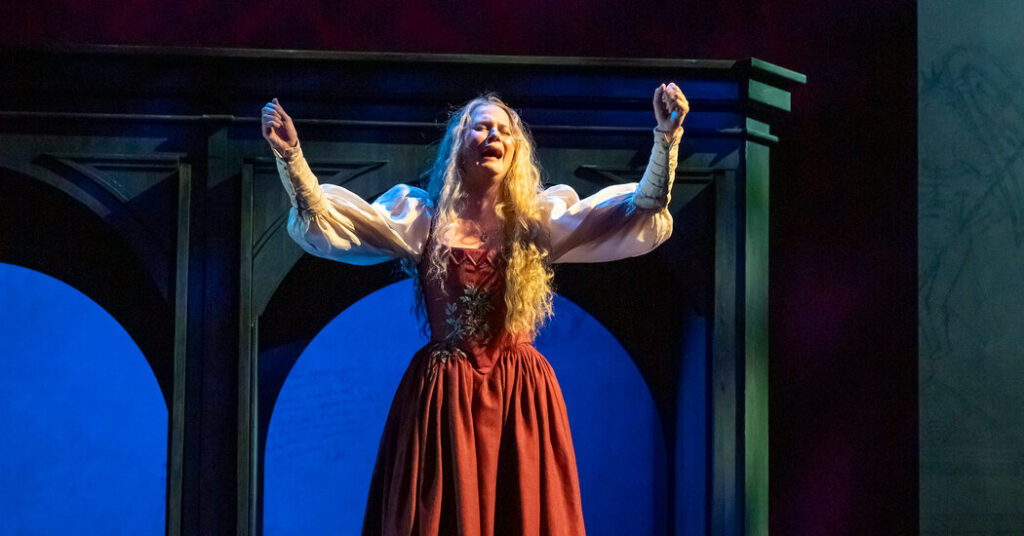
At least that’s the version put forth in “Giulia: The Poison Queen of Palermo,” the new musical written by and starring the country star Jennifer Nettles. “Have you ever done something wrong for all the right reasons?” Nettles’s Giulia sings, reflecting on the corpses in her wake. Sorry not sorry.
The real Tofana’s activities and motives tend to be attributed to a desire to support women hopelessly constrained and oppressed by a patriarchal society. In Nettles’s occasionally stirring, tonally muddled telling — which opened on Friday at the Perelman Performing Arts Center in a deluxe production directed by Mary Zimmerman (“Metamorphoses”) — Giulia is a brave champion of feminist sisterhood, delivering rote empowerment through musical numbers.
As its title indicates, the musical is set in Palermo (said to be “hotter than inferno”) in 1653. We are repeatedly told the city is suffering a water crisis, but that pales in comparison with the problems facing its female residents, who are treated by men like interchangeable possessions at best or are brutalized and vilified at worst.
With a society rigged against them, Giulia’s only option to protect herself, her daughter and the female clients she serves at her apothecary shop is murder. Her profession has made her knowledgeable about a wide variety of herbs and roots, which Giulia uses for oils, tinctures and potions. She can assist with issues ranging from rashes to unwanted pregnancies, but she has also concocted a poison to quickly dispatch the possessive, abusive men who appear to teem in Palermo, starting with her own husband, Carlo (Matthew Amira).
Carlo is a mere amateur chauvinist when compared with the show’s two major villains. Overseeing the spiritual realm, but not averse, it is implied, to the pleasures of the flesh, is the red-clad, impassive Cardinale (Quentin Earl Darrington). His ally in political matters is the Governatore (Christopher M. Ramirez), who is so cartoonish that were his mustache longer, he’d certainly twirl it while cackling about dastardly plans. That character is the most egregious embodiment of the show’s zigzagging modes. He’s a menace who’s hard to take seriously — even when he sets his predatory sights on Giulia’s young daughter, Vitoria (Naomi Serrano) — which downplays the dangers and indignities our heroine works so hard to either prevent or avenge.
Zimmerman’s production, though elegant, seems equally uncertain about how to dance to Nettles’s particular tarantella. (The unobtrusive choreography is by Austin McCormick, of Company XIV; Daniel Ostling’s scenic design makes smart use of a cabinet whose doors open to reveal changing settings; and Ana Kuzmanic’s costumes mostly stick to a sober period-ish mood.)
A member of the Grammy-winning band Sugarland and a successful solo artist, Nettles has musical theater experience, at least as a performer. She played Roxie Hart in “Chicago” on Broadway in 2015 (a show that brilliantly walks the tightrope Nettles is attempting here), and in 2021 she released an album of show tunes, “Always Like New,” and then returned to Broadway for a short stint in “Waitress.” Her performance in that production was wonderfully grounded, and she exhibits a similarly warm, inviting presence here.
Her generosity is most evident in the way that the show functions as an ensemble piece, even if the characters, including the title one, are thinly developed and too often seem to merely coexist on the stage rather than connecting to one another. The score spreads the goods, with enough big solos for everybody to step into the spotlight and earn some applause. (It’s a well-balanced cast, but the very funny Didi Romero deserves a special mention as the wealthy, spiky Duchessa.)
Nettles overly relies on cadences bound to remind audience members of “Hamilton” (and “Suffs,” to a lesser extent), but she has also written evocative, instantly impactful melodies, which are bolstered by the contributions of the music director and arranger Adam Rothenberg and the orchestrator Cian McCarthy, who make the score pop. Some of the music has a rollicking energy, and it often soars toward showstopping bravura.
Or at least it would if so many of the lyrics weren’t so distractingly bland.
While this is not a country musical, it’s hard not to wish that Nettles had used some of that genre’s writing tactics, especially lyrical specificity and impudent turns of phrase. You get that irreverent touch at times, as when Giulia sardonically sings “Let mama up the ante / I’m feeling vigilante,” whose dark humor integrates the spirits of both “Chicago” and such Nettles solo tunes as her 2016 song “Drunk in Heels” (written with Brandy Clark).
But too often “Giulia” leans on generic images that could fit any number of setting. Flying as a metaphor for breaking free, for example, is a grating, sappy cliché that’s shoehorned anywhere, from “Defying Gravity” in “Wicked” to “Flying Away” in “Real Women Have Curves.” And here we go again with “Fly Away,” an aria in which Nettles’s Giulia passionately, angrily pushes away shame and regrets, only to find refuge in the safe embrace of airborne imagery. I expected more from a poisoner, even an altruistic one.
Giulia: The Poison Queen of Palermo Through Aug. 2 at the Perelman Performing Arts Center, Manhattan; pacnyc.org. Running time: 2 hours 30 minutes.
The post ‘Giulia’ Review: Jennifer Nettles Delivers Empowerment (and Poison) appeared first on New York Times.