Last year, the Environmental Protection Agency was preparing to greenlight the first ever fish farm in federal waters, one that would supply a fish popular in Cajun and Creole restaurants. But the agency had a novel requirement.
It wanted to require the company, Ocean Era, to monitor the farm for microplastics, the tiny particles that have become a rising environmental and health concern.
However, some top E.P.A. officials balked. They said that mandating any company to track microplastics could set a cumbersome precedent for other industries, according to interviews and documents examined by The New York Times. So the agency ordered the requirement struck from the permit, and when an E.P.A. official filed a memo laying out his objections to that, the agency fired him.
The Trump administration, as part of its “Make America Healthy Again” agenda, has vowed to tackle microplastics pollution, which can get into the bloodstream and affect the immune system, disrupt hormone regulation and cause chronic inflammation. But the firing of an E.P.A. official over the fish farm permit highlights a collision between the administration’s health pledges and its efforts to lessen regulatory burdens on industries.
The fired employee, Kip Tyler, who was an environmental engineer at E.P.A., has filed an appeal with the Merit Systems Protection Board, which protects federal workers from unfair firings. He alleges harassment and discrimination and says that his managers’ orders to remove the microplastics monitoring requirement were “unscientific, politically motivated, unethical, an abuse of authority.”
Mr. Tyler also alleges that the E.P.A. fired him by falsely claiming that he had intentionally tried to embarrass the agency with his memo. Mr. Tyler said in his appeal that the agency had made his memo public, but then tried to blame him for doing so.
It would be “highly inappropriate for agencies to suppress any scientific gathering data in order to protect industries from regulation,” said Richard W. Painter, a professor of law at the University of Minnesota Law School who served as President George W. Bush’s chief ethics lawyer from 2005 to 2007. If Mr. Tyler’s claims held true, he said, it would be “a very troubling development, not just in terms of the politicization of science, which is very dangerous, but also for the protection of the civil service.”
This month the E.P.A. issued an updated permit for the fish farm without a microplastics monitoring requirement. Environmental groups had challenged the permit, saying it would degrade the marine environment. To bolster their argument, they cited Mr. Tyler’s memo.
Brigit Hirsch, the E.P.A. press secretary, said the agency was “upholding the best scientific standards” and called Mr. Tyler’s claims otherwise “unfounded.” She said the agency “continues to combat microplastics contamination with historic action to ensure safe water for every American.”
Lobby groups in the chemical industry have long opposed regulating microplastics.
Kimberly Wise White, vice president of regulatory and scientific affairs at the American Chemistry Council, said in a statement that microplastics differed fundamentally from other contaminants because they varied in size, shape and other characteristics, making the tiny debris more difficult to identify and quantify. That made trying to include microplastics in permitting requirements premature, she said.
Microplastics, which are typically produced from wear and tear on larger plastic items, have been found in the snowy peaks of the Antarctic, the depths of the Mariana Trench and in the bloodstreams of human and animals.
While scientists are just starting to explore the health effects of microplastics in humans, animal research suggests they can harm reproduction and may increase the risk for lung and colon cancer. The fishing industry is thought to be a major source.
Microplastics aren’t regulated or well tracked. “There’s limited data, particularly from real world cases” like a fish farm, said Aron Stubbins, a professor in marine and environmental sciences at Northeastern University in Boston who studies the global distribution of microplastics in the ocean.
In April, the E.P.A. and the Department of Health and Human Services said they were joining forces to curb levels of microplastics, along with pharmaceuticals, in the environment. The E.P.A. proposed adding microplastics and pharmaceuticals to a list of priority pollutants, a move that would unlock more federal research into the prevalence of plastic debris, how it harms human health and how it can be cleaned up.
The federal government would “act on the evidence regarding microplastics,” Robert F. Kennedy, Jr., the Health Secretary, said in announcing the effort. “We’re not going to speculate, we’re going to measure.”
The E.P.A.’s handling of the fish farm permit followed a different path.
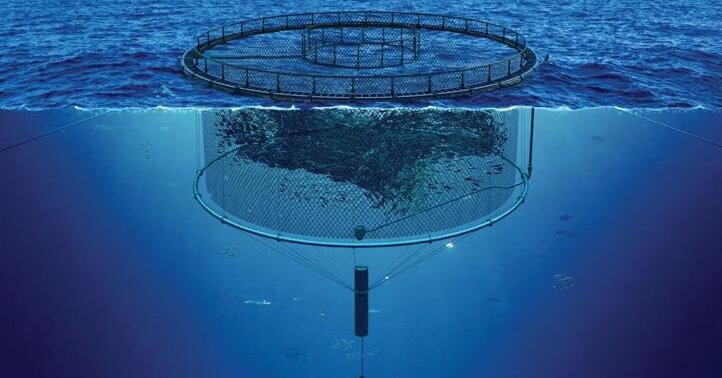
Ocean Era, a marine aquaculture firm based in Hawaii, initially planned to farm fish destined for sushi restaurants at the site, located in federal waters about 45 miles off the coast of Sarasota, Fla. (It later switched to red drum, a large, reddish fish used in Cajun and Creole dishes.) The farm, called Velella Epsilon, is a pilot project aiming to show that aquaculture can have minimal environmental effects even in the deeper waters of the Gulf. Fish farms in the United States are in shallower waters closer to the coast.
The project’s planned use of plastic mesh pens drew the attention of Mr. Tyler, the E.P.A. official. He had become aware of research on the effects microplastics could have on fish farms so he sought to require Ocean Era to monitor for microplastics coming off the nets.
The company readily agreed. Ocean Era’s chief executive, Neil Anthony Sims, said in an affidavit that he had “nothing but the highest praise” for Mr. Tyler’s work.
Mr. Tyler’s superiors ordered that the requirement be removed. One of them, Craig Hesterlee, the Surface Water Protection Branch Chief, said he “did not want this permit to be the first permit in the country to impose a microplastics monitoring requirement,” according to a separate affidavit prepared by an E.P.A. attorney.
In response to the decision to remove the requirement, Mr. Tyler filed what is known as a differing scientific opinion memo, citing scientific literature to support microplastics monitoring. He then placed the memo in what is known as the administrative record, which contains documents related to the permit at hand.
That got Mr. Tyler in trouble.
When environmental groups challenged the permit, the administrative record was released — including Mr. Tyler’s memo. The E.P.A. accused Mr. Tyler of trying to embarrass the agency by giving his memo a deceptive title and backdating it to elude checks by agency lawyers, according to E.P.A. disciplinary memos.
In an interview, Mr. Tyler said he did no such thing. “We’re supposed to be using science and making science-based decisions,” Mr. Tyler said. He said he wrote the memo and circulated it to agency attorneys whose job it is to be aware of documents that potentially shouldn’t be made public in a lawsuit.
He is trying to get his job back. The Public Employees for Environmental Responsibility, a legal group that works with government environmental whistle-blowers that is representing Mr. Tyler, argues that his removal is illegal retaliation.
Francesca Grifo, who until 2025 was the E.P.A.’s scientific integrity chief, said Mr. Tyler had simply tried to do the right thing as an agency scientist. She herself had advised Mr. Tyler to put his differing scientific opinion in writing and to share it with his managers.
“He was worried about human health and the environment, and he was worried about making sure the science was complete,” Ms. Grifo said in an interview.
In an email, Mr. Sims, the Ocean Era chief executive, said that the company remained willing to agree to any monitoring the E.P.A. required. He was confident, he said, that the project would have “zero impact on the levels of plastic in the ocean.”
The post He Wanted to Track Microplastics in the Sea. The E.P.A. Fired Him. appeared first on New York Times.