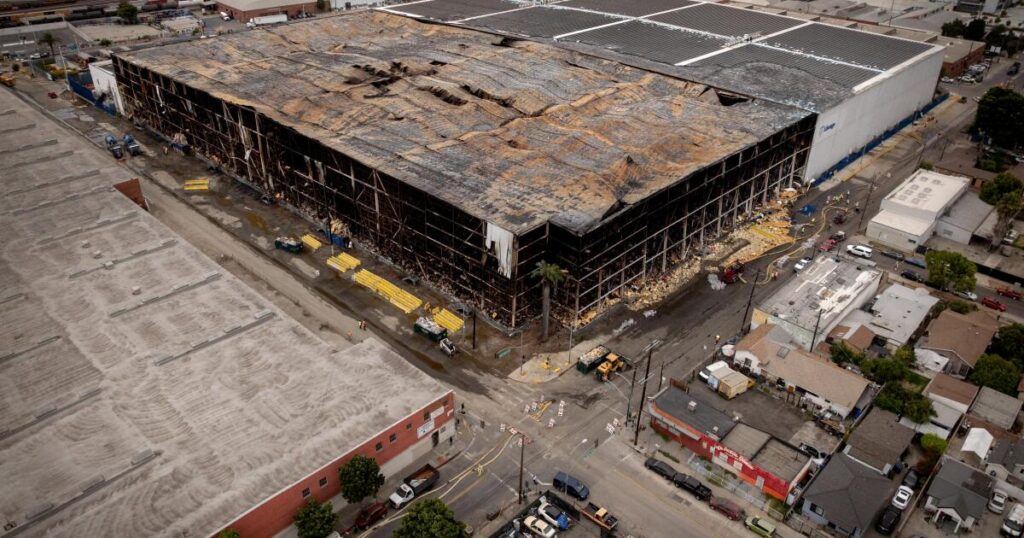
A year before a massive fire at a Boyle Heights cold storage building sent polluted smoke into surrounding communities, the operator of the facility came to Los Angeles City Hall with a request.
Lineage asked about removing an emergency shutdown switch from the solar panels on the roof of the structure, according to the Los Angeles Department of Building and Safety.
A spokesperson for Lineage said that the company was inquiring about what it described as a safer alternative to rapid shutdown devices. Though intended to protect firefighters from shock, some shutdown devices have also been linked to increased fire risk.
Ultimately, the company did not receive any variances or exemptions as a result of its efforts, the spokesperson said.
Neither Lineage nor the city would provide any details about what kind of shutdown system was in place at the time of the fire. Altus Power, which owns the solar panels, declined to specify, citing the ongoing investigation into the fire.
But the solar panels have become a focus of the fire. According to Lineage, company officials believe the fire began while third-party subcontractors were testing the rooftop solar array at the nearly 500,000 square-foot warehouse.
The Los Angeles Fire Department has not announced a cause for the blaze.
The state code requires that rooftop solar arrays have rapid shutdown systems that quickly reduce the voltage to a level that makes it safe for first-responders to access a roof in an emergency.
The systems are typically activated by a switch, which communicates with rapid shutdown devices to reduce the voltage to the panels, said Ryan Mayfield, chief engineer and founder of Mayfield Renewables, which specializes in solar energy.
While rapid shutdown devices are intended to protect firefighters, a recent white paper raised concerns that they may actually increase the risk of fires starting. The report by technical advisory firm HelioVolta found the devices were the most likely cause of 71% of fires and thermal damage events it had identified in rooftop solar systems. The technology typically involves installing devices underneath each solar panel, and each device and its connections pose a risk of failure, which could spark a fire, the report found.
The solution to reducing the fire risk is to use a different kind of technology, called micro inverters, which convert the electricity to the same form that powers homes, said Capt. Richard Birt, who retired from Las Vegas Fire and Rescue and now trains firefighters on how to deal with solar panels.
Lineage’s request to the city came after an earlier fire that started among the rooftop solar panels in 2024. The Los Angeles Fire Department declined to disclose the cause of the fire and said records requested by The Times on the matter were part of an open investigation of the property and could not be immediately released.
The building’s solar array had a shutdown switch that firefighters flipped when the most recent blaze began, according to the fire department. Still, officials said the panels remained energized for several days and cited the array as one of several challenges they faced while attempting to bring the fire under control.
Lineage, which leases the space, has said repeatedly that it does not own, operate or maintain the solar panels. Nevertheless, the company relied on its lobbying firm, Veritas Public Affairs, to communicate with several city agencies about those panels, records submitted to the city’s Ethics Commission show.
Chris Thurston, Lineage’s vice president of energy and sustainability, and Tracey Chavira, a lobbyist with Veritas, contacted the city’s Department of Building and Safety in July 2025 to “verbally inquire” whether the array’s rapid shutdown switch could be removed, according to Devin Myrick, the agency’s director of government and community relations. A Building and Safety manager told them the switch is required by the California Electrical Code and cannot be removed or omitted, Myrick said.
When asked about the lobbying effort, Chavira referred questions to M Strategic Communications, a lobbying firm retained by Lineage two days after the fire to provide crisis communications and other services. Shannon Murphy, the firm’s co-founder and a former communications representative for Mayor Karen Bass when she was in the State Assembly 16 years ago, did not answer specific questions about the lobbying. She provided a statement on behalf of Lineage saying that Altus Power owns the solar array and is solely responsible for its operation and maintenance.
“After the Altus Power solar array at the Los Palos warehouse caught fire in 2024, we communicated with city agencies about the safety of the solar array,” the statement said. “This did not result in any code variances or exemptions being granted.”
“Lineage was asking the city to see if a safer alternative to [rapid shutdown devices] was possible,” a representative added in a follow-up statement.
According to disclosure forms filed with the Ethics Commission, Lineage also retained Chavira to lobby LAFD and the Department of Water and Power on the rapid shutdown issue, described as a “remedy relative to a rapid shutoff device alternative.” The company paid Veritas $45,000 for lobbying all three city departments between April 1, 2025 and Dec. 31, 2025, the forms state.
DWP spokesperson Ellen Cheng said her agency has no authority over requirements for rapid shutdown devices. Cheng said that Lineage “had expressed interest in extending their agreement with LADWP” to continue selling power from the solar array through the Feed-in Tariff Program, which enables commercial property owners to sell renewable energy to the DWP, but no deal was made. The agency hasn’t purchased electricity from the solar array since 2024, another spokesperson said.
Lineage didn’t provide details about the discussions with the DWP.
It’s unclear to what extent the solar array hampered firefighting efforts. Crews were able to reach the warehouse’s roof during their initial response but were forced to retreat when an ammonia line was compromised and a large stream of the chemical shot out, Los Angeles Fire Chief Jaime Moore told reporters. The roof later became structurally unsafe so firefighters used helicopters and water cannons to dousethe flames.
But fire officials also pointed to the energy flowing through the solar panels as a complicating factor.
Los Angeles Fire Capt. Anthony Tubbs said that firefighters shut off a switch to the solar panels the day the fire ignited, but that the panels kept drawing energy from the sun and posing an electrocution risk for several days. The DWP then came in to disconnect the system on the customer side of the meter, spokesperson Riana Basuel wrote in an email. “Usually this would be done by the customer, but in this case LAFD requested our assistance and we dispatched crews who handled it,” she wrote.
While it’s true that a solar panel will produce voltage whenever it’s exposed to sunlight, rapid shutdown devices are meant to ensure there’s no current flowing in the wires that would shock firefighters, said Mayfield, the solar engineer.
He said that he couldn’t speak to the specifics of the array. But if the rapid shutdown switch sent the proper signal to the rapid shutdown devices, the voltage of the solar panels would have been reduced and the panels would not have continued to pose a hazard, he said.
“The whole purpose of rapid shutdown in the code is to reduce that voltage to what’s deemed a safe level so firefighters won‘t get shocked or electrocuted,” he said.
Fire officials have begun working with the DWP to give firefighters more training on their handling of large-scale solar arrays and ensure they are “well informed on the various ways to shut off power,” Moore said Tuesday during a fire commission meeting.
Times staff writer David Zahniser contributed to this report
The post Safety concerns over solar panels were raised a year before massive Boyle Heights fire appeared first on Los Angeles Times.