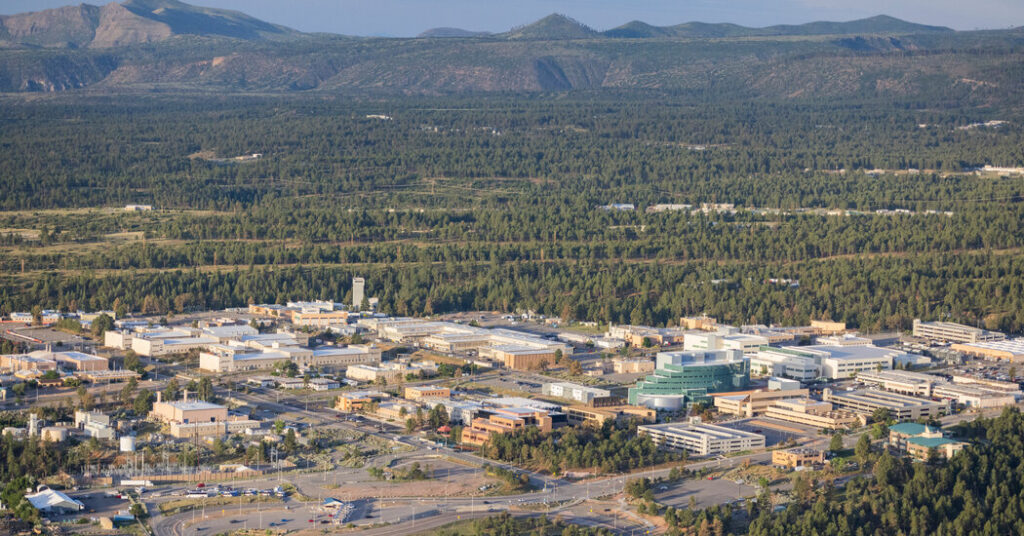
The Energy Department has underestimated the potential deadly consequences should plutonium escape the Los Alamos National Laboratory in New Mexico, which produces bomb cores for America’s nuclear weapons, a study published today by independent scientists found.
The chances of a leak are considered minuscule. But one is possible, especially following a natural disaster like an earthquake. Plutonium could escape from protective work stations inside a building called Plutonium Facility 4, or PF-4, and ignite. Then, if one or more of the building’s safety systems fail, radioactive plutonium particles could enter the outside air and spread through the surrounding communities in a plume of smoke.
The Energy Department, which manages the country’s nuclear weapons production, had previously concluded that a so-called loss of containment at the lab could spread about one kilogram of plutonium, a radioactive metal, leading to nine cancer deaths on average in the surrounding area. But modeling in the new study, published in Science and Global Security, showed the potential for much worse: Hundreds of people who inhale or ingest particles from a leak could eventually die from cancer, the researchers said.
And in the most serious possibility modeled in the study — if more than one kilogram of plutonium escaped — the town of Los Alamos could become unlivable and radioactive particles could spread across state lines. As many as 3,200 people could eventually get cancer, the researchers estimated, leading to about 1,000 deaths. The remediation of land could run up to an estimated $150 billion.
“In the worst case, it would be devastating for Los Alamos and New Mexico,” said Sébastien Philippe, an assistant professor of nuclear engineering and engineering physics at the University of Wisconsin-Madison, who led the study. “We find that it could be 10 to 100 times worse” than the government’s estimates, he added.
The peer-reviewed study is the first to independently evaluate the department’s assessment of a potential leak. The journal Science and Global Security is affiliated with Princeton University, where Dr. Philippe is also a visiting researcher. The study was funded by the Andrew Carnegie Foundation and the Ploughshares Fund, both of which underwrite arms control and nonproliferation research.
The study arrives amid a threat of a global nuclear arms race. China, North Korea and Russia are upgrading or expanding their arsenals. And Iran, at war with the United States and Israel, has a stockpile of enriched uranium. The United States is ramping up its own bomb core production at Los Alamos, where the country’s only active plutonium-handling facility is running round-the-clock operations as part of a $1.7 trillion effort to modernize the nation’s weapons.
The country already has thousands of bomb cores — each about the size of a grapefruit — made during the Cold War, but the new ones are intended to arm next-generation land-based missiles and submarines. Just one would produce a blast far more powerful than the one at Hiroshima. And while Congress required the production of at least 30 bomb cores per year by 2030, Los Alamos could be called upon to produce up to 80 per year.
The lab sits on a fault system, and the federal government has identified the most consequential risk to be an earthquake that knocks over one of PF-4’s thousands of glove boxes, oxygen-free enclosures where workers handle radioactive materials.
Plutonium particles pose little harm if they are not inhaled, similar to radiation from an X-ray. But when inhaled or ingested, those particles can cause damage over years or decades, even altering DNA. Children are the most vulnerable because their cells are still forming.
In a statement, a spokesperson for the National Nuclear Security Administration, an agency within the Energy Department, wrote that PF-4 “has robust safety programs and systems in place to ensure multiple and redundant layers of protection for our workers, the environment and the public.” The statement continued: “The facility is one of the safest places in the country to be in the event of a natural disaster.”
In 2008, the department publicly released a loss-of-containment scenario written by a government contractor. It concluded that if all of the plutonium estimated to be in the handling facility were engulfed in flames, just over one kilogram would escape outside in a form that could be inhaled, and an average of nine people would eventually die of cancer related to exposure.
For the new study, the researchers reverse-engineered the government’s methodology, and replicated a similar fatality average. But then, they recalculated the risks of a leak with additional context and under different assumptions.
Using wind and precipitation data from every hour of every day of 2022, the researchers modeled 8,760 scenarios of a plutonium leak, tracing the possible trajectory of particles. In some circumstances, the data shows that particles would have traveled as far north as Central Colorado and as far south as Southern New Mexico.
Thomas B. Cochran, a former senior scientist at the Natural Resources Defense Council and former adviser to the Energy Department, who was not involved in the study, said the research seemed to offer a “thorough analysis of the issue.”
And the scientists chose the best modeling software for the analysis, said Steven Hanna, an expert in meteorology and atmospheric physics who was also not involved with the study. But, he added, they did not account for statistical uncertainty as exhaustively as is possible.
For estimates in its own assessment, the government had used an Energy Department handbook that relied on data from the 1960s through the 1980s, information that predated findings about other containment breaches, the study said.
For example, from 1951 to 1989, hundreds of fires occurred at the Rocky Flats Plant, a federal nuclear facility near Denver that produced bomb cores during the Cold War. A major fire there in 1957 released a large amount of plutonium particles, according to research published after the plant shuttered in the 1990s.
Soil analysis from Rocky Flats show that the size of those particles were roughly one-fifth the size of the particles considered in the government’s analysis. Smaller particles can disperse farther, the researchers said, increasing the area contaminated and the number of people exposed. They can also remain in the lungs longer, increasing the risk of cell damage.
In one scenario modeled by the researchers, approximating a lab breach on an October night in 2022, shifting wind patterns could have moved smaller particles across several towns, tribal reservations, Santa Fe and parts of Albuquerque. Up to 210 people could have eventually died from cancer, they estimated.
Things get even more dire should more plutonium escape. Using other data from Rocky Flats, the researchers determined that just over five kilograms of plutonium — quadruple government estimates — could escape Los Alamos. On that October night, as many as 3,200 people could have developed cancer, leading to about 1,000 deaths, not including lab workers or emergency medical workers, the study said.
The researchers also examined the Savannah River Site in Aiken, S.C., which is expected to begin plutonium-pit production in the mid 2030s. The Energy Department estimated in 2020 that a breach there would lead to an average of two long-term cancer fatalities. But the scientists identified a night in May 2022 when wind could have carried the particles northwest beyond a buffer zone and into Georgia, possibly leading to as many as 330 cancer-related deaths.
The plutonium-handling facility was built almost 50 years ago for nuclear research, not production. Now, it is replacing aging infrastructure that has disrupted work at times and spread contamination, a New York Times investigation found last year.
The lab performs its own internal safety analysis, which is not made public. Workers are installing a new fire suppression system, which Rocky Flats didn’t have. And some, but not all, of the glove boxes at Los Alamos have been made earthquake resistant as part of the renovation.
But one component will not be fully replaced: the ventilation system.
For decades, the Defense Nuclear Facilities Safety Board, a federal watchdog, has recommended the facility upgrade the system so that, in the case of a catastrophe, it could capture tiny plutonium particles before they leak into the environment.
In 2022, the Energy Department said the upgrade was too expensive.
Map Methodology
There is no agreed upon standard for acceptable radiation levels. The above map uses the following thresholds, measured in becquerel (a unit of radioactivity) per square mile.
Hazardous (18,500 and above): This is the cleanup level set by federal authorities after a fire at Rocky Flats Plant in 1957.
Moderate (1,000 to 18,499): Scientific analysis recommends land is not released for public use above 1,000.
Low (370 to 999): Colorado will not allow new construction above 370. It is the only state to set such a limit.
The post U.S. Underestimates Peril if Los Alamos Were to Leak Plutonium, Study Says appeared first on New York Times.