In the San Fernando Valley’s tight-knit Vietnamese community, Thien “Kim” Nguyen was known as a successful entrepreneur.
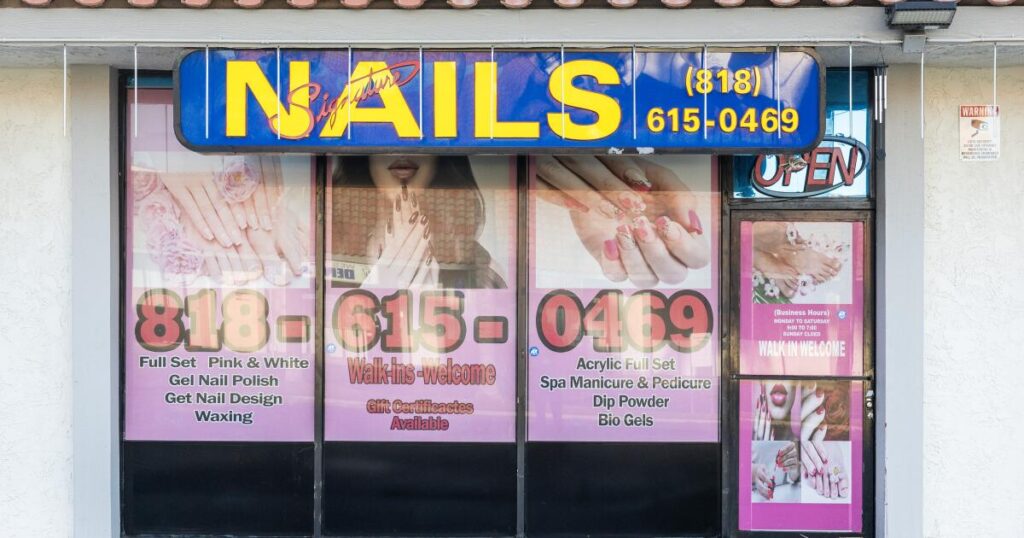
She ran a nail salon in Canoga Park and spoke of dabbling in lucrative sidelines — a car dealership, an import-export business, real estate investments, according to Hua Ma, a San Fernando Valley resident who went into business with Nguyen.
So when Nguyen asked Hua Ma to invest in her nail salon, he agreed.
Ma was enticed by a promise of quick returns and encouraged by what seemed like trappings of success, he said in an interview: Nguyen wore Chanel sunglasses, dressed in designer clothes and drove a Tesla. But what clinched the deal, he said, was the fact he’d known Nguyen’s husband and his extended family for years.
“In our culture, you want to know someone, know their family,” Ma said.
Ma brought a bundle of $100 bills to Nguyen’s home in Winnetka, where he took pictures of Nguyen and her husband counting the cash at their dining table, according to Ma and photographs reviewed by The Times. Between multiple instances, Ma lent the couple $105,000 in all, a Los Angeles Police Department detective wrote in an affidavit supporting charges against Nguyen and her husband, Phuc Huynh.
But after receiving three payments totaling $4,900, Ma tried cashing a check from Nguyen, the detective wrote. It bounced. When Ma asked for his money back, Nguyen told him there wasn’t any, according to the affidavit. Her businesses were underwater. She had no money to pay him.
According to investigators from the LAPD and the California attorney general’s office, Ma was one of a dozen people who gave $1.4 million to Nguyen and her husband, Phuc Huynh. Most of the money was never repaid, investigators allege. The couple are accused of operating a scheme that targeted fellow Vietnamese immigrants. Authorities claim they engaged in a scheme to exploit networks of trust within ethnic or religious communities.
Nguyen and Huynh have pleaded not guilty to 12 counts of grand theft. They didn’t return a request for comment left at their home, and their lawyer didn’t respond to a phone message seeking comment.
The allegations against Nguyen and Huynh, who were charged in November and remain out on bail, have left many of Ma’s friends and relatives rethinking the lending practices that have powered many immigrant-owned businesses.
“The whole valley is shocked,” he said.
Immigrants often turn to each other for financing, either because they’re locked out of the traditional banking system or because they’re more comfortable borrowing and lending within their own community.
Loan pools like the Chinese hui, the Japanese tanomoshi and the Korean kye involve groups of investors who pay into a kitty that is then doled out on a rotating basis. Without anything more binding than a handshake, these loan pools rely on community ties to ensure debts are repaid.
Ma was not part of a loan pool, but he described a similar approach to doing business that was based on trust. He recalled when he was 15, growing up in the Vietnamese city of Ca Mau, he overheard his father’s friend ask for a loan to buy a car.
“They went the next day and got the car. There was no contract, no paper,” Ma said. “We don’t go to the bank.”
After fleeing Vietnam on a boat in 1979, Ma lived for a year on Bidong Island off Malaysia before a Beverly Hills attorney sponsored him and 41 others to immigrate to the United States, he said. The lawyer rented Ma an apartment in Van Nuys, and he has called the San Fernando Valley home ever since.
While smaller than its counterparts in Orange County or the San Gabriel Valley, the San Fernando Valley has a strong Vietnamese community with churches, temples, civic organizations and even a small magazine, Ma said.
Ma said he met Nguyen and Huynh at a friend’s party around 2010. Twelve years later, Nguyen asked him to invest in her nail salon, he said. They met at a lawyer’s office in Van Nuys and drew up a contract that said Ma’s $40,000 investment would entitle him to 75% of the business, according to a copy of the document filed in court. Nguyen and Huynh agreed to repay the amount in three years, along with $800 a month in interest.
To Ma, who had worked at an electronics company and invested in real estate, it sounded like a guaranteed way to make his cash grow. He ended up loaning $105,000 in all to the couple, according to the LAPD detective’s affidavit. The interest rates were high. One $10,000 loan, memorialized in a note scribbled in Vietnamese, called for $100 a day in interest.
After the repayment check bounced, and Ma demanded his money back, he told The Times, he got a call from an unknown man. “Stop bothering Kim, OK?” the man said, according to Ma. If he didn’t back off, the man warned, “you’ll have trouble.”
Others had bought a piece of the same salon. According to lawsuits filed in New York City, Nguyen took out loans from three financial firms who gave her a combined $65,000 in cash. In exchange, she promised to pay them $1,895 a day from her salon’s sales. The lenders sued, alleging she didn’t repay the money, and obtained default judgments against Nguyen.
Fliers began to appear outside Vietnamese restaurants and shops in the San Fernando Valley, Ma said. They showed a photograph of Nguyen in a red dress and a pearl necklace. “Everyone should be warned,” it read, according to a photograph reviewed by The Times. “In the valley there is currently a woman named Thiên kim Nguyen she is telling stories and lying [to] borrow a lot of money.”
Ma said he went to the LAPD’s Van Nuys police station three times to report Nguyen. “They kicked me out. They said, ‘This is a civil case.’”
The fourth time, Ma was put in contact with Kimberly Santander, a detective assigned to the LAPD’s Commercial Crimes Division. Santander wrote in her affidavit supporting charges against the couple that she investigated Ma’s claims and learned 11 others had accused Nguyen of a similar grift.
In the affidavit, Santander laid out the story of a 60-year-old nail technician who’d saved for years toward a dream of opening her own salon. The woman gave Nguyen $253,000, a mix of what she thought were investments in a salon and personal loans, Santander wrote. Nguyen repaid only $240, according to the affidavit. The woman told Santander she was depressed and did not know how she could stop working after losing her life savings.
Another alleged victim lent $320,000 to Nguyen, who promised to repay the money with rates of 4 to 6% interest, Santander wrote. The lender trusted Nguyen because his cousin had once been married to Nguyen in Vietnam. Nguyen repaid only $24,000, according to the affidavit.
Santander wrote that Nguyen and Huynh have spent at least some of the funds on “clothing, food and other personal expenses.” Ma, who obtained a $173,000 default judgment in civil court that Nguyen has yet to pay, suspects she has sent money to Vietnam that is beyond the reach of U.S. authorities.
Even if he gets his money back, Ma said the trust that had existed among the San Fernando Valley’s Vietnamese community has been broken by the scandal.
“I’ve lived here since 1980,” Ma said. “I’ve never seen it.”
The post Nail salon owner charged with scheme that bilked fellow Vietnamese immigrants appeared first on Los Angeles Times.