There are moments when history reaches across the centuries with startling clarity. Standing in the Palazzo Pubblico in Siena, Italy, and looking at Ambrogio Lorenzetti’s “Allegory of Good and Bad Government,” I had one of those moments.
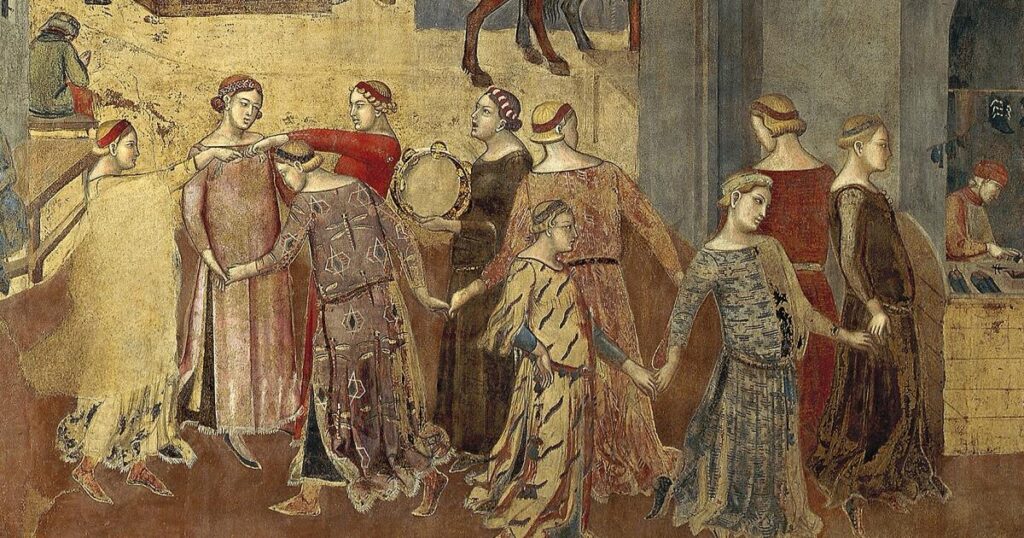
Nearly 700 years old, the series of fresco paintings includes a depiction of a bustling city that illustrates the effects of good government, as well as representations of the decay that results from arbitrary and unjust rulers. The visual treatise on political economy holds important lessons for us today.
Lorenzetti’s city isn’t thriving because its government is energetic or ambitious. It’s thriving because a wise government knows its place.
The people creating its wealth aren’t politicians. They’re merchants opening shops, artisans practicing their crafts, builders raising new homes, farmers bringing goods to market, families walking safely through the streets and a couple getting married. Prosperity comes from their voluntary cooperation. The government appears as the guardian of the rules that make prosperity possible: justice, security, predictable laws and limits on arbitrary power.
That distinction is everything. America did not become the richest nation in history because Washington, D.C., was exceptionally good at directing the economy. It thrived because its institutions largely prevented Washington from interfering. The rule of law and constitutional limits have allowed millions of individuals to make sound decisions that no central authority could possibly coordinate.
Lorenzetti understood that institutions shape incentives, and incentives shape civilization. When political institutions protect a people’s liberty, property and contract rights, they will invest, innovate, trade, build and cooperate. When institutions become vehicles for arbitrary power, society reorganizes itself around politics instead of production, and everything decays.
That’s why the most troubling trend in American politics today isn’t just how remarkably bloated the government has become. It’s that both major political parties are now comfortable using their power to direct private economic life, and they seem unbothered by whether this undermines the rule of law.
Federal spending and debt continue their relentless rise because politicians prioritize today’s voters over future generations. They support industrial policy to prop up their favorite industries. The Trump administration is taking equity stakes in companies like Intel and USA Rare Earth, with some members enriching themselves in the process.
Meanwhile, many Democrats champion taxes on held wealth and unrealized capital gains, challenging the principle that property exists independently of political permission. Genuine Socialists who aspire to subordinate property rights and voluntary exchange to political power are now winning elections.
Today, Democrats and Republicans share an understanding that the government should actively allocate resources, direct investment and determine economic outcomes, often for its own benefits.
That’s a shift Lorenzetti’s frescos implicitly warned against. The danger is not poorly executed government; it’s that society’s rules eventually begin to break down. Businesses learn that political influence matters as much or more than serving customers. Investors devote increasing attention to Washington rather than to innovation. Entrepreneurs spend more time competing for subsidies than for customers. Citizens become clients of the state instead of participants in a free society. Political discretion displaces voluntary cooperation.
This transformation rarely arrives dramatically. It instead comes one exception at a time: one bailout, one industrial policy, one new entitlement, one emergency spending bill, another emergency bill that no one feels any need to repay, one “golden share,” one creative tax hike. Together, these changes reshape the relationship between citizen and state.
Lorenzetti’s companion depiction of a bad government is often interpreted as a portrait of tyranny. Justice lies bound at the feet of a horned, demonic ruler, her scales broken and cords cut. Around them, the city decays: buildings crumble, the streets empty of commerce, stores are looted and the only workshop still doing business belongs to the armorer. Soldiers seize a woman — a dark reflection of the happy bride processing through the city on the opposite wall — while a man lies slain at her feet.
Similarly, in one painting of the countryside, the figure of Security, guaranteed by law and not by whim, flies above cultivated fields. In another, Fear hovers over villages burning and barren ground. Same land, same people, different institutions.
But tyranny isn’t simply oppression. It’s the condition under which political power, no longer constrained by enduring principles, becomes society’s organizing force. That’s where bad becomes worse. High taxes become levies meant to punish and confiscate. Regulating industries becomes the locking down of an economy. Constraints on speech become censorship and book burning.
That’s why institutions matter. A constitutional government’s purpose is not to directly produce prosperity. It’s to prevent political power from suffocating the countless acts of creativity, exchange, investment and cooperation through which free people produce prosperity themselves.
America’s greatness has never rested on the brilliance of its politicians. It rests on institutions that leave enough room for people to flourish. The lesson from Siena is that we must restore and preserve what keeps political power in check. Without it, the government does not merely redistribute wealth; it coarsens and corrupts the character of the people, leading to its destruction.
Veronique de Rugy is a senior research fellow at the Mercatus Center at George Mason University. This article was produced in collaboration with Creators Syndicate.
The post What a 700-year-old Italian fresco can teach America today appeared first on Los Angeles Times.