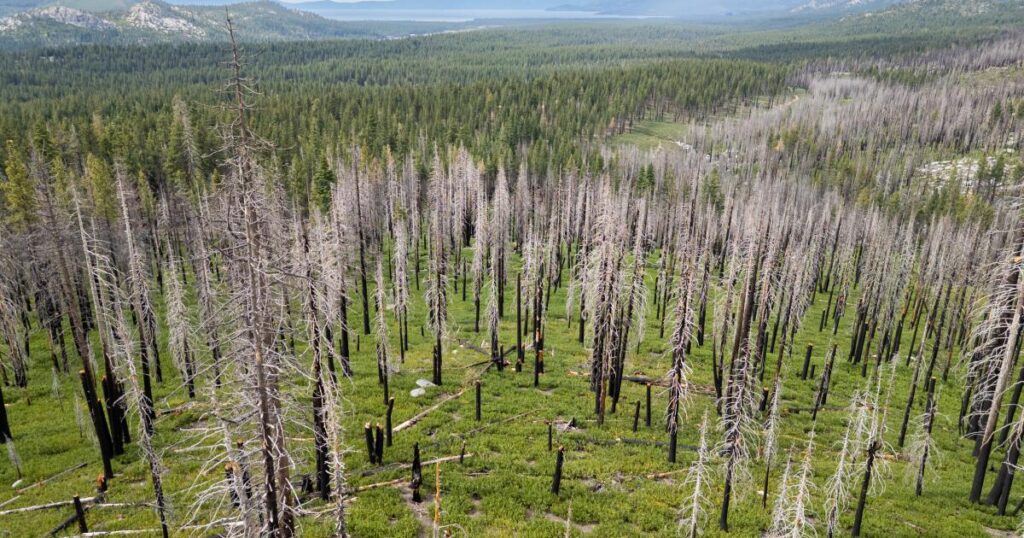
SOUTH LAKE TAHOE, Calif. — For years, Reid Reichardt walked the forest trails behind his Tahoe Basin cabin nearly every day with his dog Jasmine. Then in 2021, the Caldor fire swept through, incinerating it all.
“It was really a sense of mourning and grief to lose this,” Reichardt said, eyes fixed on the towering blackened sticks around him.
Since then, Reichardt has watched birds, flowers, a sea of green shrubs and baby conifers fill in the moonscape. It’s been a ray of hope for him, as Jasmine aged and eventually passed.
But two months ago, Reichardt got a text from a friend: The Forest Service had approved a plan to kill off shrubs it says are blocking the conifers from growing. It plans to use glyphosate, an herbicide California has determined causes cancer.
“I think many people, including me, would say, I’d rather my house burn down than get cancer,” he said.
Increasingly severe wildfires — fueled by climate change and more than a century of forest mismanagement — have forced an environmental reckoning on mountain towns nestled in California’s Sierra Nevada. Their residents face difficult questions: Will some kind of forest grow back? And, if not, should humans intervene to make that happen? Two communities, 100 miles apart, may be choosing different answers.
Many foresters and fire ecologists argue the plentiful baby conifers behind Reichardt’s home will struggle to compete with the fast-growing shrubs for sunlight, water and soil nutrients. Should another fire roll through, the seedlings are not yet tall enough to hold their branches above the flames.
But many Tahoe Basin residents say they are willing to live with whatever grows back, if it keeps glyphosate away.
“I’ll never see it like it was in my entire lifetime, and we need to be OK with that,” said Madeline Moritsch, who spent summers at her parents’ Tahoe cabin growing up and now lives in town. “It’s really sad … to lose connection to the forest, but then also, it is part of the forest life cycle. I have great trust that the forest is going to do what it’s going to do.”
In the Tahoe basin, opposition to the herbicide reached a fever pitch after an article chronicling the Forest Service’s use of the chemical across California appeared in Mother Jones magazine.
The agency had posted newspaper notices and sent emails mentioning herbicide use and seeking public input last year, but Tahoe residents said they had missed them or didn’t make much of them.
“We continue to welcome feedback from community members and appreciate the ongoing interest and involvement from the public,” the Forest Service said in a statement.
The controversy over reviving the forest is a shame, some say, because, done right, these projects can help restore the identity of forest towns and a feeling few have felt in decades: safety.
The stewards of the forest
About 100 miles northwest of the Tahoe Basin, lower down in the foothills, survivors of the epic 2018 Camp fire that destroyed the town of Paradise have a very different relationship with forest stewards.
The Butte County Fire Safe Council — made up of three dozen foresters, former firefighters and local fire survivors — has countless stories of working with local landowners to heal forests and reduce wildfire risk.
In a ride with four of them in one of the council’s heavy-duty white pick-ups, conversation is constantly interrupted as they point out areas across the county’s rugged wild lands that they’ve worked on.
More than a third of Butte County’s 1 million acres have burned over the past decade. That has made taking action and having tough conversations — including about herbicide — unavoidable.
Connor Gilmartin, the Fire Safe Council’s director of development, sympathized with residents in the Tahoe Basin. “It’d be completely reasonable that people feel slighted if they were to have something happening in their proverbial backyard without knowing about it,” he said. “It’s a non-option for us.”
The Fire Safe Council and forestry herbicide experts stressed that when herbicide is used, crews take significant precautions to protect ecosystems and communities. They post signs along trails and mix in dye so residents can see where the chemical has been used. It can’t be applied near streams and lakes.
Experts also said it is extremely unlikely for people using trails to get accidentally exposed to glyphosate levels that scientists deem unsafe.
Why use glyphosate
For well over a century, the state and federal government aggressively suppressed all fire in California forests — many of which were adapted to low-severity flames that rolled through the understory every five to 20 years. These free-range “good” fires, set by lightning and Indigenous tribes, thinned out and rejuvenated forests for millennia.
Without them, parts of the Sierra Nevada have grown five to six times as dense as they were a few hundred years ago.
Combine that with increasingly hotter and drier weather due to climate change, and forests in the Sierra Nevada are left with a ton of stuff that’s ready to burst into flames.
Now when a fire ignites, it’s often high-intensity, devouring virtually everything in its path — including hundred-foot-tall trees.
After such a fire, shrubs that usually fight for scarce sunlight on the forest floor suddenly have it all day and take over.
It’s for this reason many experts say intervention is necessary if the forests are to grow back within the next several decades.
Without intervening, “the Forest Service is not getting a forest back. That’s pure and simple,” said Scott Stephens, UC Berkeley professor of fire science. Hoping fire stays out of the forest during its slow recovery process, “I would call that risky business,” he said.
To cut back on the shrubs and give the conifers a chance, Stephens said land managers have a few options: Goats, hand crews and herbicides.
Goats are great at munching up unwanted vegetation; however, if they aren’t introduced immediately, the goats are no match.
Land managers can also send in hand crews to take down shrubs with loppers, hoes and chainsaws. But that is labor intensive, and when a fire burns thousands of acres, the time and cost involved can be too high.
That leaves herbicides.
Of those, glyphosate is one of the few reasonably priced, effective and, many argue, comparatively safe herbicides that land managers can rely on for restoration work.
In the Tahoe Basin, the Caldor fire restoration plan outlines roughly 3,600 acres where the Forest Service could use ground crews to apply herbicide directly to shrubs — no aerial spraying.
“Even though it’s gotten a bad name because so much attention has been focused on it, it’s actually effective and comparatively benign,” Jon Souder, retired Oregon State University forestry professor, said of glyphosate.
Whether glyphosate causes cancer is still debated.
The U.S. Environmental Protection Agency determined it is not likely a human carcinogen. The cancer research arm of the World Health Organization says it probably is.
For many residents near Lake Tahoe, it’s not a risk worth taking.
Teaching the land to trust
Matthew Williford Sr., tribal chairperson of the Konkow Valley Band of Maidu, shook his head as he stood on a dirt road overlooking the fire-ravaged Concow Basin, separated from Paradise by just one canyon.
“Nature needs help too, just like we need help from nature,” he said. “We don’t understand that because we went another way. We lost connection with the land. That’s why.”
“This is 3A,” he said, referring to the Forest Service’s name for this plot. “We have a tribal name for it — it’s called the Place of the Grasshoppers.”
Growing up, Williford heard stories of ancestors catching giant grasshoppers, wrapping them in a maple leaf, adding a berry, then roasting them in fire and eating them like popcorn.
But those grasshoppers were long gone.
California outlawed cultural fire in 1850, the year it became a state. The forests grew dense. Conifers took over the oaks. The plants and animals Williford’s ancestors held relationships with became strangers.
Then everything burned.
The Forest Service began increasingly approaching the tribe for help.
With the blessing and support of the Forest Service, the tribe began working to restore parts of its homeland — not as a shrubland, or thick conifer forest, but an open and free tapestry anchored by oaks.
For the work, the tribe has sometimes leaned on herbicide — particularly to kill ornamental French and Spanish broom, which are invasive. The alternative, digging it up, risks damaging cultural sites.
On plot 3A, the tribe worked with the Forest Service to grow oaks and bring back good fire.
One day, Williford stopped by 3A.
As he hopped back into his truck, a loud buzzing startled him. His truck was covered in giant grasshoppers.
“It’s just getting the land to trust us and to see that we’re here to help it — like we used to,” he said. “The land will respond. There’s no doubt about it.”
The post ‘I’d rather my house burn down than get cancer’: Herbicide use upends California’s fight to save forests appeared first on Los Angeles Times.