As World Cup matches take place across the United States, Nike and Adidas, the two largest sportswear companies in the world, are spending millions of dollars in a duel over the future of soccer in America.
The longtime corporate rivals see the tournament being played across 11 cities in the country as their biggest opportunity in over 30 years to raise the sport’s profile and sell more soccer merchandise to a valuable market.
Soccer has become one of the fastest-growing sports in America, driven by a surge in interest in Major League Soccer. More than 62 million people followed the sport in the United States, making it the fourth-largest soccer fan base in the world, according to a report from Nielsen, the analytics firm. And that was before televisions at bars and in homes tuned in to World Cup matches.
At least a dozen sportswear brands — including Puma, Umbro and Reebok — have vied for attention throughout the 39-day tournament, but none have done more than Nike and Adidas.
“It’s critical for us,” said Camilo Andrade, a global vice president and general manager of soccer for Nike. “This is an accelerator of growth.”
Chris Murphy, a senior vice president of brand marketing for Adidas, shared a similar sentiment about the event’s potential impact. “It’s hard to overstate this,” he said. “It’s massive.”
Adidas sponsored 14 national teams in the World Cup. Nike sponsored 12. Each held soccer events across the United States, Mexico and Canada, the host nations. Each has released expensive, anthemic commercials with its biggest stars and unveiled exclusive new shoes, jerseys and gear. Each hopes that it comes away with the win on the pitch and attracts more shoppers to its brand in the years to come.
Neither side wants to come in second place. But Nike, in particular, cannot afford another loss.
Nike, based in Beaverton, Ore., has struggled to revive sales since 2024, when it fell into a prolonged slump after a series of strategic missteps. The company had pushed too far into lifestyle product lines and neglected investment in the types of technical innovations for its shoes that had defined the brand for decades.
In June, Nike reported quarterly earnings and gave a cautious outlook for the next six months. Elliott Hill, the chief executive of Nike, has made soccer one of the company’s top priorities and a key part of its turnaround plan, alongside basketball and running.
“The World Cup is always a moment to prove ourselves,” Mr. Hill told analysts on a conference call. “It’s one of the toughest battlegrounds in sport, and we’re coming with our best.”
As Nike languished, Adidas went on a roll. The German company reported continued sales growth in April, with strong results in both its lifestyle product and performance goods, and carried that momentum into the World Cup. The company reiterated its forecast that its sales would increase this year by a percentage in the high single digits.
“We want to make sure that we are showing up very, very well during the World Cup — that we win that event and use it as a platform for the brand overall,” Harm Ohlmeyer, the chief financial officer of Adidas, told investors in April.
Star power
The last time sportswear executives were so giddy about soccer in America was in 1994.
FIFA, the sport’s global governing body, chose the United States as the World Cup host nation even though professional soccer’s popularity lagged far behind football, baseball and basketball.
“It pretty much changed the trajectory of soccer in this market,” Mr. Murphy, the Adidas executive, said of the 1994 World Cup and its legacy.
Adidas — which introduced the first screw-in studs to soccer boots in 1954, when West Germany won the World Cup — had been the dominant force in the sport for decades, providing the official balls and equipment while sponsoring the biggest stars.
Nike had only dabbled in soccer and was irrelevant on the global stage until the 1994 final.
“We meant absolutely nothing in the sport to anybody,” Sandy Bodecker, the first head of Nike’s soccer division, once said, according to Nike’s archive department.
That was until Brazil faced off against Italy in that final match. Eight of the Brazilian players, including the star striker Romario, had Nike Tiempos on their feet for their dramatic penalty shootout win at the Rose Bowl in Pasadena, Calif. Nike went on to sign the U.S. team, and then signed a deal with Brazil’s confederation.
This year, the U.S. club, backed by Nike, performed well, even though it fell short of the final rounds. The team won its group, defeated Bosnia and Herzegovina 2-0 in the knockout stage, but was eliminated this week in the round of 16 by Belgium, in a 4-1 rout.
As a crucial part of America’s bid to host the 1994 tournament, FIFA required the U.S. Soccer Federation to create a professional league to help grow the sport. That league, Major League Soccer, debuted in 1996 and gained momentum over the years with international signings. In 2007, the L.A. Galaxy made a splash when they signed David Beckham, the English soccer star, near the end of his career. In 2023, Inter Miami brought in Lionel Messi, the Argentine legend, giving the league a new level of global attention. Both players have deals with Adidas.
Spikes in domestic participation often materialize in the year after a World Cup, and the U.S. men’s national team’s performance on the global stage can affect the sport’s popularity. But in 2018, when America didn’t qualify for the tournament, engagement in soccer declined in the country, according to the Sports & Fitness Industry Association, a trade group.
Participation reached a record high in 2025, and more than 25 million Americans played indoor or outdoor soccer this May in the run-up to the World Cup, according to the trade group.
The sportswear brands are rushing to capitalize on the moment by mobilizing their substantial marketing operations and their sizable rosters of sponsored athletes.
“At Nike and Adidas’s scale, every big event matters,” Simeon Siegel, an analyst at Guggenheim Partners, said. “These businesses need to be out there, they need to be present and they need to be top of mind when you think of sport.”
In May, Adidas released its World Cup ad with Mr. Messi, its headliner, and some top stars including Jude Bellingham, Lamine Yamal, Ousmane Dembélé and Trinity Rodman. They were joined by soccer legends like Mr. Beckham, Zinédine Zidane and Alessandro Del Piero, with crossover cameos from the rapper Bad Bunny and the actor Timothée Chalamet.
Nike responded with an ad blitz of star power in June that featured some of soccer’s biggest names including Cristiano Ronaldo, Kylian Mbappé, Vinícius Júnior and Erling Haaland. The basketball star LeBron James made an appearance, and there were vignettes starring the K-pop singer Lisa and the actors Channing Tatum and Jason Sudeikis.
Kim Kardashian, who has an activewear brand with Nike through her Skims underwear label, and the rapper Travis Scott, a longtime Nike collaborator, showed up in the ad, too.
“We really believe that this is another moment, like the decade of the ’90s, where the global scale of this sport can help us accelerate the ongoing momentum that we have,” Mr. Andrade, the Nike soccer executive, said. “Of course, in America, we have a tremendous advantage.”
‘Coming soon’
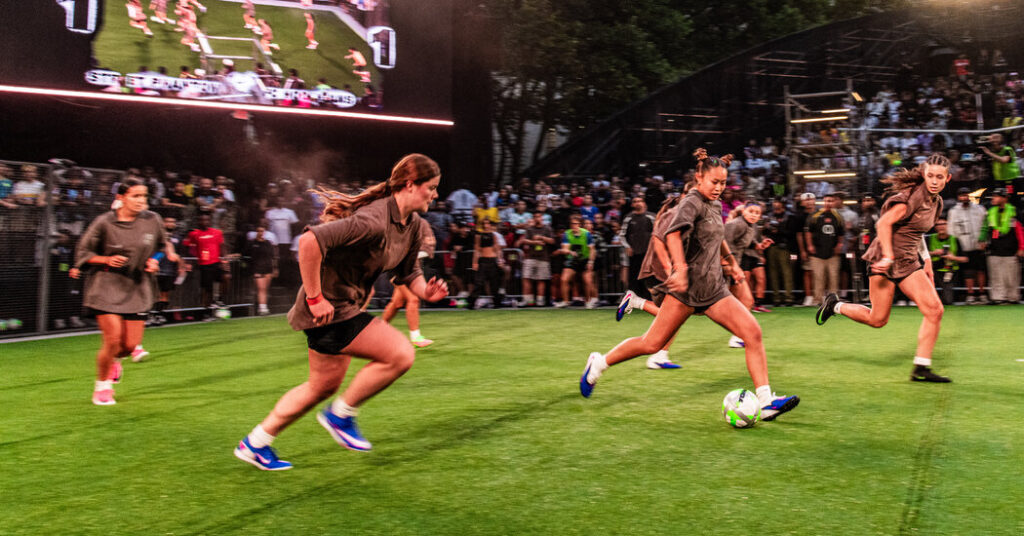
As the matches unfolded across the United States, Mexico and Canada, Nike held its own tournament, Nike Toma, in Midtown Manhattan.
Nike transformed Bryant Park into a soccer stadium, recruited elite street players to face off for the championship and even brought in Mr. Scott for an appearance. Everyone, of course, wore Nikes.
Across town, Adidas, the official World Cup sponsor and match ball provider, hosted its own party at Brooklyn Bridge Park, converting the area into a fan zone that held watch parties and concerts.
Spectators pushed up to the rails to watch matches on the big screens or catch a glimpse of the athletes Adidas brought to the venue, including Mr. Beckham, Ms. Rodman and Aitana Bonmatí, a three-time women’s Ballon d’Or winner.
At the World Cup, each brand has teams remaining in the quarterfinals. Nike equipped France, England and Norway, while Adidas sponsored Spain, Argentina and Belgium. The other two squads, Morocco and Switzerland, are with Puma.
But Nike has scored at least once. For the first time in more than 70 years, the Adidas logo will not appear on the kits of Germany, its home country, at the next World Cup, which is set to be held across Europe, North Africa and South America. Instead, the team will wear the swoosh: Nike signed a contract to supply the kits, starting in 2027, in a move that rocked the nation and drew the ire of politicians.
“German football is pure home turf, not a pawn in multinational corporate warfare,” Markus Söder, the minister-president of Bavaria, said after the deal was announced. “Commerce isn’t everything.”
Nike could not help but take a jab at its rival. As the German team played a match in New Jersey, Nike sailed a barge down the Hudson River carrying a billboard with the German star Jamal Musiala in a pixelated jersey that hid its logo.
“Coming soon,” the message read.
The post At the World Cup, Nike and Adidas Duel Over the Future of Soccer appeared first on New York Times.