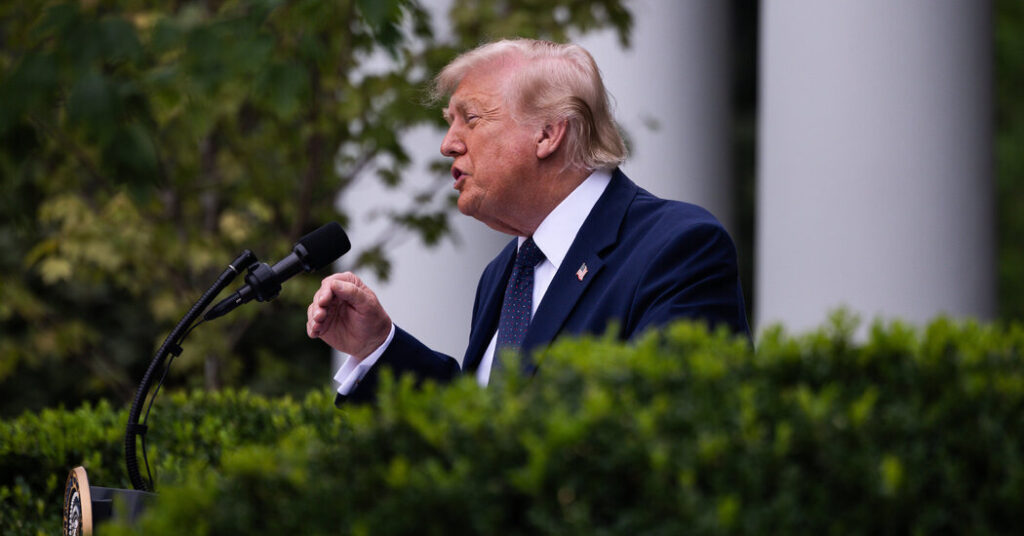
President Trump said on Wednesday that he would ask the Supreme Court to reconsider its decision to strike down his executive order that aimed to revoke birthright citizenship, a request that the justices are highly unlikely to take up.
The declaration, made in a social media post, showed the president’s continued frustration with the court’s decision last week, when a majority of justices ruled that the citizenship given to nearly all children born on U.S. soil was enshrined in the Constitution.
Mr. Trump claimed that signs and billboards were being placed along the southern border and in Mexico advertising the right, and that citizenship would be granted to “anyone willing to pay.”
The president appeared to referring to a Fox News report that identified a hospital in Texas that had advertised paying for “Birth Packages in South Texas” on billboards in Mexico. The outlet reported that Gov. Greg Abbott of Texas, a Republican, had ordered an investigation into the hospital, which told Fox News that “marketing materials regarding maternity services are no longer in use due to any unintended misunderstanding.”
“We do not support or facilitate any unlawful activity and work to comply with all applicable federal and state laws and regulations,” the hospital added in a statement to the outlet.
On Wednesday, Mr. Trump said that he would ask for a “rehearing” of the case “IMMEDIATELY,” and that the justices would “destroy America if they don’t change their absolutely insane decision.” As of Wednesday evening, administration lawyers had not filed a request with the court.
Under Supreme Court rules, parties can ask the justices to rehear a so-called merits case after it has already been decided. But it is exceptionally rare for the court to grant such requests.
The last time the court granted a rehearing request after it had announced a decision in an argued case was in 1965. The court has only once reversed itself after rehearing a case, according to Stephen I. Vladeck, a professor at Georgetown University Law Center. That reversal happened in a 1956 case examining military tribunal jurisdiction for civilian spouses of service members.
Mr. Trump, who attended the oral arguments in the Supreme Court citizenship case, has continued to lash out at the court over its ruling, which was delivered by Chief Justice John G. Roberts Jr.
“Citizenship, then and now, was the right to have rights — to freely participate in our political community,” Chief Justice Roberts wrote in the decision. “The framers of the 14th Amendment extended that promise to ‘every freeborn person in this land.’”
The 6-to-3 decision capped a more than decade-long effort by Mr. Trump to use the issue as a political tool. In the immediate aftermath, he urged Congress to take up the issue with legislation, incorrectly asserting that “no long and unwieldy Constitutional Amendment is necessary.”
Several days later, the decision received renewed attention after Mr. Trump intervened in an officiating decision in the men’s World Cup on behalf of a U.S. player with foreign-born parents.
He called Gianni Infantino, the president of the body overseeing the tournament, to protest a red card that was given to Folarin Balogun, a star player who was born in the United States while his parents, who were born in Nigeria and lived in London, were on a trip.
FIFA, the World Cup governing body, reversed the referee’s decision, which would have prohibited Mr. Balogun from playing in a match against Belgium; the United States lost the game on Monday.
Mr. Trump said that he had decided to act when he learned of the implications of the red card, saying that “when they take your best player, or just about,” it is “very unfair.”
Tariq Panja contributed reporting.
The post Trump Says He’ll Ask Supreme Court to Rehear Citizenship Case, an Unlikely Event appeared first on New York Times.