Lost Science is an ongoing series of accounts from scientists who have lost their jobs or funding after cuts by the Trump administration. The conversations have been edited for clarity and length. Here’s why we’re doing this.
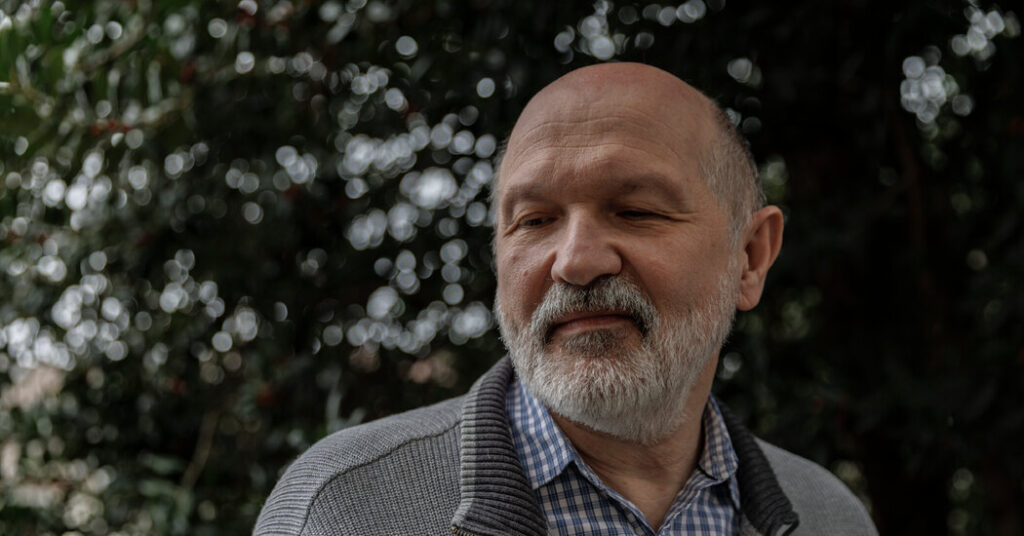
Yuri Ralchenko: I was with the Atomic Spectroscopy Group at the National Institute of Standards and Technology for 23 years and was the leader of the group for the past 12 years.
Our group, composed of six scientists, engineers and other staff members, was one of the leading, if not the most important, atomic spectroscopy groups in the world. We made precise measurements of the spectra, or the light emission and absorption, of different atomic elements at different temperatures. We also critically evaluated other sets of data and maintained online tools and databases, including benchmarks for atomic parameters. It was the gold standard for atomic data.
In space, this database was used to help measure the composition of rocks on Mars and the makeup of faraway stars. But it gets used across many other fields, including lithography, atmospheric physics, medicine and even archaeology and geology. Our database is cited in the scientific literature twice a day and queried nearly a million times a year.
The first scientific paper that came out of NIST in 1904 was on atomic spectra. Last year, we celebrated 120 years of atomic spectroscopy research at the agency. But in March, we were informed that the group would be disbanded because it did not align with current priorities at NIST.
We are able to preserve the whole group and move our tools and databases to the NASA Goddard Space Flight Center. But our experiments will be difficult to move. They consist of dozens of devices, connectors and computers, which have to be disassembled and shipped, and then unpacked and reassembled. The most complex instrument, which uses an electron beam to trap ions, spans some 2,000 square feet. It was built at NIST over 30 years ago and has never been moved.
Our estimate is that it will take at least one and a half years to have the experiments ready again. What we’re taking is of most use to NASA’s goals. Other instruments will be left behind. They have been viable workhorses for decades but are big things. One sits on a 15-ton granite slab, just to prevent external vibrations. They will stay at NIST, for now, but what will happen to them we do not know.
Our mission was to give the most solid foundation on which other work could be based, like a ruler that allows researchers to understand their spectral data. If you don’t know what you see, then the rest becomes meaningless.
Yuri Ralchenko remains a guest researcher at NIST. He is now a visiting research scientist at the University of Maryland and a contractor at NASA Goddard Space Flight Center.
Katrina Miller is a science reporter for The Times based in Chicago. She earned a Ph.D. in physics from the University of Chicago.
The post His Group Made World-Class Measurements of Atomic Elements appeared first on New York Times.