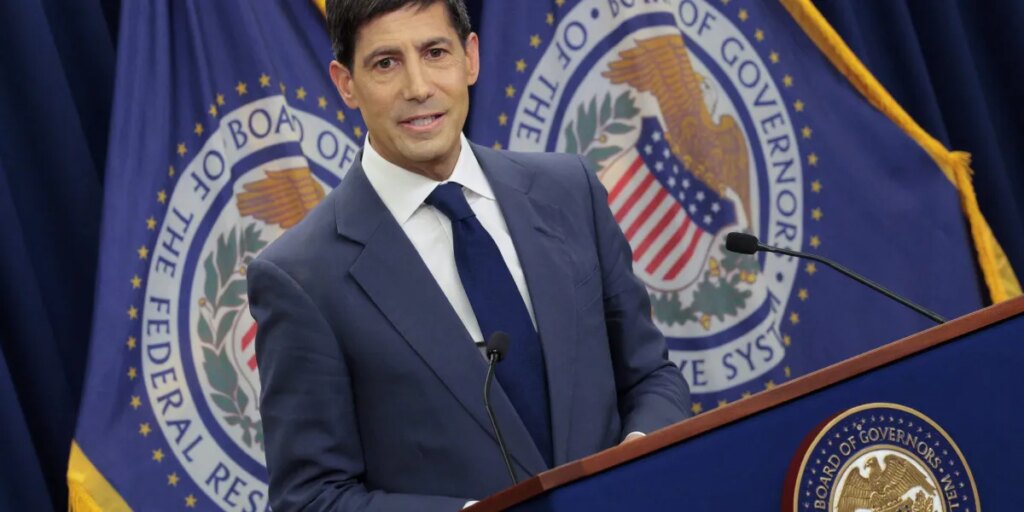
Buried in the Federal Reserve’s June policy statement—the shortest of Kevin Warsh’s young tenure as chair—is a single sentence with no qualifiers, no hedges, and, according to at least one longtime Fed watcher, more signal than anything in the minutes released Wednesday: “The Committee will deliver price stability.”
“There’s not a qualifying statement after that,” said Laura Ullrich, a former senior regional economist at the Federal Reserve Bank of Richmond who now directs economic research at the Indeed Hiring Lab. “It doesn’t say the committee will deliver price stability while also blah blah blah blah. It doesn’t have a qualifying statement.”
Despite its brevity, she called it “a very short, but very strong statement.” It read as an unhedged commitment that doesn’t usually appear in a document over which every word is fought over by the 19 people who make up the Federal Open Market Committee.
The minutes confirmed what Warsh had already previewed at his post-meeting press conference: a “family fight” over where rates go next. The FOMC voted unanimously on June 17 to hold the benchmark rate at 3.5%-3.75% for a fourth straight meeting—the first unanimous vote in some time. A handful of participants saw a case for raising rates immediately but agreed to go along with the hold. The rest of the committee split over where things should stand by December: many said the appropriate rate was at or slightly below the current range, while the minutes noted “many other participants” argued it needed to be higher. The minutes noted only that future action “would depend on incoming information.”
But the division itself isn’t new information so much as confirmation of what the June dot plot already showed: nine of 18 officials penciled in at least one hike before year-end, a reversal from March’s cut-leaning median. Fortune reported that markets reacted immediately to that dot-plot shift the day it was released, with the Dow falling more than 500 points and two-year Treasury yields jumping as traders priced in higher odds of an October hike. The minutes, however, don’t explain the tone Warsh chose to project despite the committee’s internal split.
Ullrich sees the shift less as a dodge than as a new chair recalibrating how the institution talks. Warsh was known as a hawkish governor before ascending to the chairmanship, she noted, and “as long as inflation remains elevated, you should expect to see the committee to be more on the hawkish side.” Inflation has stayed elevated while labor market conditions “just didn’t change very much.” It remains stuck in a low-hire, low-fire holding pattern that’s tilted the committee’s attention toward prices over jobs, even as a few members floated hikes that had been off the table for months.
“I think if you look at the discussion, there were even some people that maybe saw a case already for raising rates,” Ullrich said, noting that the dissent that used to run toward cutting rates has essentially disappeared. “Now it’s tilted more where everybody thought they should be held steady, but there were a few that were saying, ‘Hey, we might need to raise them.’”
“This is like normal new-chair stuff,” she said. “There’s a new leader, and so, how are we going to handle things under this new leadership?” Powell hasn’t actually left, he remains on the committee as a voting governor, sitting in the room for a process now being run by his successor. Asked which way the data currently points—toward a hike or a hold—Ullrich said the honest answer changes by the day. “If you’d asked me this yesterday versus today, I’m going to think differently,” she said, citing the Fed’s dual mandate and the volatility in energy prices feeding the inflation story. “The fact that it was 12 to zero says that right now they were more concerned about the inflationary pressure” than the labor side of the ledger.
Warsh’s press conference performance backs up Ullrich’s read. Fortune’s account of the June 17 briefing quoted him telling reporters “forward guidance isn’t the business we should be in,” while the statement itself had been slashed to 132 words, down from 341 in April. Brookings’ Robin Brooks thought the performance was “largely performative,” meant mainly to draw a clear line between Warsh and a White House that had pushed hard for cuts.
Whether that tone matches the data is a harder question. Total PCE inflation was estimated at 4.1% in May, per the minutes, with core PCE at 3.4%, both up from April and, per the staff’s own assessment, driven partly by tariff pass-through, Middle East-linked energy costs, and what the document repeatedly flags as AI-related demand. The minutes note that “ongoing strong demand for AI infrastructure would likely sustain upward pressure on prices for technology products and electricity,” a line that lands squarely in the middle of a broader debate over whether the AI buildout is inflationary in the near term or disinflationary once productivity gains materialize.
Inside the minutes
The minutes also sketch out just how far apart the committee’s mental models are. “Several participants remarked that they did not see the current policy stance as restrictive, while a few other participants commented that they saw the current policy stance as slightly restrictive,” read the minutes, showcasing a disagreement over the basic starting point for any future move. The document lays out two full scenarios rather than a single forecast: one in which inflationary pressure fades and it “would likely be appropriate to maintain or eventually lower” rates, and another in which AI-related demand, the Middle East conflict, or tariffs keep inflation elevated and “some policy firming would likely be warranted.” The committee didn’t say which scenario it considers more likely, only that, as the minutes put it, participants’ “future policy actions would depend on incoming information.”
That refusal to pick a lane is happening against a political backdrop Warsh has had to navigate carefully since taking office. Former Kansas City Fed president Esther George said she’d plan for higher rates, not cuts, despite President Trump’s months-long campaign for the opposite outcome. A separate Fortune report noted that Trump has continued to call the Fed’s board “hostile,” and a Fortune profile of Warsh, drawing on his mentors and colleagues, described him as someone unusually determined to demonstrate independence, even at the cost of disappointing the president who put him in the job.
Ullrich, who spent years at the Richmond Fed before moving to the private sector, said anything can change whether a hike is imminent. “Gosh, I wish I could predict that. I don’t know,” she said. “The markets were predicting more significant cuts than we saw when cuts were coming.” She said her time inside the institution left her with real respect for what went into that decision-making: the sheer amount of data absorbed and produced through direct conversations with companies and business leaders across the country. “It’s really an incredible process,” she said. “And so I know very well how quickly that data can turn.”
“Even though I worked at the Fed for a while,” she added, “I find it very difficult to predict something like that.”
The post Kevin Warsh buried an unusual, unhedged promise in his first Fed minutes—and one economist says it’s the strongest signal in the document appeared first on Fortune.