Along NATO’s eastern flank, the military alliance is no longer relying solely on tanks, fighter jets, and troops. Instead, it is building a vast digital battlespace network made up of thousands of sensors, drones, satellites, and artificial intelligence. The goal: to detect an attack on allied nations as early as possible and block the attacker before they can penetrate deeper into Alliance territory.
The concept is called the Eastern Flank Deterrence Initiative (EFDI). In documents obtained by BILD, one potential adversary is explicitly identified: Russia. It is intended not only to offset Russia’s advantage in mass and momentum — large troop numbers and rapid advances — but also to discourage Moscow from launching an attack in the first place. NATO refers to this principle as “deterrence by denial.” It is expected to rely on systems from Palantir and other leading Western defense contractors.
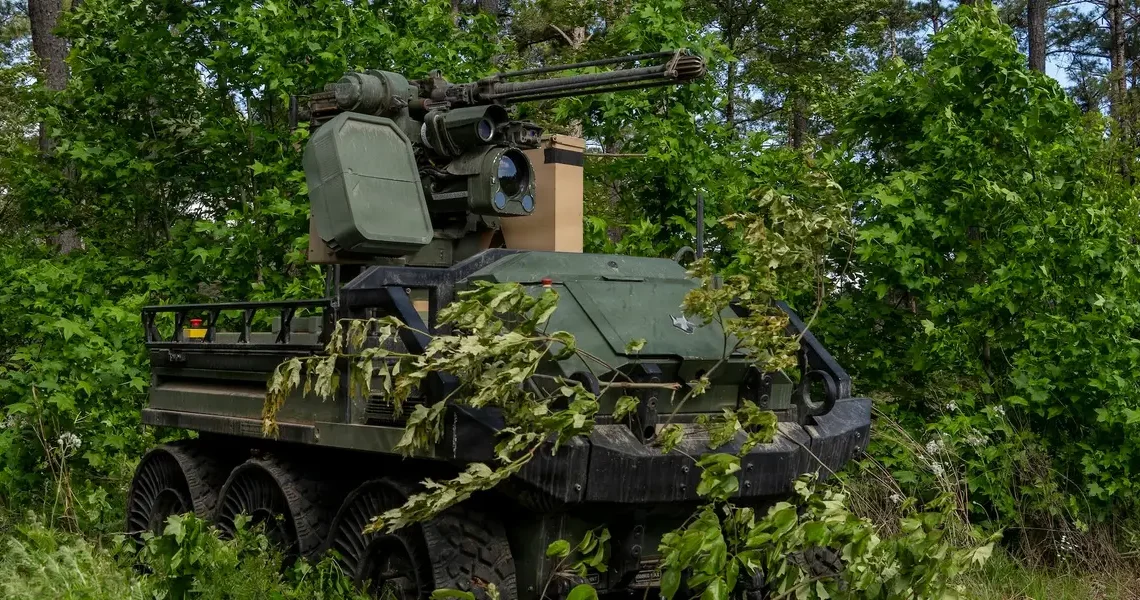
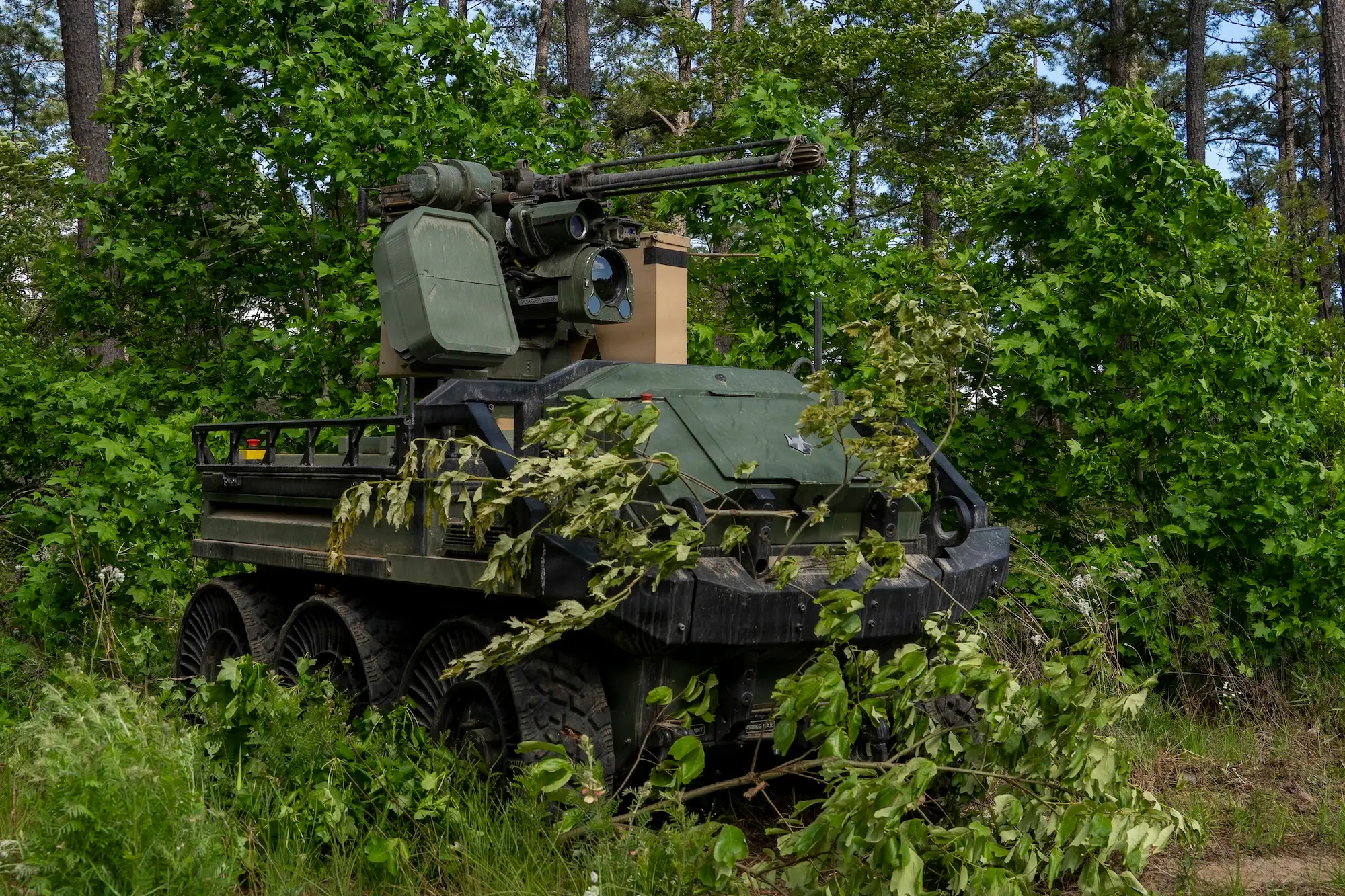
The new strategy creates a vast AI-guided network to detect and strike targets — not unlike the powerful web Russia has built fighting Ukraine. But it is just the beginning of a much larger shift, where uncrewed systems like attack drones and remote-controlled machine gun turrets will be NATO’s first line of defense.
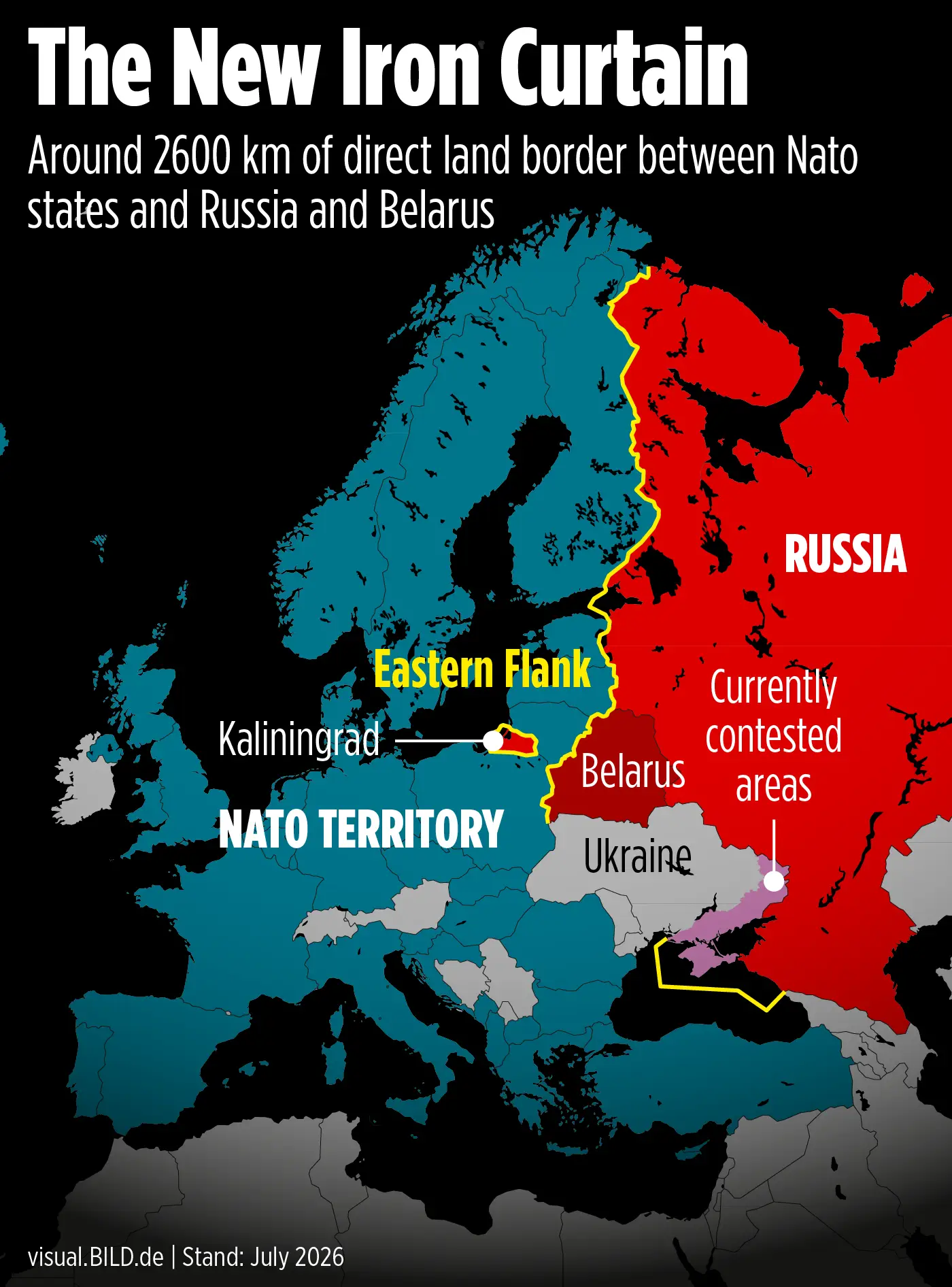
The New Iron Curtain
Following Finland’s accession to NATO in 2023, the Alliance’s shared border with Russia expanded significantly. Today, NATO’s eastern border stretches from Finland through Estonia, Latvia, Lithuania, and Poland to Romania on the Black Sea. It also includes the border with Belarus, Russia’s close ally. Along this entire line, EFDI is intended to strengthen the Alliance’s defense through a system of sensors, drones, command networks, and conventional military forces.
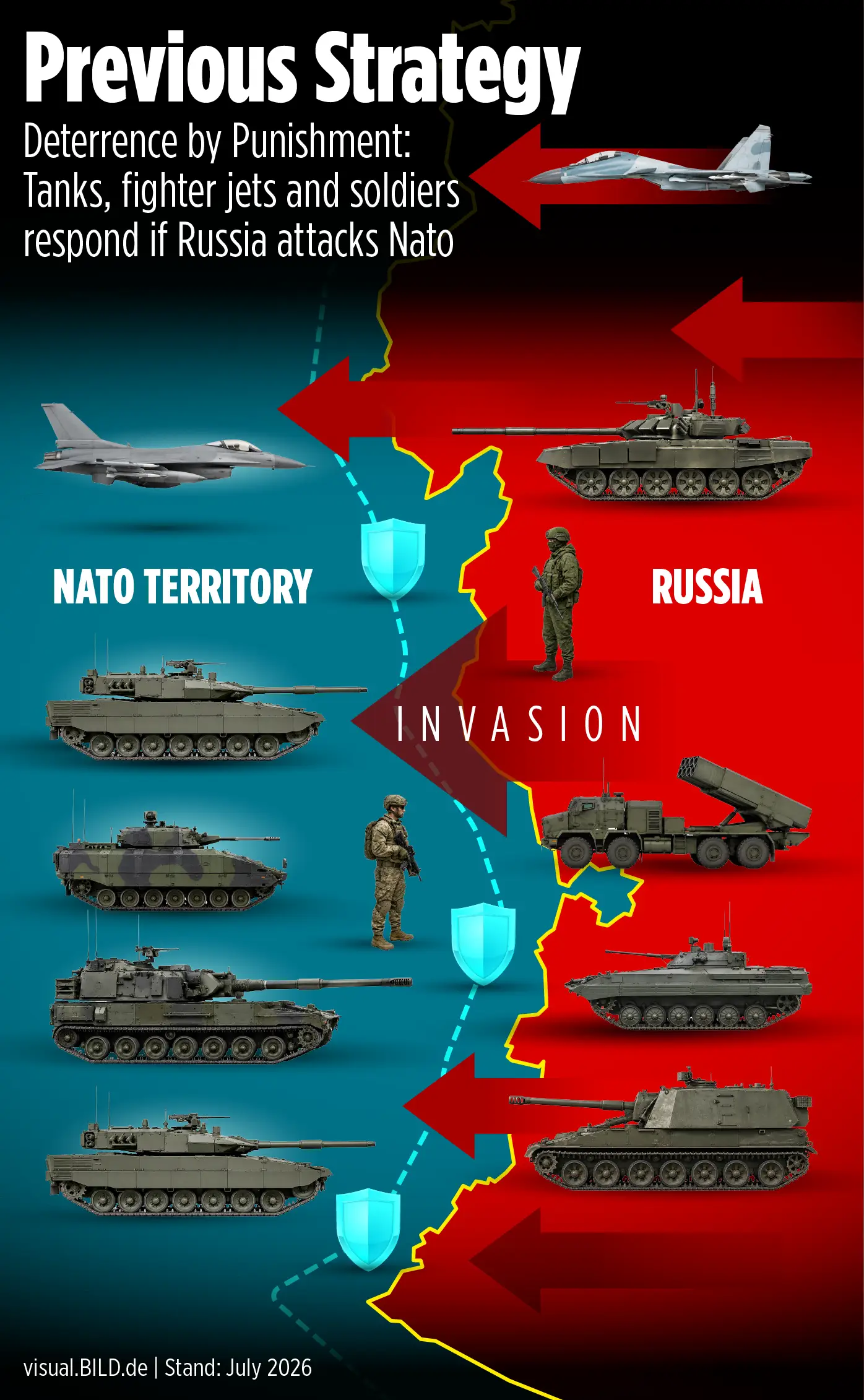
For decades, NATO relied on the principle of “deterrence by punishment.” The idea was that if Russia attacked NATO territory, tanks, artillery, fighter aircraft, and ground troops would repel the assault and later recapture lost territory. These conventional capabilities will remain the backbone of NATO’s defense. Leopard 2 tanks, M1 Abrams tanks, HIMARS rocket launchers, artillery, and F-35 fighter jets will continue to play an essential role.
What is new, however, is an additional layer of defense. Its purpose is to detect, delay, and engage an adversary before NATO’s conventional ground forces come into contact with it, allowing those forces to preserve their combat power and be committed only at the decisive moment.
“EFDI does not replace tanks, artillery, fighter aircraft, or soldiers,” said Maj. Matt Blubaugh, a spokesman for US Army Europe and Africa. “It is designed to help preserve their combat power and give commanders more time and decision advantage.”
The New Strategy
When people think of border defense, they often imagine walls, anti-tank trenches, or soldiers guarding fences. EFDI is neither a wall nor a new front line. Instead, it is a distributed defense architecture supporting NATO’s entire eastern flank from Finland to Romania. The NATO documents frequently refer to a “Kill Web.” The term describes a tightly connected digital network. If one node fails, others immediately take over its functions.
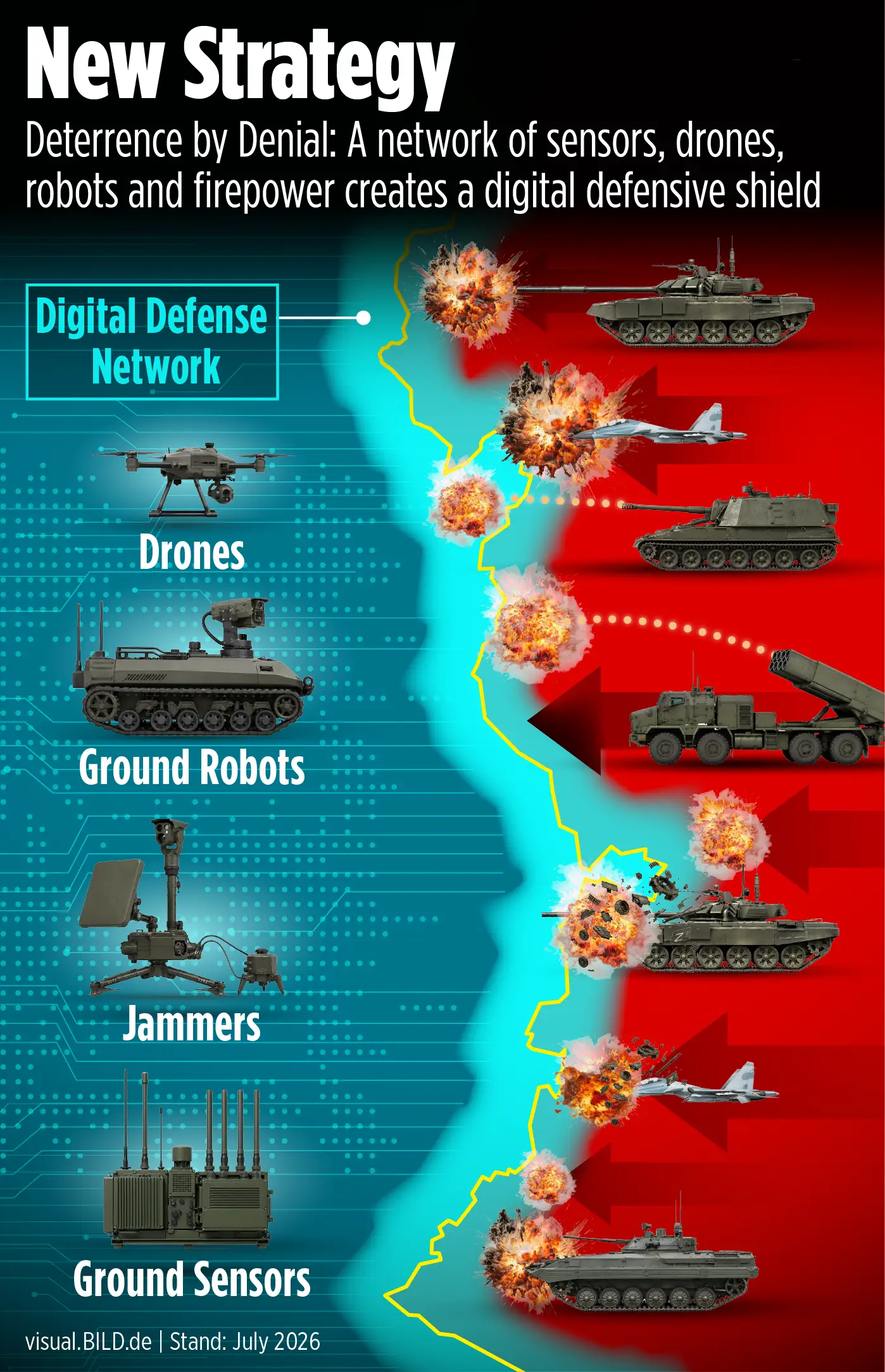
These nodes include satellites in orbit, reconnaissance drones, radar systems, ground sensors, cameras, and electronic surveillance assets. Together, they continuously collect information about activity along NATO’s eastern flank.
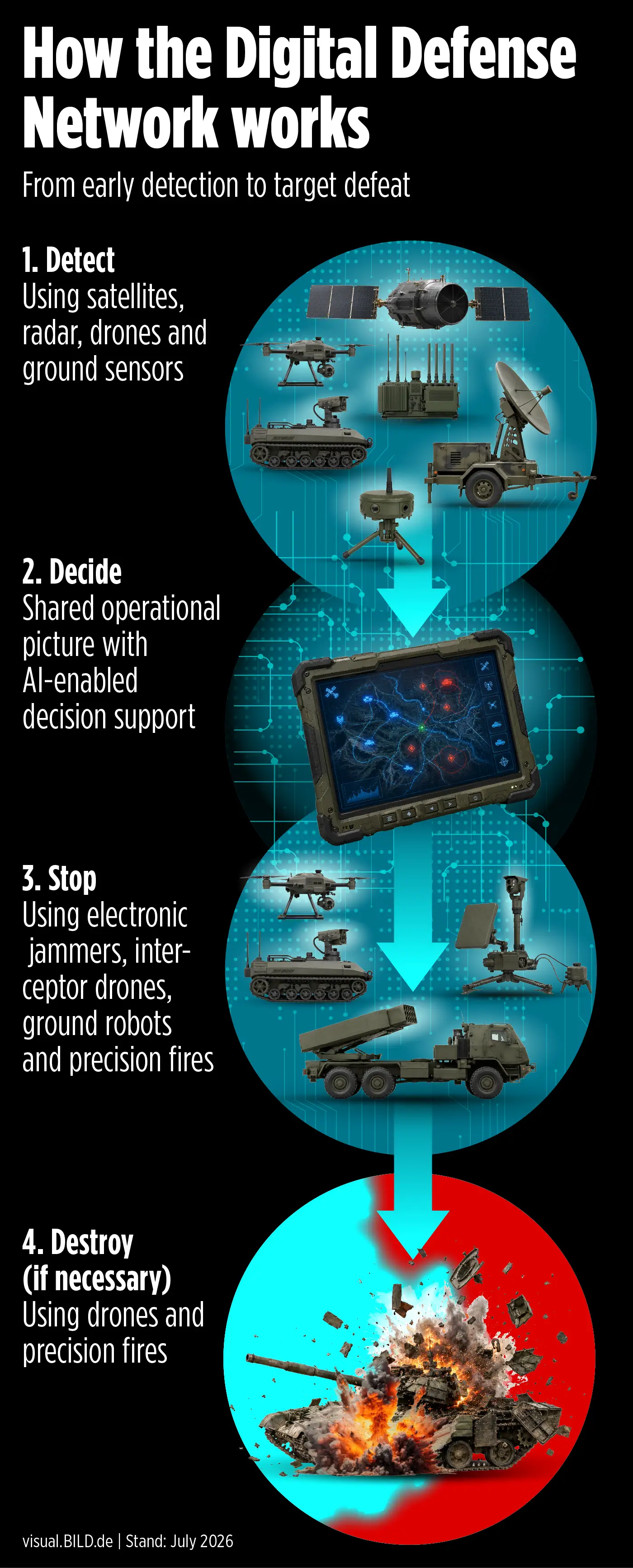
In the recent past, engaging a newly detected target often took considerable time. A drone, for example, would first report the target to headquarters, where the information was analyzed before a firing order was passed through tactical commanders on to a military unit like a squadron. This process consumed valuable time.
In the near future, information collected by all NATO members is intended to flow into a shared digital network and be distributed immediately. Artificial intelligence will analyze the data in real time, helping commanders build a common operational picture as quickly as possible.
The new strategy is expected to incorporate technologies from a wide range of defense contractors through NATO’s open-architecture approach. At the core is Palantir’s Maven Smart System (MSS), which serves as the AI “brain” of the EFDI by processing data from all-domain sensors and enabling faster decision-making. The initiative also integrates systems such as Perennial Autonomy’s Merops AI drone interceptor, alongside capabilities from companies including RTX, Rheinmetall, Saab, Lockheed Martin and Boeing, all connected through the EFDI Data Backbone into a unified sensor-to-shooter network.
In practical terms, if a drone detects a Russian armored formation, the information will immediately be cross-checked with satellite imagery, radar data, and information from ground sensors. Commanders can then select which weapons — such as drones, artillery, rocket launchers, or other weapons — should engage the target. Weapons can be chosen by their range, their likelihood of hitting moving or static targets and also the importance of the targets.
NATO summarizes the principle in three simple steps: “See first. Decide first. Strike first.”
Machines Fight First
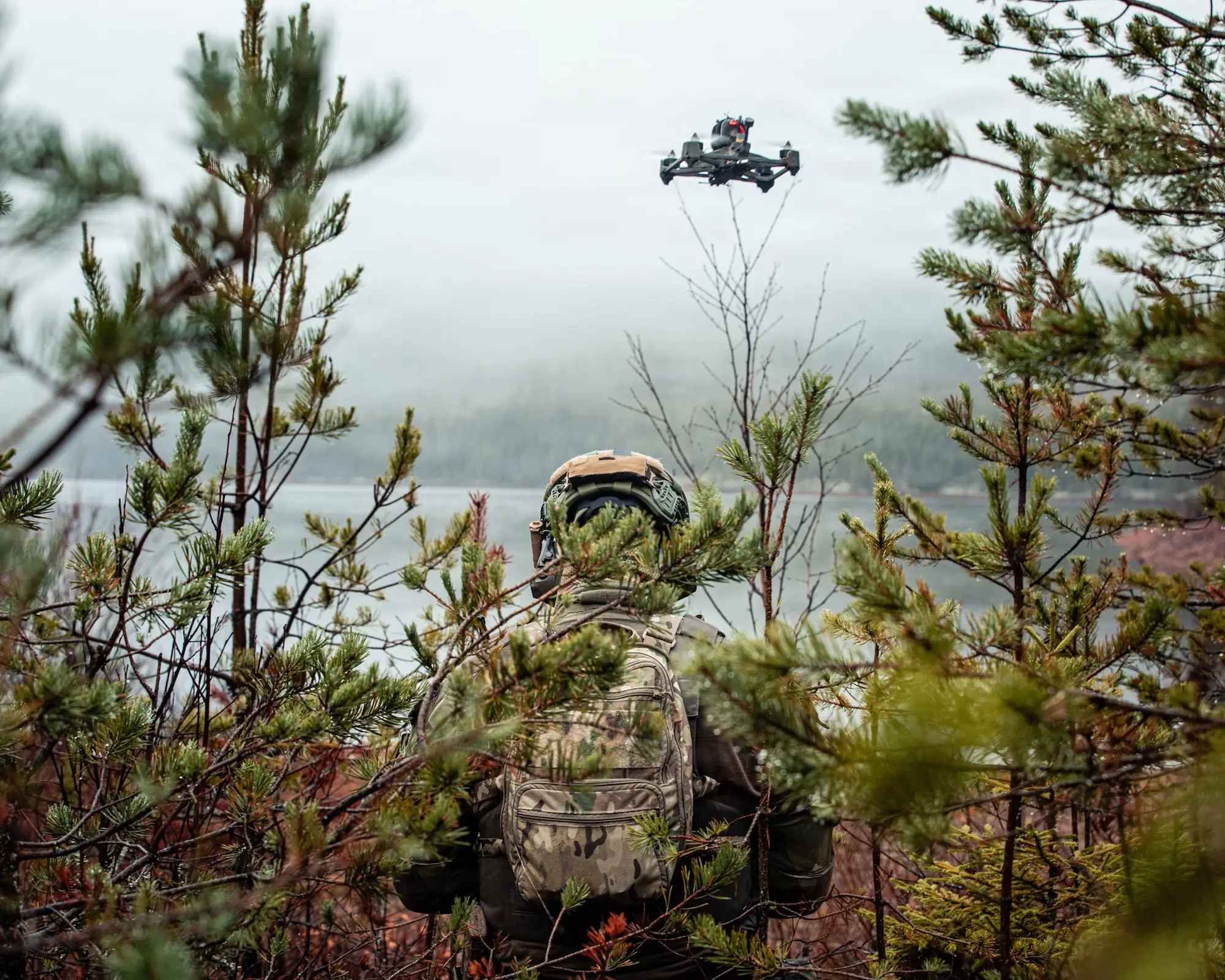
The front line itself is also expected to change significantly. Under NATO’s plans, uncrewed systems would be the first to confront an attacking force. A forward zone is envisioned where drones, ground robots, sensors, and other autonomous systems engage the enemy before conventional troops do.
The idea is straightforward: machines — not soldiers — should absorb the initial attack. This saves time and preserves NATO’s frontline combat formations.
“EFDI buys us time and clarity but at the end of the day, soldiers, tanks and aircraft are still needed to secure and hold ground,” Blubaugh said.
Lessons from Ukraine
The war in Ukraine has shaped the new concept. NATO is incorporating lessons learned by the Ukrainian military directly from the battlefield.
Specifically, thousands of low-cost drones, robotic systems, and sensors are intended to complement conventional weapons and offset Russia’s advantages in mass and momentum — its ability to field large numbers of troops and advance rapidly.
Luca-Marie Hoffmann is a BILD journalist based in Berlin, focusing on military affairs and crisis reporting.
The Axel Springer Global Reporters Network harnesses the resources of the company’s newsrooms to publish ambitious scoops, investigations, interviews, opinion pieces and analysis. It allows journalists — including those from POLITICO, Business Insider, WELT, BILD, Onet and Fakt — to collaborate on major stories for an international audience of hundreds of millions across platforms: online, print, TV and audio.
Read the original article on Business Insider
The post NATO is building an AI ‘Kill Web’ to stop Russian attackers in their tracks appeared first on Business Insider.