A few officials at the Federal Reserve said they could have supported raising interest rates at their meeting in June to address resurgent inflation, according to minutes from the gathering released on Wednesday.
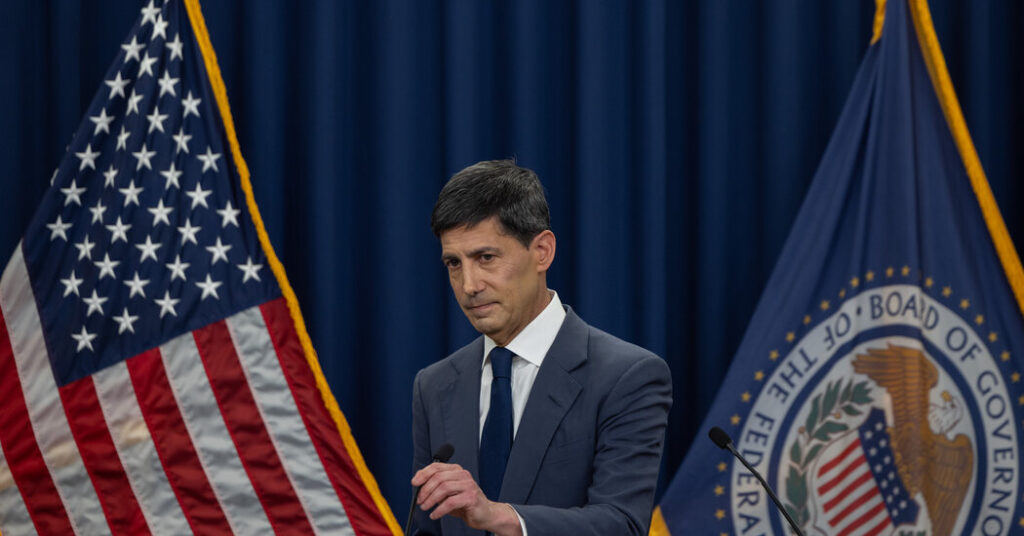
The record of the meeting, which was Kevin M. Warsh’s first as chairman, underscored the extent to which concerns about rising prices have come to dominate the central bank in the wake of the war with Iran. Officials also appeared on guard to fresh inflationary pressures stemming from booming demand tied to artificial intelligence.
The minutes indicated broad support of higher rates in the event that inflation does not decelerate this year, especially if the labor market remains stable.
“In such scenarios, almost all of these participants indicated that some policy firming would likely be warranted to return inflation to 2 percent,” the minutes said.
At June’s meeting, officials were essentially split down the middle about the need to raise rates at a moment when inflation remained above the Fed’s 2 percent target. The Fed has overshot this target for five years.
Those leaning toward higher rates worry that borrowing costs at the current range of 3.5 to 3.75 percent are not doing much to constrain economic activity and in turn keep a lid on inflation, which has surged to a three-year high after the war with Iran. Others make the case for the central bank to hold rates steady given their expectations that inflation will decelerate after the recent blip, although they emphasize that the outlook is highly uncertain.
On Wednesday, President Trump indicated that a preliminary truce reached to end the war with Iran might be on the verge of collapse, igniting concerns about a renewed energy shock that will further stoke inflationary pressures.
The minutes were only marginally pared down compared with those released under Mr. Warsh’s predecessors. That stood in contrast to the Fed’s decision last month to publish a much more abridged policy statement to accompany the central bank’s vote to keep rates steady for a fourth straight gathering.
June’s statement emphasized the central bank’s commitment to “deliver price stability,” but removed any guidance about what it might do next on rates to achieve that. It also provided a more abbreviated overview of the Fed’s assessment of the economic backdrop.
The curtailment in communications is a central pillar of Mr. Warsh’s efforts to change how the Fed operates. He has long opposed the institution’s penchant for cuing up markets ahead of policy moves, including its provision of quarterly forecasts that capture how officials see rates evolving alongside growth, inflation and unemployment in the coming years.
Mr. Warsh’s opposition to so-called forward guidance extends beyond the immediate policy decisions the Fed makes. He has also demurred from offering details about the conditions under which he would support moving rates up or down, and about how he weighs the risks to his outlook. Instead, he has stressed the importance of policymakers having a “family fight” as they deliberate each move.
Other officials have pushed back on the utility of providing explicit signals about the Fed’s plans for rates in light of the enormous uncertainty now plaguing the economy. But they have also stressed the importance of sharing insights with the public about their own thinking.
“If your reaction function is not well defined and markets don’t understand it, then you do need to talk,” Christopher J. Waller, a governor, said at an event on Monday. “It’s important to communicate your reaction function — be clear about what your objectives are and how you would respond to the data.”
To Mr. Waller, the risks to the economy have “completely flipped around,” he said, pointing to the fact that inflation had surged and the labor market had stabilized. “That changes how you might want to think about policy,” he added.
John C. Williams, the president of the Federal Reserve Bank of New York, acknowledged that inflation was far too high for the central bank’s liking but he seemed less concerned about future risks given the recent decline in energy prices. Moreover, he stressed that the Fed was “well positioned” to handle any forthcoming shocks.
The Fed next meets at the end of the month. Investors broadly do not expect the central bank to raise rates then, although the lack of direction from Mr. Warsh has kept open the possibility. Some argue that doing so would help fortify the chairman’s pledge to get inflation back down to target and bolster his credibility.
The post A Few Officials Signaled Support for Higher Rates at Warsh’s First Meeting appeared first on New York Times.