In July, thousands of visitors descend upon southern France for the best known photography festival in the world, Les Rencontres d’Arles, which this year is curated around the globalist theme “Worlds in View.”
This month, too, thousands of Americans will sample exhibitions about the revolutionary founding of their country and ask what remains of that legacy.
But I am reminded of a much lower-budget photography scene that is more naturally global than any Rencontres I have seen, and more directly engaged with the project of self-rule than any of the semiquincentennial shows I have yet had the pleasure to view.
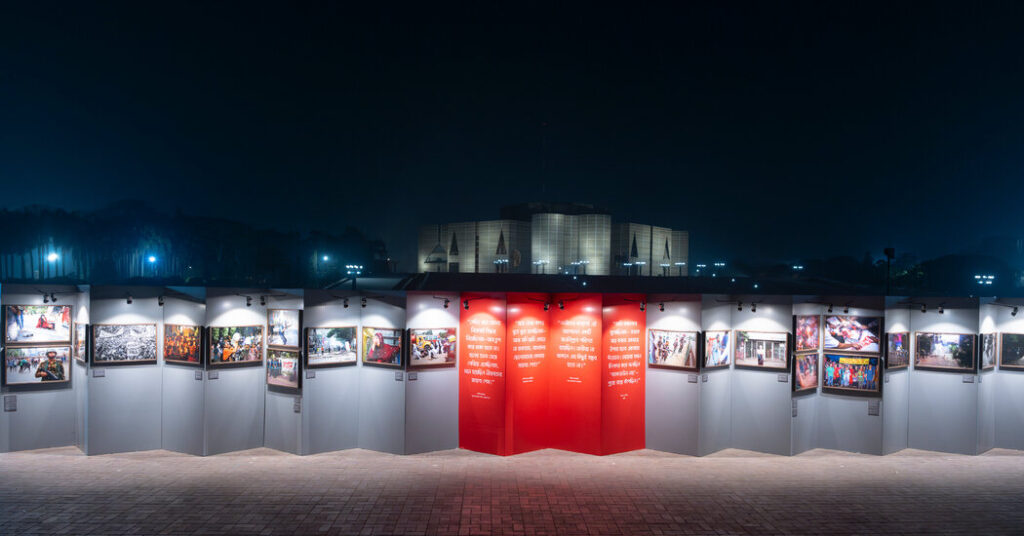
Earlier this year I visited Dhaka, the capital of Bangladesh and the second most populous city in the world, where I met dozens of scrappy photographers during the installation of Chobi Mela. Known locally as the longest-running and most nationally diverse festival for the medium in Asia, Chobi Mela (“photography festival” in Bengali) has run since 2000, roughly biennially. This year’s edition revealed what might be the most subversive and adaptive photography scene in the world right now.
“This is The Time”
The festival, which ran for two weeks in January, was showing 58 photographers, from Bangladesh and 17 other countries, with programs for the public daily. Attendance, the organizers told me, topped 70,000. What revealed the gumption of the scene was the political uncertainty in the streets.
Five weeks remained until a general election for prime minister. The first free election in a generation, it would replace the interim government that had been keeping a relative peace since the summer of 2024, when student protesters rose in the streets, ousting Sheikh Hasina, the strongwoman prime minister of more than 15 years, who fled by helicopter to India and was later convicted in absentia of crimes against humanity in connection with a bloody crackdown on the protests. A wave of new holidays in the country — including July Mass Uprising Day, which celebrates the day Hasina fled, and New Bangladesh Day, which marked the anniversary of the interim government that replaced her — have been treated with the sense of possibility and rebirth that July 4 once commanded in America.
In January, Bangladesh was largely stable. But just before my visit there had been bouts of sectarian violence, political assassinations and the torching of newspaper offices. Would the coming election be fair? (In February some 76 million Bangladeshis voted the opposition leader Tarique Rahman into office, and out of exile, without violence.)
“There is some kind of tension in the air,” said the photographer Munem Wasif, one of this year’s curators, as he strode through the National Art Gallery that would soon house part of the show. The building is the tall and imposing center of the Bangladesh Shilpakala Academy complex. Disused since Hasina’s ouster, it now housed the army.
“We can’t just sit back and think there will be an ideal moment,” Wasif added, as he passed a group of soldiers with machine guns. The hooah! of their drills boomed through the complex, and their laundry flapped from the balconies. “This is the time we need to respond.”
Part of that response was to reckon with the immediate past. On view, Mosfiqur Rahman Johan, 28, photographed the families of political dissidents whom the prior regime had disappeared. Elsewhere, an outdoor exhibition showed photos of the summer 2024 protests with a focus on women. Under Hasina, such candor would have been unthinkable. Until she left, Johan had to publish under a pseudonym.
In Dhaka, even the photographers of the past (Ernest Cole, the apartheid chronicler from South Africa, was one) landed harder than they possibly could have in Arles, Lagos or New York. The show reminded me why the context of public display can matter just as much as the photographs themselves.
Photographing the Struggle
Wasif entered a large, busy gallery. It was day two of installation. Women mopped. Hammers cracked. Young photographers — many of them students or alumni of the Pathshala South Asian Media Institute, where Wasif and his co-curator Sarker Protick teach photography — sat at folding tables, their laptops tangled with chargers.
Contributors from Sudan, Myanmar, Kashmir and elsewhere had submitted work that dealt with familiar themes of state hostility, civil war, independence and democracy.
Palestine was the biggest foreign presence. On a far wall, preparators huddled around 39 small framed prints. Each print was a smear of messy pixels. Only vaguely could you make out human faces, a building, a hospital bed.
These prints, Wasif explained, were screenshots of video calls captured by the Palestinian photographer Taysir Batniji from his home in France. Like many of his fellow expats, Batniji would attempt to reach his family by WhatsApp, through their failing wifi, whenever Israel sent another round of drones. His glitchy screenshots captured the fog of technology that makes distance its own toll of war.
Some things can’t be photographed. “We were interested in different kinds of rhetoric and strategies that the artists are adapting to speak about the world we’re living through,” said Wasif, 43, himself a photographer. “Though it’s an image-based photographic festival, we really want the audience to think, to sit, to listen, to read.”
We passed a group of vaguely surreal photographs documenting the dreams of different foreign exiles in England. They were shot by the Iranian photographer Amak Mahmoodian, a political exile in Bristol. “When you are in exile, you are all united,” she said in an interview by phone. “It’s about the collective narrative.” When we spoke, Iran was 10 days into an internet blackout and a fatal government crackdown not unlike Bangladesh’s in 2024 — except Iran’s snowballed into a U.S.-led assault.
Wasif said of the countries on view: “We have a lot of similarities in terms of struggle, but there is no infrastructure to bring us together. It’s only when you look at some historical moment when you see how connected we are.” Then he disappeared into a large gallery pungent from a fresh coat of cranberry red paint.
“The Only Really Relevant Art Medium”
In walked Sarker Protick, Wasif’s co-curator. Protick has a boyish face that belies his graying beard and mentorly aura. A gifted and atmospheric photographer of landscapes and people, Protick shot a Time magazine cover of Hasina at her height in 2024, then a Time story on her interim replacement, the 2006 Nobel Peace Prize laureate Muhammad Yunus. Protick has since photographed the new prime minister, Tarique Rahman.
The Time shoots explained the turbulence of Bangladesh’s regime change. But not its struggles to connect to like-minded countries.
“It’s very difficult for us to bring an artist from Latin America or from Africa or from India,” Protick said. “There’s no big funds for that.” Several corporate sponsors backed out this year, citing political instability, and each of the photos on display arrived as electronic files and were printed here in Dhaka — a handoff necessitated by shipping costs and customs bureaucracy.
Protick checked his phone. Tea time. He crossed the plaza full of soldiers, then dodged a river of rickshaws to the far sidewalk.
While a vendor poured us chai, Protick, 40, who has been a resident curator of Chobi Mela since 2017, described the slow demise of the government building he and his colleagues were hurriedly fixing up. Its storage rooms of historically significant Bangladeshi paintings now molder in humidity. Hasina used the facility for propaganda murals and sculpture.
“In Bangladesh the only really relevant art medium is photography,” Protick said, half-shouting over the car horns, “because photography was never part of the institutional or government-supported mediums. It was planted separately.”
It was planted mainly by the godfather figure Shahidul Alam.
Changing the Storyteller
Close to the center of town, I met Alam, 71, at the Drik Picture Library, the archive he founded in 1989. The building also hosts Pathshala, the school he opened in 1998, which offers a bachelor’s degree in photography, and the headquarters for Chobi Mela. (In 2018 Alam spent more than 100 days in prison for criticizing the Hasina regime’s violence.)
“If you want to change the story, you need to change the storyteller,” Alam said. In the 1980s, Alam said, he had been to the Rencontres d’Arles. He found it thrilling but globally lacking. He was also fed up with the trope of the impoverished Bangladeshi, powerless to comprehend his past and therefore alter his fate. “Who,” Alam asked me, “creates the image on which the perception is based?” So he founded his own festival.
For 25 years the arms of Alam’s empire — Drik, Pathshala and Chobi Mela — have worked together to revise Western misconceptions about documentary in South Asia.
But Chobi Mela also teaches Bangladeshis about their own history.
In a corner of the office an Epson the width of a small car was slowly spitting out a sheet. “This is the only museum-grade printer in the country,” Protick said. Here he and his colleagues were printing hundreds of electronic files submitted by the participants of the festival.
Technicians in white gloves were stacking the day’s fruits: prints by the Bangladeshi photographer Amanul Huq (1925-2013), who shot well-known covers for the Dhaka magazine Bichitra and collaborated with the Indian filmmaker Satyajit Ray.
Huq’s archive represents a strange combination of dramatized and candid documentary. He photographed the first martyrs of the so-called Bengali Language Movement in the 1950s, and West Pakistan’s killing of hundreds of thousands in 1970 with occasional staged elements reminiscent of the American war photographer Timothy O’Sullivan.
For the Chobi Mela show, Protick chose 83 Huqs for display at the Bangladesh National Museum. It was Huq’s first retrospective, and though Protick didn’t shy away from a ghastly image of a skeleton from the ethnic cleansing that led, in 1971, to Bangladesh’s liberation from West Pakistan, Protick leaned on later, more touching and mainly rural photos of nation-building.
His favorite: a young man gondaleering his family through a marsh. From the boat, two children meet your eyes dead-on. The foreground is a thin strip of plashed water. But the background seems boundless: an infinity of grass sparkling in the sun.
Protick waxed about the textures, the echoes of American road photography. Then he paused. “It’s a typical Bangladeshi landscape,” he said. Because of constant erosion, “our rivers break down. But after a while all this sediment gathers again and builds new land, and that’s all the grass you see,” Protick said, pointing. “This low land you see is actually new land rising from the water.”
The post America250? Try Bangladesh 2. appeared first on New York Times.