I don’t generally like watching sports — which might be an odd admission when the entire globe seems obsessed with the World Cup. I don’t feel attached to any particular team. For whatever reason, fervent displays of happiness and excitement make me uncomfortable — except, I suppose, after a dictator is overthrown by mass protests. My aesthetic sensibilities are offended by sports jerseys. As they say, there is no accounting for taste, because it really does come down to instinctive and sometimes visceral reactions to what we see and experience around us.
But I’m changing.
I went viral a few years ago for an ill-considered tweet expressing my dislike of sports as a collective ritual. I was in my hometown of Philadelphia on a Sunday when the Eagles were playing, which made it seem like a betrayal to fans. As sociologist Emile Durkheim wrote, sacred things are “set apart and surrounded by prohibitions.” It was as if I were criticizing their religion, and in a way I was. This was their day of devotion, with Sunday football mimicking — or even replacing — church as a weekly ritual. The stadium had become the new house of worship.
Now, I’m much more sympathetic to anything that provides a sense of communal pride, bringing people (peacefully) around shared identities. I believe we all have a religious impulse — a desire to become one with something transcendent, something beyond ourselves. Whether or not we realize it, we yearn for ways to express that impulse.
Much of my writing and research revolves around the role of religion in creating a sense of belonging, featuring community rituals and what Durkheim famously called “collective effervescence,” in which individuals are “transported into a special world entirely different from the ordinary.”
Like religion, sports are a way of creating the unusual and the extraordinary. Slowly, I am starting to understand this.
Sports help create bonds of understanding between people who otherwise would have little in common. As conservative writer Patrick Brown observes, “Sports contribute to stronger social capital: they give us something to talk about at the proverbial water cooler.” It isn’t quite Christianity. It’s “Sportianity,” as Sports Illustrated writer Frank Deford put it in 1976.
I’m spending the summer on a sort of mini-sabbatical in New York City, as good a place as any to become a convert. As it happened, I arrived a day before Game 5 of the NBA Finals. Twenty-four hours later, I was in the streets with Knicks fans celebrating their unlikely victory. I hadn’t even realized that the Knicks were competing for the championship until a few days before. But the good thing about most “religion” is that anyone can take part. And so I did. And it was like nothing I’ve ever experienced — except, perhaps, when I was in Egypt’s Tahrir Square the day dictator Hosni Mubarak fell from power in 2011 after nearly 30 years.
This is also the season of the World Cup, which furthers the sports-as-religion metaphor in interesting, unexpected ways. Here, the object of loyalty is the nation, expressed through one’s national team, although it can become complicated. Some conservatives might see star American striker Folarin Balogun as an “anchor baby.” His Nigerian mother gave birth to him in Brooklyn after she was prevented from boarding a flight back to Britain because she was seven months pregnant. America’s tradition of birthright citizenship, recently upheld by the Supreme Court, meant that he was American. Balogun grew up in London. He could have played for England or Nigeria but instead chose the United States.
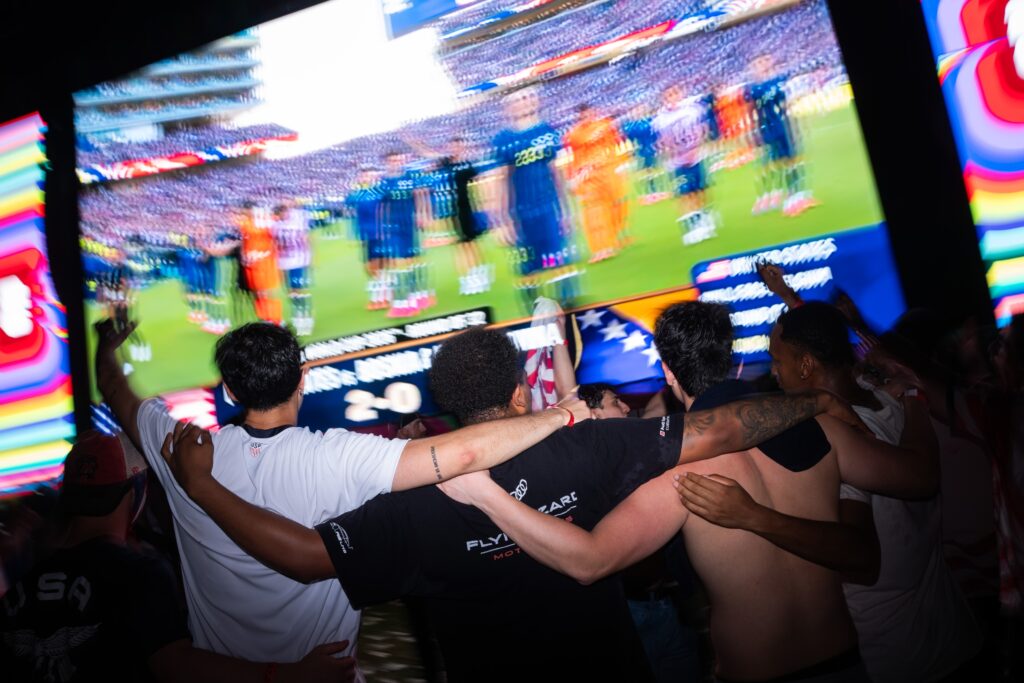
Regardless of whether fans here realized it, to cheer for the U.S. meant, at least indirectly, cheering for American ideals. I was watching the U.S. men’s soccer team beat Bosnia last week in a loud, boisterous bar in the East Village. After Balogun scored the first goal, some fans next to me broke out in a “U.S.A.” chant. For a moment, I experienced a tinge of discomfort, not being used to such overt displays of American patriotism in the era of Donald Trump. The moment passed. I smiled. A feeling of pride washed over me, and I knew that millions of my fellow citizens would feel the same. This was my country, and it was worth paying tribute to, warts and all.
But there was also the home country of my parents: Egypt. And this is where I really felt it, in a loss to Argentina on Tuesday that was as painful as it was exhilarating. Egypt has underperformed on the world stage for much of my life. It, too, had been a nation divided, during the tumultuous years of the Arab Spring. Soccer, though, is perhaps the one thing that unites Egyptians. At a hookah lounge in Astoria’s Little Egypt, I sat and stood and shouted with other Egyptian Americans who marveled, as I did, at these scrappy upstarts. The “I” became a “we.”
Obviously, devotion to a nation can be dangerous, but sports allow us to express those tribal identities in a way that’s (mostly) constructive. In the modern world, most of us aren’t going to go to war and invade a foreign country. That’s a good thing. In his defense of American football, sportswriter Ethan Strauss explains that “modern life might be unfulfilling, but the fact remains you’re unlikely to die on a beach separated from your entrails. Still, the old imperatives remain. We have war within us, whether or not there’s one to wage.” If men have the thirst for war in their very being, then they need outlets for expressing it in peaceful ways.
What do fans feel? They can feel, as Knicks fans did for decades, intense disappointment and yearning. And that sense of failure, now redeemed, was what brought New Yorkers together. Mayor Zohran Mamdani said it particularly well: “So often, when this city comes together, it is because we are forced to by a moment of tragedy or adversity. What a gift it is to be brought together by pure, unfiltered joy.”
Similarly, the success of the American team in the World Cup was the success of all Americans. And its defeat was our defeat. We could forget, briefly, that we are a nation divided by party or candidate. Like religion, sports are an arena of life where we bracket our normal ways of being and enter another mode of belonging. The “spiritual” high we experience is temporary, but it’s something we can remember and return to.
In “The Joy of Sports,” Catholic theologian Michael Novak argued that “sports flow outward into action from a deep natural impulse that is radically religious: an impulse of freedom, respect for ritual limits, a zest for symbolic meaning and a longing for perfection.” He’s at least partly right. As I wrote in a previous column, we need religion, but not everyone is going to be religious or comfortable with organized forms of religious life. Sports can help fill the void of meaning and belonging that so many of us feel.
Somewhere in Philadelphia, there’s a version of me a few years ago, sitting alone on a Sunday, irritated at an Eagles fan for being loud about the wrong things. I understand him more than I used to. Maybe that’s the right direction for understanding to move — toward the Knicks fans, toward the U.S.A. chant that startled me before it moved me, toward whatever it is that made Tahrir Square and a spontaneous Knicks celebration feel, even if just for a moment, like they belonged to the same part of me.
Politics, of course, is the other pastime that can fill our God-shaped hole. We’ve seen the results of that — they aren’t great. The stakes are simply too high in political combat, where every election feels like the most important of our lives. Sports share the intensity of politics, but the stakes are lower. America didn’t win the World Cup. And that’s fine. There is disappointment, even anger, but there have been no riots. Whatever tribalism sports demands of us, it’s gentler than what we bring to the ballot box. And that’s its own kind of mercy.
The post I mocked sports fans. Then I became one. appeared first on Washington Post.