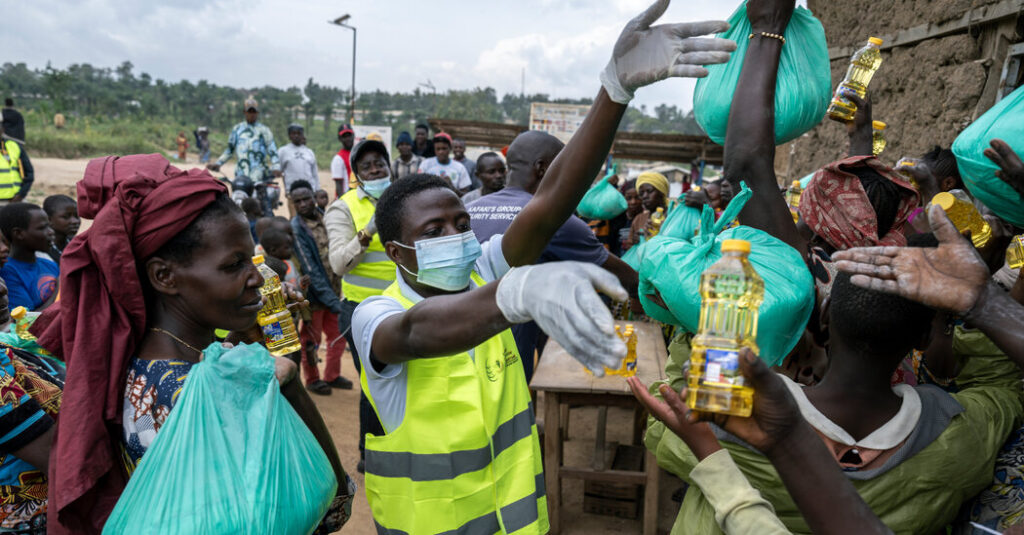
The deadly Ebola outbreak in eastern Democratic Republic of Congo is moving faster than efforts to contain it, raising fears about what might happen if it explodes in highly populated areas held by M23, the powerful rebel group that seized vast swaths of territory last year.
Ebola cases have already been reported in the rebel zone, including one infection in the city of Goma, the rebel headquarters. Transmission for the moment appears to be low there, according to figures released by Congo’s health ministry, but hot spots are getting closer and closer to occupied areas, moving south from the epicenter in the province of Ituri.
When M23 seized territory last year, thousands of people were killed, and hundreds of thousands were displaced. Now, the rebels impose taxes, control public utilities and present themselves as the only legitimate authority in their territory, which includes two provincial capitals, Goma and Bukavu.
Officials say a full-scale outbreak in M23-controlled areas would be devastating for civilians trapped by fighting and the virus. But it may also present an opportunity for the rebels. If M23 manages to contain Ebola successfully, it could bolster the image it has cultivated as a legitimate authority, at a time when the Congolese government is struggling to get the outbreak under control.
M23 rules over a population that is highly skeptical of Ebola. Some Congolese have called the virus a hoax meant to line the pockets of government officials and foreigners. Isolation wards in Ituri have recently been burned and medical workers violently attacked.
During an outbreak in 2018, hundreds of millions of dollars flowed in for the Ebola response and some funds were misused, leading to the health minister’s imprisonment for embezzlement.
Against this backdrop, M23 has set up an Ebola task force, produced slick videos documenting visits to laboratories and treatment centers and released cartoons about hand washing.
It has introduced measures aimed at containing the spread, like limiting the number of passengers allowed on buses, and accused the Congolese government of “indifference” toward those in Ituri.
Congo’s neighbor, the tiny country of Rwanda, has supported and supervised M23 for years and has stationed between 14,000 and 18,000 troops in Congo, according to a United Nations panel of experts.
But the Congolese government says M23 is in no position to handle the outbreak. “Both the M23 and Rwanda are ill-equipped to run an emergency response for a threat of this magnitude,” said Thérèse Kayikwamba Wagner, Congo’s foreign minister.
For health workers to have unfettered access and be able to do their work, she said, “Rwanda must leave the D.R.C.”
Responding to a request for comment, Rwanda’s government said it was accelerating the withdrawal of Rwandan troops from Congo after a peace agreement brokered in Washington last year. Rwanda closed its borders to Congo in May, when the outbreak was first detected by the World Health Organization, but has since partially reopened them.
Many people living under M23’s rule refused to comment for this article, fearing for their safety.
One medical worker in South Kivu province said the Ebola response had become so politicized that speaking out was dangerous. Even sharing situation reports — normally widely disseminated documents providing infection updates — was not allowed, the worker added.
Congolese health officials have hardly any visibility into what is happening in rebel territory beyond a few basic numbers about infections, contact tracing and deaths that cannot be independently verified.
Dieudonné Kazadi, the director of Congo’s National Institute of Public Health, said he had no information about what was happening in rebel-held areas. “I can’t give you the situation in the territories occupied by M23 because I don’t have access,” he said.
M23 has kept two key airports in the area closed since the rebels seized territory last year, despite calls from the United Nations and the United States to reopen them for humanitarian aid during the outbreak.
Rwanda has gradually eased restrictions, allowing humanitarian supplies and workers, and now some civilians through. The rules were adjusted to “protect both our population and the region while minimizing unnecessary disruption,” said Rwanda’s health minister, Sabin Nsanzimana.
This Ebola outbreak could become the worst in history, partly because the species of the virus, known as Bundibugyo, was identified so late. Congo’s health ministry said on Sunday that there were 1,561 confirmed cases in the country and 506 confirmed deaths.
“We have to plan actively around an explosion of cases, which will descend in the Kivus,” said David Munkley, the east Congo director for the Christian humanitarian organization World Vision.
Dr. Jean Kaseya, the head of Africa Centres for Disease Control and Prevention, said in an interview that verifying virus reports in rebel territory was currently impossible.
“Independent people don’t get access there,” he said.
Trying to contain an outbreak across rebel lines requires careful diplomacy, he added. He has shuttled between capitals in the region, meeting regularly with Congo’s president, Félix Tshisekedi, and others.
A planned meeting with President Paul Kagame of Rwanda has not yet been scheduled, though Dr. Kaseya said he works closely with Rwandan officials.
“The very first day I was informed about the case in Goma, I had a conversation with Rwandan authorities. And we started to coordinate from that day,” he said. One of his aims is to secure vital access for health workers and humanitarians working on the response.
M23 has also been accused of treating the crisis as a financial opportunity.
One health worker in M23 territory who spoke on condition of anonymity for fear of retaliation said rebels are constantly calling health authorities in the area, like hospital directors and chief medical officers, asking about Ebola funds. The health worker accused the rebels of trying to siphon money meant to stop the outbreak.
Despite the politics of the outbreak, a degree of technical cooperation exists across the front lines. Some test samples in rebel areas have been sent to Kinshasa, the capital, and others from Beni, in government-controlled North Kivu province, to the laboratory in Goma.
The Congolese government continues to pay health workers and laboratory technicians in M23-held areas, and it collects data about cases, testing and contact tracing, though health officials cannot independently verify the data.
Most people living under M23 obey the group’s Ebola measures, fearing the consequences of disobedience.
But not everyone.
One taxi-bus driver in Goma, Raimo Mukiza, said he had reduced the number of passengers in his taxi, wore a face mask and carried disinfectant. “Some people follow the measures and others don’t,” he said.
For the millions of Congolese trapped in rebel-held territory, the risk is “to be contaminated by Ebola, or to die by hunger or by violence,” said Denis Mukwege, a gynecologist who won the 2018 Nobel Peace Prize for his work treating victims of sexual violence.
Dr. Mukwege said he has not been able to travel to he hospital that his group, the Panzi Foundation, runs in South Kivu since the M23 takeover last year. He excoriated the United States and others for failing to stop the fighting in eastern Congo.
“The world closes its eyes on this situation,” he said.
The post How Rebels in Congo Could Use Ebola to Consolidate Their Power appeared first on New York Times.