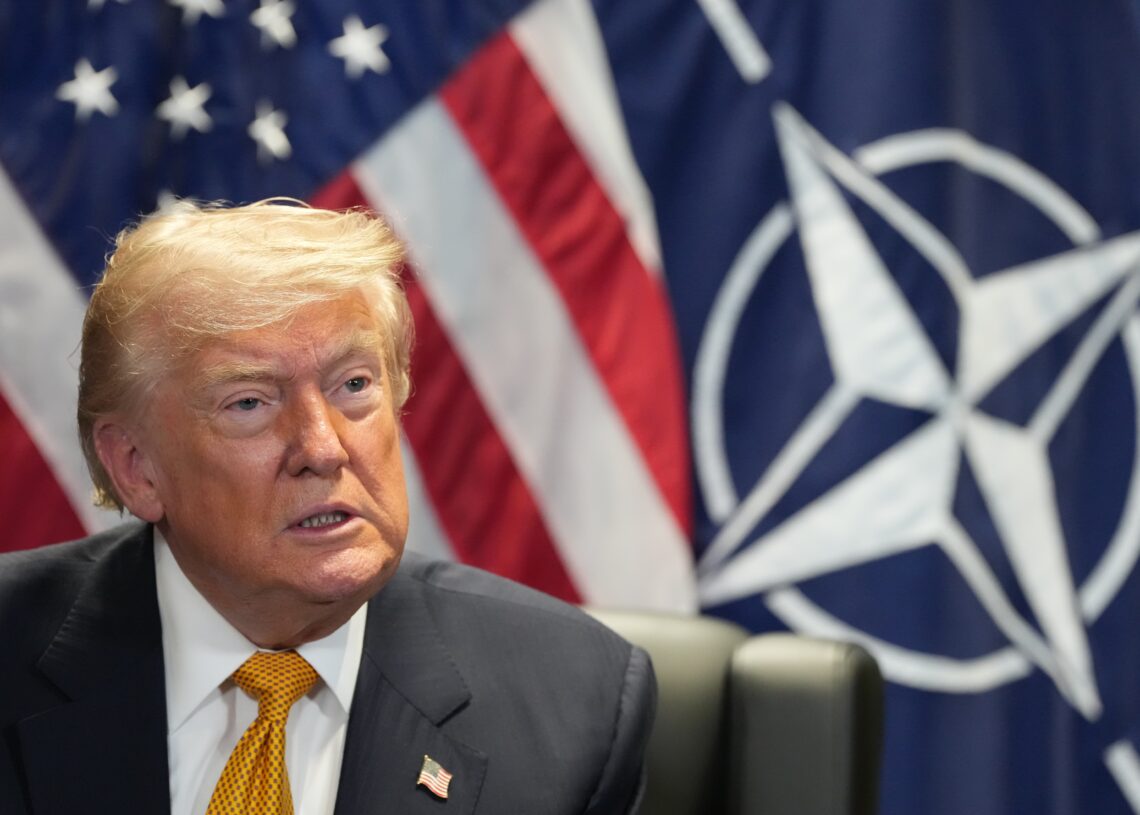
ANKARA, Turkey ― The ceasefire between Iran and the United States is “over,” President Donald Trump declared Wednesday, castigating Tehran after days of escalating attacks and raising the prospect of major renewed hostilities.
“I think it’s over,” Trump said at a meeting of NATO leaders, the morning after U.S. forces launched over 80 strikes on Iran in response to Iranian attacks on ships passing through the Strait of Hormuz.
The president spoke after Iran launched heavy retaliation overnight, with the Islamic Revolutionary Guard Corps saying it had targeted 85 U.S. military facilities including in Bahrain and Kuwait on Wednesday, according to the semiofficial media outlet Fars.
“They’re scum. They’re sick people. They’re led by sick people, and they’re vicious, violent people,” Trump said. “Far as I’m concerned, it’s just a waste of time dealing with them. They’re liars … there’s something wrong with them. They’re cuckoo. As far as I’m concerned, it’s over.”
Trump said that talks with Iran could continue, but that he was deeply skeptical they would be productive.
“They can talk, but I think they’re wasting their time. They’re a bunch of lying guys,” Trump said. “They’re bad people, and frankly, I don’t want to waste my time with them. Now, I’ll let our wonderful negotiators keep talking if they want, but I don’t see it.”
The U.S. and Iran reached a preliminary peace deal last month to reopen the Strait of Hormuz to shipping traffic while continuing to discuss the thornier nuclear issue and possible lifting of U.S. sanctions against Tehran.
But the tentative agreement appeared to collapse less than halfway through the 60 days that negotiators had allotted to reach a more durable accord. Trump previously had expressed hope that the negotiations would lead to strict controls on Iran’s nuclear program.
The renewed hostilities were a setback for the president, who cited his concern about becoming a new Herbert Hoover as a major reason for seeking peace when he announced the initial deal last month. Hoover was president at the start of the Great Depression in 1929.
Trump had been focused on reopening the Strait of Hormuz, a crucial shipping choke point through which 20 percent of global oil products flow. Iran closed the strait to shipping traffic soon after the U.S. and Israel initiated the war in February.
Oil prices had eased but they quickly spiked on Wednesday. Brent crude futures rose more than 6 percent to $79 per barrel on fears that a renewed war would further disrupt energy supplies.
Iranian leaders, too, had seemed to be interested in peace. The country has been focused on days of mourning and funeral rites for its supreme leader, Ayatollah Ali Khamenei, who was killed in an airstrike during the first hours of the war.
In the U.S., Iran hawks criticized the tentative deal for relieving economic pressure on Tehran while leaving the trickiest subjects for later.
Subsequent negotiations had stalled. Talks began with days of delays before Vice President JD Vance flew to Switzerland to kick them off. But the two sides traded barbs, and sporadic strikes, from the get-go. And Trump expressed frustration on Wednesday that Iran’s public representation of what was being discussed differed from his understanding.
“We make a deal. Everyone’s agreed. No nuclear weapon. We make a deal. They go outside, joke to the press, they say we never even talked about it,” Trump said.
Iran’s leaders in recent days have appeared emboldened, with several senior officials appearing in public for the first time since the start of the war as part of the mourning rituals for Khamenei.
Late Tuesday, U.S. Central Command, which oversees U.S. military operations in the Middle East, said it had targeted more than 80 Iranian sites as “an immediate response to Iran’s latest attacks on commercial vessels transiting the Strait of Hormuz.”
The vital, narrow waterway has been at the center of tensions between Washington and Tehran for months, as the halting of cargo traffic led to a global spike in oil prices and to supply-chain shortages.
The U.S. strikes hit Iranian air defense systems, command-and-control networks, coastal radar sites, anti-ship missile weapons and more than 60 small boats associated with the IRGC, Iran’s paramilitary force, the U.S. statement said. The effort is meant to degrade Iran’s ability to continue attacking commercial shipping.
Both the U.S. and Iran accused each other of violating the previously agreed-upon ceasefire.
Iran’s parliamentary Speaker Mohammad Bagher Ghalibaf said “the era of bullying and extortion is over,” in a post on X Tuesday. “It leads nowhere. We don’t fold,” he added.
Kuwait’s military said overnight air defense systems were activated in response to missile and drone attacks. The country’s Ministry of Foreign Affairs condemned Iranian aggression while efforts to de-escalate regional tensions are underway.
In Bahrain, the Interior Ministry said sirens had been sounded and people were urged to take shelter. Authorities in Kuwait and Bahrain did not say if the Iranian strikes had caused damage or injuries.
Craw reported from London. Dan Lamothe in Washington contributed to this report.
The post Trump says ceasefire with Iran is over, calling its leaders ‘scum’ appeared first on Washington Post.