NAJAF, Iraq ― Funeral rites for the Iranian supreme leader, Ali Khamenei, shifted on Wednesday to neighboring Iraq and the holy city of Najaf where Shiite Muslims from around the world are often brought to be buried near the shrine of Imam Ali, cousin and son-in-law of the Islamic prophet Muhammad.
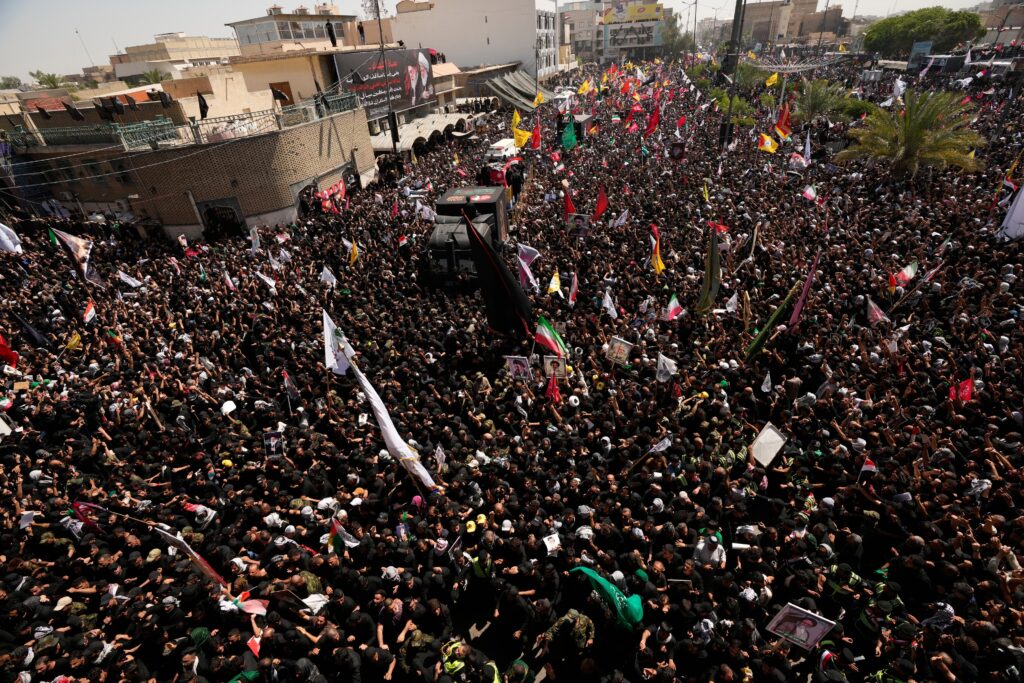
Khamenei will be laid to rest in his hometown of Mashhad in eastern Iran. But in Najaf, his coffin, equipped with nitrogen gas and dry ice technology to preserve his body, was carried through the streets on a truck during a procession attended by an estimated 2 million people.
On the roads leading to the shrine, black flags hung from buildings, and giant black-and-white portraits of Khamenei accompanied by slogans promising revenge were displayed throughout the city. Huge throngs surrounded the truck and surged forward as it rolled by.
A senior Iranian diplomat, speaking on the condition of anonymity because he was not authorized to talk to the press, said one goal of the public outpouring was to demonstrate Tehran’s continuing influence in Iraq despite Washington’s effort to hold sway in Baghdad.
“One of the main missions of the funeral is to show Iranian influence in Iraq for the global audience,” the diplomat said. “Tehran intends to mobilize the largest possible turnout to convey the message that Iraq is neither Syria nor Lebanon — this is the scale of our influence.”
That message was intended to land just days before Iraqi Prime Minister Ali Falih al-Zaidi travels to Washington to meet President Donald Trump.
The funeral procession, which started at Najaf Airport, was set to continue to another holy city, Karbala, before returning to Najaf, all under the military protection of Iraq’s Popular Mobilization Forces.
As the coffin, draped in the Iranian flag, arrived at the airport, a heavy crush developed among Iraqi officials and attendees attempting to reach it.
A group of Shiite members of parliament began chanting, “Death to America! Death to Israel! We will avenge our leader!” Several lawmakers wept uncontrollably, striking their heads and shouting, “We have lost our leader!”
Prominent officials who traveled to Najaf for the ceremonies included al-Zaidi, Iranian President Masoud Pezeshkian, Iranian Foreign Minister Abbas Araghchi, commander of the Quds Force of the Islamic Revolutionary Guard Corps Ismail Qaani, and a broad range of Iraqi political, religious, tribal and public figures.
Security forces repeatedly paused the convoy as mourners surged forward trying to touch the vehicle or catch a glimpse of Khamenei’s coffin.
The atmosphere mixed religious mourning with political messaging.
Loudspeakers alternated between Shiite eulogies, revolutionary anthems associated with Iran and audio clips from the final speeches of Khamenei, who was killed in an airstrike on the first day of the joint U.S.-Israeli war on Iran, and Hasan Nasrallah, the Lebanese leader of Hezbollah who was assassinated by Israel in 2024.
The procession also highlighted Iraq’s political divisions. Many attendees described their presence as a religious obligation and a political statement of solidarity with Iran and the “Axis of Resistance.”
Others watched quietly from sidewalks or stayed away altogether, reflecting the unease many Iraqis feel about the country’s close relationship with Iran.
Haider al-Amari, 52, said he drove through the night for five hours with relatives from Basra in southern Iraq to attend. He could not find a hotel to stay in, so they slept outside in a public garden.
“Whatever people think politically, he was a religious leader for millions,” Amari said. “I wanted to be here for this historic moment. He died fighting the enemy and he died fasting. He is the martyr of Islam.”
Ali Salman, 20, a university student from Baghdad who traveled with friends, said they arrived before dawn after sleeping in their vehicle just outside Najaf. “We knew the roads would close. We wanted to be here to pay respect to our imam,” ,” Salman said, referring to Khamenei.
Mohamed al-Jassani, a political analyst from Najaf, said the giant outpouring of grief and support for the assassinated Iranian supreme leader pointed to decades of missteps by Washington in the region.
“What you are currently seeing is the biggest evidence of the failure of American policies in the region,” Jassani said.
“The Americans spent trillions of dollars to kill Khamenei and end the mandate of the faqih,” he said, referring to Khamenei with the word for an Islamic scholar. “These millions are here to send a message to America that Iraq and Iran are one body. It is not possible to part.”
That view was not universal. A shopkeeper in central Najaf, who spoke on the condition of anonymity because of the fear of reprisal, said he did not like what he was seeing.
“There are so many armed groups and security forces that most people are staying home,” the shopkeeper said. “Some support this funeral, others simply want it to end peacefully. He is an Iranian leader who died in his country, I just don’t understand why the whole state of Iraq are shutting down everything for his funeral.”
Another resident of Najaf, who also spoke on the condition of anonymity, said the funeral illustrated a gap between Iraq’s official government policies and realities on the ground.
“You hear the government talking about limiting weapons to the state. Then you see this,” the resident said, gesturing toward the columns of heavily armed PMF fighters lining the route. “The message today is very different, I have a relative who died in the Iraqi-Iranian war, I have so many friends who were killed during the demonstrations in 2020. They were killed by Iranian groups based on a fatwa [religious decree] by Khamenei. It’s just not right to have a state funeral for a person who fought our country.”
Indeed, thousands of PMF members were deployed across Najaf’s streets, many carrying portraits of Khamenei while distributing free food and drinks to the public.
Every armed faction operating under the umbrella of the “Islamic Resistance in Iraq” has appeared openly, filling the city with banners reading: “The Islamic Resistance in Iraq will continue taking revenge for the martyrs.”
That display appeared to contradict assertions by al-Zaidi, the Iraqi prime minister, that the militant groups had agreed to surrender their weapons.
Former Iraqi prime minister Nouri al-Maliki, who attended the ceremonies, said: “Today’s message from Iraq clearly confirms that the Islamic Republic is not alone. There are those who stand with it and support it, that it is on the side of truth, and that it has many supporters across the world — even if some peoples are unable to express that openly because of the political circumstances in which they live.”
As Khamenei’s coffin, draped in an Iranian flag, arrived at the shrine, the vast crowd chanted: “Death to America! Death to Israel!”
A loudspeaker blared a message back to them: “Your presence here in these millions is the strongest message to the deranged Trump: We will remain loyal to our leaders and our faith.”
The post Funeral rites for Iran’s supreme leader shift to Shiite cities in Iraq appeared first on Washington Post.