The World Cup has reached new heights of cinematic excitement with glorious upsets, last-gasp turnarounds and controversies galore. In a written online conversation, the Times Opinion editors John Guida and Tim Schneider hosted Marcela Mora y Araujo, a soccer writer; Anton Jäger, a contributing Opinion writer; and Rowan Ricardo Phillips, a poet and sportswriter, to discuss the United States-Belgium match, the state of the tournament, nationalism in sport and in politics and, of course, a video-assistant-referee intervention from a certain national leader.
Tim Schneider: Let’s start with Monday night’s game: a big win for Belgium over a slightly hapless United States side. What did you all make of it?
Marcela Mora y Araujo: I think it’s fair to say soccer was the winner. It was redemption.
Anton Jäger: One of the downsides of being an avid Belgian fan is that your team rarely, if ever, plays stress-free games. Exceptionally, I watched Monday’s duel without clenching my teeth. Belgian matches are extremely dependent on mood, and luckily the team received some foreign backing after this week’s meddlesomeness. Not as spectacular and exhilarating as the éclat against Senegal, but relaxing. A Belgian rarity.
Rowan Ricardo Phillips: I think “slightly hapless” is being kind. For all the confidence surrounding the Americans before kickoff, they ran into a team that was simply operating at a different level. The deeper problem isn’t talent so much as identity. The United States still doesn’t seem to know exactly what it wants to be in tournaments like this. The best national teams arrive with a recognizable way of playing that survives pressure, adversity and substitutions. The United States still looks like a collection of players searching for a collective idea.
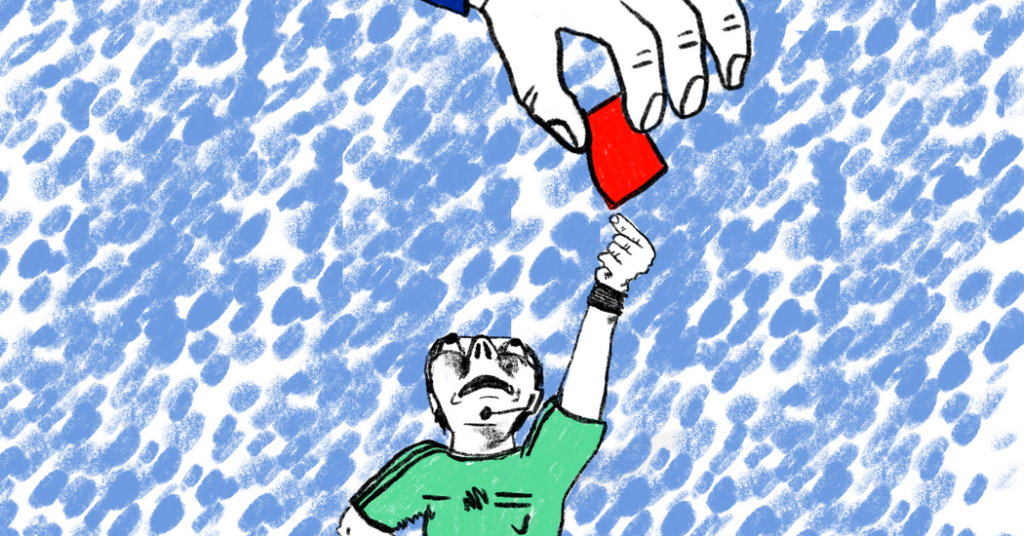
John Guida: You all alluded to a non-soccer event leading up to the match. Until this one, President Trump had not interfered or really been a factor in the tournament. And then he was. Did his intervention, seemingly pressuring FIFA to drop the suspension for the U.S. striker Folarin Balogun, matter to the game last night?
Mora y Araujo: I think without a doubt Trump’s intervention had an impact on the game last night. Perhaps Mauricio Pochettino, the U.S. coach, could have handled matters differently — but his open support for the decision left his players vulnerable. It’s as if a good campaign that had the support of plenty of people around the world was undone in a single hideous off-the-pitch saga. And the players didn’t look comfortable, especially Balogun, who clearly was the main victim.
Phillips: The U.S. players say it didn’t matter … and that’s what they would say. But it certainly mattered to the Belgians, who played with a sense of greater stakes: that they were defending the game against crude intrusions of political power. Belgium’s captain, Youri Tielemans, acknowledged it was motivating. “Overturn this” wasn’t just a joke. It was Belgium’s way of saying that soccer, not political intervention, had settled the matter. The big tell was that Balogun made a beeline directly to Rudi Garcia, the Belgium coach, after the match to explain himself. You don’t do that if what happened wasn’t on your mind.
Jäger: As I said, mood dependency looms large for Belgium in these tournaments. It has already cost them a few games that seemed perfectly winnable. I find it hard to see how they could have found the zest for this game without the presidential interference hovering over it; nothing fuels aggression like a sense of unfairness, and aggression is precisely what Belgium needs. So I’d say it was crucial but not indispensable. At the same time, Belgium’s playacting as anti-imperialist spearhead did come across as rather cheap. Last time I looked, NATO is still headquartered in Brussels!
Guida: Rowan, Marcela noted that “plenty of people” globally had become enamored with the U.S. team. The team certainly seemed quite popular in the United States — a rare point of consensus in a country with deep political divisions. What does this mean for U.S. soccer, and for U.S. politics?
Phillips: I think this means more for U.S. soccer than for U.S. politics. For U.S. soccer, this felt like a threshold. In some ways, the United States still occupies the place it has for just about every World Cup it has appeared in: good enough to command attention, not yet good enough to shape the tournament. Yet the old question of whether soccer has “arrived” in America now feels exhausted. Soccer is here. The harder question is whether the American game can produce not only talent, markets and attention, but also a recognizable soccer culture: a way of playing, thinking, losing, learning and remembering together.
Schneider: Anton, as you say, Belgium is central to European geopolitics — the seat of both NATO and the European Union. In soccer, too, it has punched well above its weight in the past decade, and yet national success seems elusive. How does Belgium see itself, in both sport and politics?
Jäger: Nothing is more tempting than reading national sports events as weather vanes for national moods. I cannot say I’m immune to the temptation. The fervor with which Belgian citizens cheer on their team has something compensatory to it. Except for the king, there are almost no symbols of national unity. That means the team plays an outsize role in uniting an otherwise fractious nation. But its status as a unifier is always precarious: Many Belgian players play abroad, in renowned clubs that grant them quite some individual initiative. As a result, the team has always suffered from fissiparous tendencies during tournaments. The same goes for its international standing: geopolitically relevant, but too individualistic for the performance of, say, a cohesive nation-state such as Norway.
Schneider: Marcela, one for you along similar lines. Argentina, famously, is soccer-mad, but the sport’s politics are harder to parse. With the right-wing libertarian administration of Javier Milei at home, is this tournament playing out any differently from the one in 2022 when the center left, led chiefly by Cristina Fernández de Kirchner, was in charge?
Mora y Araujo: Soccer and politics are both intrinsically connected and also quite separate. Milei has been notably quiet — although he has been posting pictures of a jersey signed by Erling Haaland, presumably to troll Brazil — and, as elsewhere, various contentious issues have slid into the background while the games are going on. The Argentina squad, for its part, is untouchable. There is a right-wing trope that Kirchneristas — or Ks, as they’re known — don’t want the team to do well. But that is not supported by the vast number of soccer fans from across the political spectrum. We all take part in the joy and sense of belonging that only sporting victories can provide. After the game, it’s back to all the old divisions and polarities.
Guida: Anton referred to the role of nationalism in soccer, which seems pretty different from the nationalism of populist politics. The British historian Eric Hobsbawm wrote that “the imagined community of millions seems more real as a team of 11 named people.” Could you tease out the differences in nationalism of the soccer pitch versus politics?
Mora y Araujo: Soccer is tribal, and love of one’s own team comes hand in hand with a desire to destroy the other. But it also allows for camaraderie and solidarity after the contest. I think in a country like Argentina, where a high percentage of the population is directly descended from immigrants, soccer has been the main provider of a shared emotional state. But it is a nationalism distinct from other forms of patriotic fervor. It’s about the songs, the banter and a ludicrously funny sense of superiority — from barbecues to biros (a ballpoint pen), suddenly everything Argentinian is “the best in the world.”
Jäger: One element about American sporting events that Europeans quickly notice is that much of the action on the pitch is secondary to being in the stadium. To me, U.S. fans simply don’t pay attention to the game as European soccer fans do. Some see this as a simple sign of commercialization — the stadium as a mall, an advertising opportunity, a cafeteria. But maybe American nationalism also has a spectatorial quality: Could it be less participatory than the European variants? Surely not in every sense, but I feel that American fans on Monday didn’t quite understand that one must not simply watch the match; one has to pretend to be on the pitch with the players.
Phillips: Hobsbawm’s insight is that the nation becomes visible. But soccer also makes it temporary. For 90 minutes, millions of people can invest themselves in 11 players, accept the same rules, the same referee and the possibility of defeat. Political nationalism too often struggles to accept those things. Soccer nationalism asks you to love your own side; it doesn’t require you to deny the legitimacy of the other. The World Cup doesn’t abolish nationalism. It teaches us how to live with rivals. And perhaps that’s because the World Cup isn’t the opposite of globalization but one of its greatest expressions. Every national team is already international. The World Cup doesn’t resist globalization; it stages it. That’s the paradox: The world’s most global game produces some of its strongest feelings of national belonging.
Schneider: The World Cup is billed as a great global festival, and this year’s tournament, swelled to 48 teams, certainly felt extra international. But given Europe’s continued hold over the sport, the question nags: How much of the world is actually in the World Cup?
Jäger: I’m of two minds about this year’s maximalist formula. On the one hand, the American schedule — hydration breaks, omnipresent ads, V.I.P. guests devouring burgers in the background — is deplorable. On the other hand, the supersizing of the pool and the longer match calendar are an enrichment. At the same time, this inclusion has also exposed the lead Europeans still enjoy over non-Western rivals. Global politics becomes less recognizably European every year, but each World Cup Europeans can pretend to be in history’s driving seat for one month. Afterward, it’s back to the harsh reality of the new multipolar world order.
Phillips: Being in the World Cup and being within a shot of winning the World Cup are two completely different worldviews. I was skeptical of the 48-team format, but I’ve come around. What an opportunity it is for nations that would otherwise never experience this stage. As the tournament narrows, Europe’s structural advantages inevitably reassert themselves. But the margins are narrowing. African teams came painfully close to breakthroughs, and Japan once again looked like a nation whose soccer project is moving steadily toward something larger.
Mora y Araujo: I’m also torn about the 48-country format. I preferred it when it was 32; it was easier to predict and felt like it flowed better. Having said that, I think it’s been widely approved of and is likely to remain, if not expand. Traditionally, the World Cup is actually the final stage of qualifying rounds played all over the world across four years. I like that. We should all watch the qualifying rounds more avidly if we truly want to see so much soccer. Some people do!
Guida: The World Cup is often described as an intersection of sports and politics. We have done that here. But do we ask too much of a sporting event by making such demands? Is it a mistake to look at it as a mirror of politics?
Mora y Araujo: International soccer is necessarily a manifestation of the context in which it takes place. But I’m a firm believer that soccer itself has very limited transformative power. Sometimes we have personalities who use their platforms to bring change, who become activists and further particular causes. But in reality the game is about entertainment and free time, the importance of play and the right to have fun — no minor things. Even clichéd ideas about soccer stopping wars and so on only mean that for 90 minutes, some hideous reality was suspended. But after the final whistle, we all return to earth.
Jäger: As others have pointed out, we cannot help but project our politics onto sports since the two are so structurally similar — as the Dutch historian Johan Huizinga once pointed out. Both are collective, competitive and involve anonymous, large-scale identification with strangers. At the same time, I think the type of indignant nationalism that World Cups bring out in otherwise cool-minded members of a nation (myself included) is symptomatic. What other experiences of shared nationhood are still available to us in the 2020s? Few Europeans still get drafted into wars or sing the national anthem at the start of school.
Phillips: I don’t think it’s a mistake to look at the World Cup politically. The mistake would be to ask it to do the work of politics. It certainly shouldn’t be asked to repair a nation every four years. What it can do, however, is show us something politics often obscures: conflict conducted under shared rules, rivalry that requires the legitimacy of the opponent, grief and joy that people enter into freely. The World Cup isn’t a mirror of politics so much as a reminder of what politics has forgotten how to stage — great acts of empathetic togetherness.
Schneider: One mirroring, perhaps, is cultural. I’ve been struck by how much of the coverage has focused on stars — Haaland, Kylian Mbappé, Cristiano Ronaldo, Lionel Messi — rather than sides. What do you all make of the ever-deepening celebrity culture that surrounds soccer?
Mora y Araujo: Ultimately, it is an entertainment industry product, and stars are essential for that. Forty years ago we had Diego Maradona as the king, with heirs to the crown of superstar quality. This year we have some amazing stars. Mbappé is a fabulous character: politically outspoken, against endorsing certain types of products. Messi is the opposite, the enigma, but what a player! And then there are emerging stars like Lamine Yamal from Spain or quirky superheroes like Haaland. How could you skip this factor in the storytelling of the World Cup? Even Vozinha, the Cape Verdean goalkeeper, has joined the pantheon.
Jäger: Agreed. Surely a political culture built around leaders would spawn a sports culture structured around vedettes? What does seem new, too, is the number of teams designed exclusively around their star players, as with Ronaldo’s Portugal; a feature maybe less prominent in the postwar period.
Phillips: There have always been transcendent figures that emerge from World Cups, but today’s media ecosystem places an even greater emphasis on individual celebrity, often detached from performance itself — at times even banking on a performance that never arrives (I’m looking at you, Christian Pulisic). That’s the real shift. The star no longer has to dominate the tournament to remain central to its advertising and coverage. Yet every World Cup reminds us that soccer is still the ultimate team sport. By the end of the tournament, we’re discussing systems, partnerships and collective identity more than individual brands. The game has a way of reclaiming itself.
Guida: Stars aside, do you have a favorite player in the tournament?
Mora y Araujo: Messi. I’m not even going to apologize.
Jäger: Not a riveting remark, but I’m particularly fond of this year’s referees. A much better feel for action and roughness than those in previous tournaments, greatly improving the tempo of the games. Their openness to risk-taking has increased the median quality, I’d say. Keep the sport martial enough!
Phillips: Pau Cubarsí, the 19-year-old Spanish center back. He hasn’t put a foot wrong all tournament and sees passes that many midfielders don’t. What a talent.
Schneider: So, to finish: What would you like to happen from here?
Mora y Araujo: I know what I would definitely not want to happen, and it’s an Argentina-England semifinal! We’ve seen some of the game’s beauty and the emotional positivity it can bring out in people. I would like the remaining matches to reflect that, for the narratives to come from the pitch.
Jäger: Seconding the veto for an Argentina-England showdown. My further demands are modest: Let Morocco crush France and, heretically, stop Belgium from reaching the final. I will be out of the country and would otherwise have to look into booking some (unaffordable) flights.
Phillips: I always want beautiful, exciting matches. If I get that, I can live with the result, no matter what that may be.
Marcela Mora y Araujo is an expert in Latin American and Argentinian soccer and the translator into English of Diego Maradona’s autobiography, “El Diego.”
Anton Jäger is a contributing Opinion writer. He is a lecturer in politics at Oxford University and the author of “Hyperpolitics: Extreme Politicization Without Political Consequences.”
Rowan Ricardo Phillips, the poetry editor of The New Republic and an English professor at Stony Brook University, is the author of seven books, including “The Circuit: A Tennis Odyssey,” and has written extensively about soccer for publications like The New Republic and The Paris Review.
John Guida and Tim Schneider are Times Opinion editors.
The Times is committed to publishing a diversity of letters to the editor. We’d like to hear what you think about this or any of our articles. Here are some tips. And here’s our email: [email protected].
Follow the New York Times Opinion section on Facebook, Instagram, TikTok, Bluesky, WhatsApp and Threads.
The post ‘Trump’s Intervention Had an Impact’: 3 Writers on America’s Heartbreaking World Cup Exit appeared first on New York Times.