In “Little House on the Prairie,” the third book in Laura Ingalls Wilder’s series of beloved frontier novels, there is a chapter titled “Indians in the House.” In it, a pair of “naked wild men” who have a “horribly bad smell” (they’re wearing skunk skins) and communicate via harsh grunts visit the family home, where they swipe Pa’s tobacco and help themselves to Ma’s fresh baked cornbread.
In the new Netflix adaptation of the children’s classic, which premieres on Thursday, Laura offers their unexpected guests cornbread and coffee and chats with one of them about her dog. Through subtitled dialogue we learn the Osage men feel entitled to a bit of hospitality because the Ingalls are squatting on their land and helping themselves to the tribe’s lumber, water and game.
The historical truth of this encounter lies somewhere in the middle.
The Ingallses were indeed squatters, illegally building their “little house” on land that wasn’t theirs. The Osage were the people being robbed, not the other way around.
“We wanted to face that part head on,” said Rebecca Sonnenshine, the showrunner.
But there is no evidence that the Osage discussed why they felt entitled to the family’s cornbread and coffee that day — not that Laura would have understood if they had.
The creators of the new Netflix series wanted to present a more complete and nuanced account of the Ingallses’ sojourn in what was then called Indian Territory. They faced a daunting challenge: incorporating the truth about the Osage experience into the “Little House” narrative while also preserving the story’s heart.
“The books are very one-sided,” Sonnenshine said. “There’s no characterization of the Osage, so we tried to show things from their P.O.V. as much as possible and to make them just as complex and interesting as the Ingalls.”
The novels also include troubling lines like “the only good Indian is a dead Indian” (spoken by a neighbor), which have diminished Wilder’s reputation in recent years. In 2018, the American Library Association removed her name from one of its most prestigious awards, citing her books’ “dated cultural attitudes toward Indigenous people and people of color.”
According to Caroline Fraser, who wrote the Pulitzer Prize-winning biography “Prairie Fires: The American Dreams of Laura Ingalls Wilder,” the author “didn’t have any real understanding of who these people were or what their culture was like, even as an adult writing the book.”
To bring the story into the modern age, the show’s creators have incorporated sympathetic, complex Osage characters, including a family, the Mitchells, whose young daughter, Good Eagle (Wren Zhawenim Gotts), becomes Laura’s best friend. They also added historical context about the Osage Diminished Reserve in Kansas and the Ingalls family’s move onto it.
“That’s what it means to adapt something in the present day,” Sonnenshine said. “You take the piece of literature and all the knowledge you have now, and you make something new that re-examines something that happened.”
Fans of the original TV series, which starred Michael Landon as the family patriarch and ran from 1974-83, may wonder at the changes as well. Where is the town of Walnut Grove? Or Nellie Oleson, Laura’s loathsome archnemesis? But unlike the new series, which was actually adapted from Wilder’s “Little House on the Prairie,” the original was based largely on her later book “On the Banks of Plum Creek,” set years after the Ingallses moved off Osage land.
Fraser disliked the TV series, particularly that Landon, who also was an executive producer and directed many episodes, took a story about a plucky, high-spirited girl and transformed it into a star vehicle for himself.
“I thought his show was terrible,” she said. “He always defended himself by saying that whatever you think of the show, he had inspired thousands of people to pick up the books and read them. But he also exposed people to a lot of stereotypes.”
Julie O’Keefe, the reboot’s Osage cultural consultant, previously worked on projects including Martin Scorsese’s “Killers of the Flower Moon” and the Netflix western “American Primeval.” She grew up on the Osage Nation Reservation, in northeastern Oklahoma, and remembers watching “Little House” with her grandmother.
“Everyone had brownface on,” she said, recalling the costumes and makeup. “Everyone looked like an Apache.”
On the new version, O’Keefe’s responsibilities included overseeing language lessons and consulting on casting. Sometimes both at the same time: Talee Redcorn was hired to teach Osage to the actors who played the Mitchells, and he ended up playing a tribal leader. For a crucial moment involving a historic meeting of elders, “those seven chiefs that sat in front, every one of them were Osage,” O’Keefe said. “And boy, you could really feel it when they were shooting that scene.”
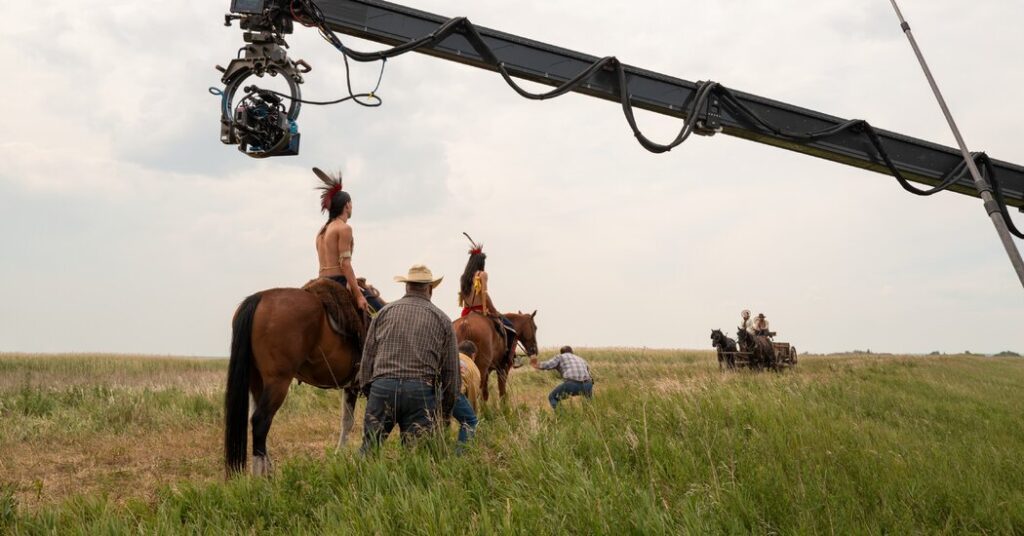
O’Keefe also helped the props department find or create more than 3,000 Native items — shell necklaces, otter fur hats, headdresses made with real porcupine quills — many of them by artisans within the Osage Nation. The show’s set designers constructed an Osage village, including a period-authentic lodge made from canvas and buffalo hides.
Osage singers also contributed a new song about the Drum Creek Treaty of 1870 — its signing is dramatized in the series — which moved the Osage out of Kansas into what is now Oklahoma.
“We never sing anything that’s traditional” for TV shows, O’Keefe said. “It’s always something new, so that if it gets out there and a car dealership wants to sell a Toyota or whatever with it, we’re not worried about our traditional songs being out there.”
O’Keefe’s role as cultural consultant required her to navigate between two worlds. “You’re trying to be amenable to everyone on conversations about things that can often be very difficult, like racism and how natives feel in Hollywood,” she said. “I have to have true respect and prove my credibility to Indian Country first, and then it’s to the team that I’m working with.”
At one point, Laura, who is being home-schooled by her mother, Caroline, alongside her sister Mary, invites Good Eagle to come “do school” with her. Ma was a teacher before she married Pa, she tells her friend, and school would be so much more fun with her there.
But Good Eagle’s mother, White Sun, isn’t having it. “Who knows what kind of nonsense they’d teach her?” she tells her husband.
That feeling is understandable to Alyssa Wapanatâhk (“Peter Pan & Wendy,” “Riverdale”), who plays White Sun.
“She doesn’t know where that might take Good Eagle,” she said. “Will she become totally colonized after being taught by a white woman who doesn’t know their traditions and cultures? She doesn’t trust them, and rightfully so.”
Caroline Ingalls doesn’t trust the Osage either; in the original books, published in the 1930s and ’40s, her fear and hatred of Indians is intense and lifelong. But in one of the series’ most surprising twists, she ends up befriending White Sun and teaching her young daughter.
For Sonnenshine, the showrunner, the character arc isn’t totally far-fetched. “If she had had more perspective and information and education, she probably could have gotten there,” she said of Caroline Ingalls.
“If you don’t want to see people evolve, you’ve got 100 years of film and television to look at,” she continued. “We can keep telling people the same stories over and over again, or we can teach people that it is possible to change.”
The post How ‘Little House’ Welcomes Native Neighbors appeared first on New York Times.